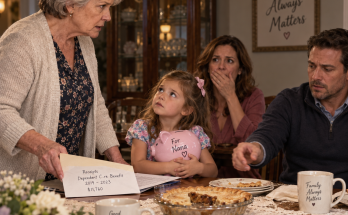
Lily graduated from high school on a hot June evening.
The ceremony was held in the football stadium because the graduating class was too large for the auditorium.
I arrived early.
At eighty-four, arriving early had become less a personality trait and more a survival strategy.
I needed time for stairs.
Emily saved me a seat near the aisle.
Ruth sat on my other side.
She was still alive, still opinionated, and still insisting that GRANDMA AUDIT had been the finest spreadsheet of her career.
Dorothy had died the previous winter.
Evelyn had moved closer to her daughter.
Life had continued doing what life does.
Keeping some people.
Taking others.
Changing everyone.
Derek attended too.
He sat several rows away with his wife, a quiet woman named Marissa whom Lily liked.
Emily had met her twice.
There was no drama.
No competition.
No whispered insults.
Twelve years had taught all of us that peace was more useful than winning old arguments.
When Lily walked onto the field in her blue graduation gown, I nearly failed to recognize her.
Not because she looked different.
Because for one second I saw every version at once.
Yellow rain boots.
Pink piggy bank.
First-grade worksheet.
Red essay folder.
Ten-year-old with twenty dollars.
Sixteen-year-old staring at a college account.
Now eighteen.
Time does not erase the child.
It layers the adult over her.
Lily had been selected to give a student address.
She had not told me what she planned to say.
“I don't want you editing it,” she explained.
“I would not edit your graduation speech.”
“You corrected my birthday card last year.”
“You used a semicolon incorrectly.”
“That is exactly why you're not seeing it.”
Fair.
After the principal spoke, Lily walked to the microphone.
She adjusted it.
Then looked toward the audience.
“I want to tell you about the first financial question I ever remember asking.”
Emily turned toward me.
I felt immediate suspicion.
Lily continued.
“When I was six, I asked my grandmother how much she cost.”
Ruth whispered, “Oh, this is going to be good.”
I elbowed her.
Lily smiled.
“I thought people who helped you were supposed to have prices. Babysitters had prices. Teachers had salaries. Stores had prices. My grandmother watched me all the time, so I wanted to know what Nana cost.”
A few people laughed.
“I didn't understand that my family was already having a very complicated argument about money, trust, and whether helping someone means they get to decide what your help is worth.”
Emily took my hand.
Lily did not explain the fraud.
She did not name Derek.
She did not turn family pain into entertainment.
Instead she said, “My grandmother gave me an answer that took me about twelve years to understand.”
I could not remember giving her any answer worthy of a graduation speech.
Apparently that did not matter.
“She taught me that value and price are not the same thing.”
The stadium became quiet.
“She taught me that kindness does not mean unlimited access to a person. Helping someone does not mean they own your time. Loving someone does not mean agreeing with everything they do.”
Derek looked down.
Marissa touched his arm.
Lily continued.
“She taught me that you can forgive somebody without pretending they didn't hurt you.”
My throat tightened.
“You can wish someone peace and still decide they cannot stand in the same place in your life anymore.”
Emily began crying.
I handed her a tissue.
Ruth stole one.
“And she taught me something I think every graduate here is going to need.”
Lily looked down at her notes.
“You do not need somebody else to put a number on you before you have value.”
The applause began before she finished.
She waited.
I could barely see her through tears.
“When I was six, I thought free meant worthless.”
She smiled.
“My Nana taught me that some of the most valuable things in life are freely given, but that does not make them free to take.”
That sentence landed directly in my chest.
I looked at Emily.
She was crying openly now.
Even Ruth had stopped pretending.
Lily finished.
“So when you leave here and people tell you what your work is worth, what your time is worth, what your attention is worth, listen. Sometimes numbers matter. Get paid fairly. Read contracts. Ask questions.”
A ripple of laughter.
“But remember that the number is not you.”
She looked toward our section.
“And if my Nana is listening, yes, I read everything before I sign it now.”
The stadium laughed.
I did too.
“Congratulations, Class of 2038. Know your value. Know your boundaries. And don't confuse being needed with being loved.”
Then she stepped away.
The applause rose.
I sat still.
Twelve years earlier, I had believed I was teaching Lily about hugs, money, and choice.
Apparently she had been listening to everything.
After the ceremony, families flooded the field.
Photographs.
Flowers.
Balloons.
Children who were suddenly adults trying to locate parents in a crowd.
Lily found me first.
“Nana!”
She wrapped her arms around me.
Carefully.
My knees had become a family institution by then.
“You used me in a speech.”
“You're welcome.”
“I should charge you.”
“How much?”
“One hug.”
She squeezed tighter.
“Paid.”
Derek approached later.
He hugged Lily.
Told her he was proud.
Then he came toward me.
“Margaret.”
“Derek.”
“Quite a speech.”
“Yes.”
He looked toward Lily.
“She got the important parts.”
“Yes.”
He hesitated.
“I heard the part about forgiving someone without pretending.”
“So did everyone else.”
He smiled.
“I know she wasn't only talking about me.”
“No.”
“But partly.”
“Probably.”
He nodded.
“I'm glad she learned that.”
“So am I.”
There was no apology.
We had passed the stage where he needed to repeat it.
No request for forgiveness.
No reopening of old accounts.
Just two people standing near the young woman whose life had once been used as justification for choices neither of us would make again.
“Take care, Margaret.”
“You too.”
And he did.
Life moved.
Lily went to college.
The Nana account paid part of her tuition.
She complained that textbooks should be considered criminal.
I agreed.
Emily remained in the townhouse longer than expected, then eventually bought a small house.
She dated.
She traveled.
She learned that being alone and being abandoned were not the same condition.
I grew tomatoes.
My garden became smaller as my knees became louder.
At eighty-two—though Lily insisted I had begun saying eighty-four early because I enjoyed exaggerating my age—I stopped pretending I could kneel in the soil.
Lily took over planting.
She visited most Sundays when she was nearby.
Sometimes she brought groceries.
Sometimes laundry.
Sometimes nothing.
One Sunday she arrived carrying a black notebook.
“What is that?”
“Evidence.”
I stared at her.
“That word is banned in this kitchen.”
She laughed.
“It's called Things Nana Taught Me.”
I held out my hand.
She gave it to me.
The first pages were old.
Child handwriting.
Then teenage handwriting.
Then adult.
She had been collecting sayings for years.
Some were mine.
Some had apparently improved in memory.
I read.
Being kind does not mean giving everybody access to you.
There is a difference between being needed and being loved.
Forgiving somebody does not require pretending the harm was acceptable.
Family should be where truth is safest, not where truth is least necessary.
And:
Read before you sign anything.
I laughed.
“That one is definitely mine.”
“I know.”
She sat across from me.
The kitchen had changed over the years.
New refrigerator.
New curtains.
Same table.
I had refused to replace it.
Too much had happened there.
Lily looked toward the wall.
The purple Nana Money drawing was framed properly now.
“You really kept that.”
“Of course.”
“It's terrible.”
“It appreciated.”
She smiled.
Then became quiet.
“Nana?”
“Yes?”
“Were you scared?”
“When?”
“When you found out about the receipts.”
I looked at her.
She had been six.
Old enough to remember fragments.
Not enough to understand the whole.
“Yes.”
“Of Daddy?”
“No.”
“Martin?”
“Eventually.”
“What were you scared of?”
I thought about it.
“That the truth would break the family.”
“Did it?”
“Some parts.”
She waited.
“Other parts became stronger.”
“Mom?”
“Yes.”
“You?”
“Yes.”
“Me?”
I smiled.
“You were always strong.”
She shook her head.
“You know what I mean.”
“Yes.”
I looked at the notebook.
“I was also scared I would discover I had been foolish.”
“For trusting them?”
“Yes.”
“Were you?”
“No.”
That answer had taken me years.
Trust was not the mistake.
The mistake belonged to people who abused it.
I would not let their choices rewrite every generous thing I had done.
Lily leaned forward.
“What made you keep going?”
“Once I knew something was wrong?”
“Yes.”
“I wanted the truth.”
“Even when it hurt?”
“Especially then.”
She looked down.
“Mom says you could have stopped after Derek paid you back.”
“I could have.”
“But you didn't.”
“No.”
“Why?”
“Because the money wasn't the whole problem.”
“Your name.”
“My choice.”
She nodded.
Then she smiled slightly.
“I think I finally know how much you cost.”
“Oh?”
“Yes.”
“This should be interesting.”
She reached across the table and took my hands.
They looked old inside hers.
Spots.
Thin skin.
Knuckles enlarged by arthritis.
Hands that had graded thousands of worksheets.
Held Emily through fevers.
Held Robert as he weakened.
Buttoned Lily’s coats.
Cut sandwiches.
Planted tomatoes.
Signed documents.
My own documents.
Lily looked at me.
“You weren't free.”
“I've been saying that for years.”
“You weren't expensive either.”
“No?”
“No.”
“What was I?”
She squeezed my hands.
“Priceless.”
I laughed.
“That is terribly sentimental.”
“You love it.”
“I do.”
She opened her notebook and wrote something.
“What?”
“You'll see.”
She turned it toward me.
NANA WAS NEVER FREE.
SHE WAS PRICELESS.
I stared at the words.
Years earlier, Martin’s system had given me values.
Eleven thousand seven hundred sixty dollars.
Fifteen thousand nine hundred twenty in corrupted reporting.
Eight hundred forty at Northstar.
Two hundred in a test transaction.
Settlement figures.
Restitution figures.
Legal costs.
Claims.
Percentages.
Participation rates.
Every institution involved had tried, in one way or another, to express the story through numbers.
Numbers mattered.
Money mattered.
Derek’s repayment mattered.
Harrison’s reforms mattered.
Restitution mattered.
But none of those numbers answered Lily’s first question.
How much do you cost?
That question had never really been about money.
Children ask simple questions that adults spend years learning how to answer.
I looked around the kitchen.
No investigators.
No archive boxes.
No compliance reports.
No copied signatures.
No lawyers.
No piggy bank on the table.
Only afternoon light.
Two cups of tea.
A plate with the remains of the lemon cake Lily brought.
A notebook.
My granddaughter.
“Do you remember asking me?” I said.
“Kind of.”
“You had mashed potatoes on your face.”
“That seems unnecessary to include.”
“Historical accuracy matters.”
She laughed.
“I remember the piggy bank better.”
“Of course.”
“I thought I could fix everything with coins.”
“Many adults believe similar things.”
“Did the money ever fix anything?”
“Some things.”
“Which?”
“It repaid what was taken. It corrected expenses. It helped companies repair systems. It paid for your college.”
“But not everything.”
“No.”
“What fixed the rest?”
I looked at her.
“Time.”
She waited.
“Truth.”
Another pause.
“Boundaries.”
She nodded.
“Anything else?”
“People choosing to do better after they had done badly.”
“Daddy.”
“Among others.”
“And forgiveness?”
“Some.”
She smiled.
“You never give easy answers.”
“Easy answers caused enough trouble.”
We sat there until the light shifted.
Later, Lily went outside to inspect my tomatoes.
She returned carrying two.
One was ripe.
The other absolutely was not.
“This one needs time,” I told her.
“It's close.”
“It is green.”
“Greenish-red.”
“Put it back.”
She laughed and carried it outside.
I watched from the doorway.
My knees no longer allowed me to follow.
That did not bother me as much as it once would have.
There had been a time when I believed love meant always being the person who showed up, carried, fixed, drove, cooked, watched, and gave.
Age taught me another version.
Sometimes love meant allowing someone else to carry the basket.
Lily came back with one tomato.
“Better?”
“Much.”
She set it on the counter.
Then kissed my cheek.
“I have to go.”
“I know.”
“Next Sunday?”
“I'll be here.”
She reached the door.
“Nana?”
“Yes?”
“Love you.”
“Love you too.”
The door closed.
The kitchen became quiet.
I looked again at the notebook.
NANA WAS NEVER FREE.
SHE WAS PRICELESS.
I could have framed that sentence.
I didn't.
Some things belong on ordinary tables.
I made another cup of tea.
Outside, the tomato leaves moved in the evening breeze.
I thought about all the mornings when Lily had arrived sleepy and hungry.
All the books we read twice because she demanded the same ending.
All the scraped knees.
The school pickups.
The sandwich triangles.
The tomatoes watered too much.
The questions.
The arguments.
The years.
No receipt could hold them.
No reimbursement claim could prove them.
No signature could transfer them.
No database could own them.
That was the final lesson the Nana money had taught me.
Love has a cost.
It costs time.
Patience.
Attention.
Sacrifice.
Sometimes forgiveness.
Sometimes distance.
Sometimes the courage to say yes.
Sometimes the greater courage to say no.
But the cost belongs to the person giving it.
That was what Derek had failed to understand.
What Martin had deliberately ignored.
What Harrison’s systems had never been built to ask.
And what Lily, somehow, had understood before most of us.
I picked up my pen.
On the final page of her notebook, beneath her sentence, I wrote one more.
Some things become valuable precisely because they are given, not taken.
Then I signed my name.
Margaret Bennett.
My handwriting was shakier than it had been twelve years earlier.
But it was mine.
Every letter.
Every stroke.
Every choice.
And that was enough.
The End
Read more original stories on Feel Every Story.
One Innocent Question at Sunday Dinner Made Margaret Wonder Who Had Been Putting a Price on Her Love
Part 20 of 20