Autumn made Emily’s townhouse feel like home.
At first it smelled of fresh paint and cardboard.
Then came Lily’s crayons on the dining table.
Emily’s coffee mug beside the sink.
A pile of shoes near the door despite the shoe basket placed six inches away.
A crooked family photograph on the hallway wall.
Life is mostly the gradual accumulation of things no real-estate brochure includes.
Emily worked the same job.
She no longer took every extra shift offered.
Her finances were tighter in some ways and clearer in others.
She knew every account.
Every bill.
Every balance.
Every debt.
She hated budgeting.
She loved knowing.
Derek saw Lily according to the custody schedule.
He called between visits.
Sometimes Lily came home happy.
Sometimes quiet.
Once angry because he would not buy her a toy.
Emily did not turn those ordinary disappointments into evidence about his character.
I respected her for that.
She never told Lily her father was a thief.
She never used adult pain to recruit a child.
When Lily asked questions, Emily answered what a six-year-old could carry.
Daddy lied about money.
Daddy broke rules.
Daddy is trying to do better.
Mommy and Daddy will not live together again.
You are loved in both homes.
That was enough.
I continued watching Lily after school several days each week.
Not because Emily could not find alternatives.
Because we both wanted it.
The first Friday after school began, Emily came into my kitchen and placed an envelope beside the fruit bowl.
“What is that?”
“Your money.”
“No.”
“Yes.”
“Emily.”
“Mom.”
“Take it back.”
“No.”
I opened the envelope.
Two hundred dollars.
Five twenties and two fifties.
I pushed it toward her.
She pushed it back.
“I am not doing this.”
“Yes, you are.”
“I've watched Lily for six years without charging.”
“And look how wonderfully that turned out.”
I stared.
Emily winced.
“Bad wording.”
“Extremely.”
She sat down.
“Mom, I need this.”
“You need two hundred dollars?”
“I need to pay you.”
“Why?”
“Because I don't want your help to become invisible again.”
That softened me.
But not enough.
“My help was never invisible to you.”
“Maybe not.”
She looked toward the living room where Lily was reading aloud to Bunny.
“But I took it for granted sometimes.”
“That is allowed between mothers and daughters.”
“Not this much.”
“There is no invoice.”
“There should be.”
“Absolutely not.”
She folded her arms.
I recognized the expression.
Unfortunately, she inherited it from me.
“Two hundred every Friday.”
“No.”
“Yes.”
“Emily, you have rent.”
“I budgeted it.”
“Utilities.”
“Budgeted.”
“Groceries.”
“Budgeted.”
“School expenses.”
“Budgeted.”
“Emergency savings?”
“Mom.”
“Exactly.”
She leaned forward.
“I need to know that when I ask you to watch Lily, I am not building my life on the assumption that your time belongs to me.”
I stopped.
There it was.
Not guilt.
Boundary.
She had learned the same lesson from the opposite side.
I picked up the envelope.
“Fine.”
Her eyes widened.
“Fine?”
“Fine.”
“You'll take it?”
“Yes.”
She looked suspicious.
“That was too easy.”
“I've matured.”
“You have not.”
“Get out of my kitchen.”
She laughed.
I deposited the money Monday morning.
Not into my checking account.
Into a savings account I opened for Lily’s education.
I did not tell Emily.
I knew that was technically a form of financial secrecy.
But unlike Derek’s secret, it did not require anyone else's signature.
And I intended to confess eventually.
Every Friday another two hundred dollars arrived.
Every Monday it went into Lily’s account.
Sometimes Emily used an envelope.
Sometimes she transferred it electronically.
Once she wrote CHILDCARE on the memo line.
I wrote back RECEIVED BY EXPENSIVE GRANDMOTHER.
She replied with an eye-roll emoji.
I was becoming dangerously modern.
Lily started first grade.
On the third week, she came home carrying a worksheet titled PEOPLE WHO HELP ME.
The assignment asked students to draw people who helped them learn, feel safe, or solve problems.
There was Emily.
Derek.
Her teacher, Mrs. Walsh.
A girl named Sophie.
And me.
My hair was drawn as a gray cloud.
“I don't look like that.”
“Yes, you do.”
“I have a head.”
“It's under the hair.”
“I see.”
She had drawn me holding a book in one hand and a tomato in the other.
Underneath she had written:
NANA HELPS ME WITH EVERYTHING EXCEPT MONKEY BARS.
“Why not monkey bars?”
“You said your knees are old.”
“My knees have been betrayed.”
She nodded seriously.
“That's what I told Mrs. Walsh.”
“Wonderful.”
At the bottom of the worksheet was a sentence:
Helping means __________________.
Lily had written:
Doing something because you care.
I stared at it.
Not because you are paid.
Not because someone owes you.
Not because a system values the service.
Because you care.
Yet caring did not eliminate boundaries.
I had learned that the hard way.
One afternoon in October, Derek picked Lily up from my house.
He stood at the doorway while she found her jacket.
“How are you?” he asked.
“Fine.”
“I heard Harrison changed the verification system.”
“Yes.”
“That's good.”
“Yes.”
He nodded.
His conversations with me had become careful.
Not frightened.
Respectful.
He no longer assumed familiarity granted access.
“I’m moving,” he said.
“Where?”
“Eventually another state. Construction company offered me a permanent position.”
“What about Lily?”
“I won't go until custody is adjusted.”
“Good.”
“Emily knows.”
“Good.”
He looked at the floor.
“I've paid the remaining credit-card settlement.”
“That is between you and Emily.”
“I know.”
Another pause.
“I wanted you to know I haven't stopped trying because court is over.”
I studied him.
“Trying what?”
“To become somebody who doesn't need to hide from his own choices.”
That sounded like therapy.
I suspected it was.
“Good.”
He looked relieved.
Then Lily appeared wearing her jacket backward.
“Daddy!”
He smiled.
“Ready?”
“Yes.”
He fixed the jacket.
Before leaving, Lily hugged me.
“Bye, expensive grandmother.”
Derek froze.
I laughed.
Emily had apparently repeated my bank-transfer joke.
“Bye.”
In the car, Derek looked back once.
Not ashamed.
Not pleading.
Just looking.
I closed the door.
By December, the legal story had faded enough that I sometimes went entire days without thinking about Martin.
That was a gift.
Christmas approached.
Emily decorated the townhouse with more enthusiasm than budget.
Paper snowflakes.
Cheap lights.
A wreath Lily made at school that shed glitter onto everything within six feet.
Derek would have Lily Christmas morning.
Emily would have her that afternoon.
I would be wherever Lily happened to drag me.
That was the plan.
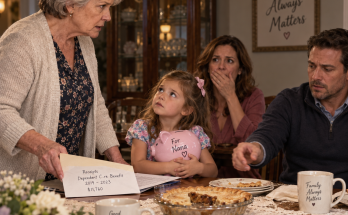
Two days before Christmas, Lily came to my house carrying the pink piggy bank.
I had not seen it for months.
“Why is that here?”
“Business.”
I looked at Emily.
She shrugged.
“I have no idea.”
Lily placed the bank on the kitchen table.
Then pulled a folded sheet of paper from her backpack.
“I made a bill.”
My stomach tightened.
“A bill?”
“For you.”
She unfolded it.
Across the top, in enormous uneven letters:
NANA BILL.
I looked at Emily again.
She was trying not to laugh.
Lily had created a list.
HUGS.
READING BOOKS.
TOMATO WATERING.
KISSES.
SANDWICHES.
PICKING ME UP.
FIXING MY HAIR BAD.
I objected.
“My hair fixing is excellent.”
“No.”
“Continue.”
Beside each item she had written:
$0.
At the bottom:
LOVE — PRICELESS.
Then:
PAID IN FULL.
I could not speak.
Emily sat beside me.
“Did you help her?”
“No.”
“I did it,” Lily said proudly.
“Why is everything zero?”
She looked at me as though the answer were obvious.
“Because you said I don't have to pay you.”
“What about Mommy?”
“Mommy pays you.”
Emily coughed.
I smiled.
“Apparently.”
Lily shook the piggy bank.
“I was going to pay too.”
“With what?”
“My money.”
“How much?”
“All.”
I looked at her.
“Why?”
“Because Daddy got Nana money before and it made everybody mad.”
The room became quiet.
I chose my words carefully.
“The money didn't make us mad.”
“The lying?”
“Yes.”
“And using your name?”
“Yes.”
She considered this.
“So paying isn't bad?”
“No.”
“Free isn't bad?”
“No.”
“Then what is bad?”
Emily and I exchanged a glance.
I answered.
“Taking someone’s choice away.”
Lily frowned.
I tried again.
“If you ask me for a hug and I say yes, that's good.”
“Yes.”
“If you grab me when I don't want a hug?”
“Bad.”
“Money can be like that too.”
She thought.
“You have to ask.”
“Yes.”
Her face brightened.
“Can I pay you?”
“No.”
She laughed.
“You asked.”
“I did.”
“And I answered.”
“Yes.”
She climbed into my lap.
My knees protested.
I ignored them.
She pressed her forehead against mine.
“Then you're free.”
I smiled.
“No.”
She pulled back.
“No?”
“I'm not free.”
“But everything says zero.”
“That doesn't mean I'm worth nothing.”
She looked at the bill.
“What are you?”
I kissed her forehead.
“Your Nana.”
She seemed satisfied.
Children often are when adults finally stop overexplaining.
Christmas afternoon, the Nana Bill went onto my refrigerator.
It remained there through January.
Then February.
The paper curled at the corners.
The marker faded slightly.
I could have framed it beside the purple bill.
I didn't.
I liked seeing it among grocery lists and school notices.
Paid in full.
Not because Lily owed me nothing.
Because there had never been a debt.
The following spring, Harrison sent one final letter.
Not from legal counsel.
From the new head of Benefits compliance.
The letter acknowledged that my identity had been used without authorization and confirmed that all associated provider records had been corrected or disabled.
It also described the new verification rules implemented because of the investigation.
Direct identity confirmation.
Independent provider contact.
No employee-controlled verification.
No reuse of legacy identities without affirmative consent.
No live personal data in demonstrations.
I read the letter once.
Then placed it in my filing cabinet.
I did not need to reread it.
A week later, Harrison offered an additional goodwill payment after finalizing its broader remediation fund.
I declined.
This time there was no debate.
I asked that the amount support provider-verification assistance for people who needed help navigating the new process.
The company agreed.
Emily shook her head when I told her.
“You really are impossible.”
“Consistent.”
“Annoyingly.”
“That too.”
The legal chapter was closing.
But family did not close like a court file.
Derek remained Lily’s father.
Emily remained someone who had loved him.
I remained his former mother-in-law whether either of us liked the awkwardness of the phrase.
There would be birthdays.
School events.
Graduations.
Emergencies.
Future partners, perhaps.
Shared photographs.
A thousand situations no settlement agreement could predict.
The challenge was not deciding who belonged to the family.
It was deciding what belonging allowed.
I knew the answer now.
Love could offer access.
It could not erase boundaries.
Family could inspire generosity.
It could not manufacture consent.
Forgiveness could soften anger.
It did not require forgetting what happened.
And money could compensate labor.
It could never purchase the right to decide what another person should give.
One Friday, Emily handed me another envelope.
I took it without argument.
She smiled.
“Progress.”
“Don't get excited.”
On Monday, I deposited it into Lily’s college account.
The balance had become respectable.
I smiled at the irony.
Nana money.
At last, there really was some.
And for the first time, every person whose choice mattered knew exactly where it was going.
Click here to continue reading: PART 19: Years After the Nana Money Scandal, Lily Asked Whether Loving Her Father Meant Forgiving What He Had Done
One Innocent Question at Sunday Dinner Made Margaret Wonder Who Had Been Putting a Price on Her Love
Part 18 of 20