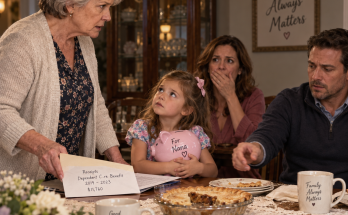
The sentence from the NANA MODEL file changed the plea negotiations.
The system works because the provider does not know there is anything to challenge.
There was no room left inside those words for Martin’s preferred explanation that he had merely been helping employees navigate complicated benefits.
He had known ignorance mattered.
He had designed around it.
He had measured it.
And when a provider finally became aware, as I had, he had classified that person as a risk.
Three weeks after Rebecca read the sentence to me, Dana called at seven in the morning.
“Martin accepted the revised agreement.”
I was watering the tomato seedlings on my kitchen windowsill.
“What did he admit?”
“Enough.”
“That's lawyer language.”
“Yes.”
“Translate.”
She laughed softly.
“He will plead guilty to fraud conspiracy, identity misuse, computer-related offenses, and commercial bribery. He is also admitting that he knowingly used provider information without consent.”
I put down the watering can.
“Does the agreement mention Helen?”
“Yes.”
“My profile?”
“Yes.”
“Larkwell?”
“Yes.”
“Northstar?”
“Yes.”
“The exported identities?”
“Yes.”
“Does it say he knew providers weren't being contacted?”
“Yes.”
I looked through the window.
Morning sunlight touched the damp soil in the garden.
“And the sentence?”
“The NANA MODEL sentence is included in the factual basis.”
That mattered more than I expected.
Not because I needed Martin publicly humiliated.
Because I wanted the record to say what happened without fog.
Dana continued.
“He is also required to cooperate in identifying every provider record transferred through systems he controlled.”
“How many?”
“The final number may take months.”
“Then the notifications continue.”
“Yes.”
“And companies have to correct the records.”
“Yes.”
I exhaled.
“Good.”
“Margaret?”
“Yes?”
“You sound disappointed.”
“I thought I would feel something larger.”
“Like what?”
“Victory, perhaps.”
Instead I felt tired.
Months of documents, interviews, meetings, lawyers, tax corrections, hearings, phone calls, and unfamiliar names had accumulated inside me like boxes in an attic.
Now somebody had finally said the case was approaching an end.
But my kitchen looked exactly the same.
The refrigerator hummed.
A spoon rested in the sink.
One tomato seedling leaned toward the glass.
“Maybe relief arrives slowly,” Dana said.
“Maybe.”
Martin entered his plea the following week.
I attended with Dana.
Emily stayed home.
She said she had heard enough courtroom language to last her lifetime.
I understood.
Martin stood before the judge and admitted that he had used real provider identities to facilitate claims and benefit-processing demonstrations without adequate authorization.
The prosecutor stopped him when he said “adequate.”
“Without authorization,” she corrected.
Martin looked at his lawyer.
Then at the judge.
“Without authorization.”
That small correction satisfied me more than any dramatic confession could have.
The prosecutor described Helen’s first false claim.
Martin admitted it.
She described the legacy databases.
He admitted accessing them.
She described the workshop searches.
He admitted conducting them.
She described the provider exports.
He admitted copying records.
She described Larkwell and Northstar.
He admitted transferring provider information into those environments.
Then she reached my record.
“Did you know Margaret Bennett had not consented to being enrolled as a childcare provider?”
Martin paused.
“Yes.”
“Did you nonetheless assist Derek Collins in activating that provider profile?”
“Yes.”
“Did you use information from an unrelated legacy database to complete missing fields?”
“Yes.”
“Did you later use Mrs. Bennett’s provider profile as a model in other systems?”
“Yes.”
“Did Mrs. Bennett authorize that use?”
“No.”
“Did you ever directly ask her?”
“No.”
There it was.
The same question beneath everything.
Did you ask?
No.
The prosecutor displayed the NANA MODEL sentence.
“Did you write this?”
“Yes.”
“What did you mean?”
Martin swallowed.
“That provider awareness could create disputes.”
“Because providers might discover their information had been used without permission?”
“Yes.”
“So their lack of knowledge was useful.”
His lawyer shifted.
Martin looked toward me.
For the first time since our meeting in his office, there was no polished confidence in his face.
“Yes.”
One word.
Enough.
The hearing lasted hours.
Sentencing would come later.
Civil settlements would continue.
Companies would still argue about responsibility.
Affected providers would spend months correcting records.
Nothing about the plea magically repaired those things.
But the central question was no longer disputed.
We had not consented.
Afterward, Rebecca found me in the hallway.
“You did well.”
“I didn't do anything today.”
“You stayed.”
“I've been sitting in uncomfortable chairs for months. I've become excellent at it.”
She smiled.
Then she handed me an envelope.
“What is this?”
“Harrison’s final remediation proposal.”
“I thought Dana had that.”
“This is the provider-verification portion you kept asking about.”
I opened it.
Harrison planned to replace automatic recurring-provider certification with direct annual confirmation.
New providers would receive independent notices.
Contact information could not be routed solely through the employee.
Legacy records could not supply identity fields without affirmative provider authorization.
Provider data could not be exported into test environments without anonymization.
And every provider would receive a direct confirmation whenever a claim was made under that person’s identity.
I read the pages twice.
“That would have stopped Derek after the first claim.”
“Probably before the first.”
“And Helen?”
“Yes.”
“Patricia?”
“Yes.”
“Evelyn?”
“Yes.”
Rebecca nodded.
“Your complaints became expensive enough that people redesigned things.”
“I prefer to think persuasive.”
“Expensively persuasive.”
I smiled.
Harrison’s settlement included an additional restitution fund for affected providers.
The company offered me a payment beyond the legal expenses and identity-restoration costs already covered.
The amount was large.
Not life-changing.
But enough for a very nice vacation, a remodeled kitchen, or several years of the practical comforts retired teachers tend to postpone because we learned thrift before we learned retirement.
Emily expected me to take it.
“So did I,” I told her.
We were sitting at my table with the paperwork.
“You're not?”
“I haven't decided.”
“Mom, Harrison failed you.”
“Yes.”
“They kept Martin’s system running.”
“Yes.”
“They ignored warning signs.”
“Yes.”
“They can afford it.”
“Also yes.”
“Then why hesitate?”
I turned to the section describing the new verification program.
“Because I already received compensation for my direct costs.”
“That doesn't erase what happened.”
“No.”
“So take the money.”
I looked at her.
“Would you?”
“In approximately four seconds.”
That made me laugh.
Then I explained.
The settlement money would feel good for a while.
The verification changes might matter for years.
I wanted Harrison to fund independent provider identity checks, especially for older caregivers who did not regularly use employee-benefit portals.
Emily listened.
“You want to trade your payment for compliance reform?”
“Not exactly.”
“That sounds exactly like what you want.”
“I want them to use the money where it prevents another person from needing Dana.”
“Dana will be offended.”
“She'll survive.”
Dana was, in fact, offended.
“Margaret, you are allowed to accept compensation.”
“I know.”
“Accepting it does not mean you're selling your principles.”
“I know.”
“Then why are we having this conversation?”
“Because I don't need it.”
“That isn't the legal standard.”
“I didn't say it was.”
She leaned back in her chair.
“You are one of the most exhausting clients I've ever represented.”
“Top five?”
“Top three.”
“I'm honored.”
In the end, we negotiated something neither Harrison nor Dana initially expected.
I accepted reimbursement for every documented cost.
Accounting.
Legal work not otherwise covered.
Identity protection.
Tax corrections.
Travel.
Time spent resolving specific administrative problems.
But I declined the additional personal restitution payment.
Instead, Harrison agreed to direct an equivalent amount into the independent verification initiative.
It would fund direct provider outreach and identity-confirmation assistance.
Dana made me sign a statement confirming that I understood I was voluntarily declining money.
“I understand.”
“Read it anyway.”
“I taught reading.”
“Read it.”
I did.
Then I signed my own name.
Slowly.
Clearly.
For months, signatures had meant violation.
That one felt different.
Nobody had written it for me.
Nobody had assumed it.
Nobody had copied it.
I chose.
Emily watched.
“You're sure?”
“Yes.”
“You could have taken us all somewhere tropical.”
“You can pay for your own tropical vacation.”
“Terrible mother.”
“I've been told.”
She smiled.
Then her expression softened.
“I understand why you did it.”
“Good.”
“I still would have taken the money.”
“I know.”
Martin was sentenced in early summer.
The judge described the scheme as especially serious because it transformed trust relationships into mechanisms for avoiding detection.
When she used the word trust, I looked down at my hands.
Martin received prison time, financial penalties, and an order prohibiting him from administering employee-benefit systems after release.
He was required to cooperate with continuing provider notifications.
I did not feel joy.
I felt completion.
Not forgiveness.
Not satisfaction.
Completion.
Outside the courthouse, reporters waited.
I had learned to dislike microphones.
Lena Park asked one question.
“Mrs. Bennett, what do you hope people learn from this?”
I could have talked about databases.
Signatures.
Corporate oversight.
Employee benefits.
Identity verification.
Instead I said, “Being family doesn't mean someone gets to make your choices for you.”
Lena waited.
I added, “And being generous doesn't make your consent unnecessary.”
That was enough.
The investigation eventually identified several hundred provider records that required review across the connected systems.
Not every record involved fraud.
Not every employee had acted dishonestly.
Some cases were legitimate.
Some were administrative mistakes.
Some were deliberate.
The important change was that providers were finally contacted.
Asked.
That word had become precious to me.
Asked.
One afternoon, Harrison sent me a test notification from the redesigned system.
PROVIDER CONFIRMATION REQUIRED.
I laughed when I saw it.
Emily was beside me.
“What?”
“They're asking.”
“About what?”
“Nothing real. It's a test.”
I opened the message.
Are you Margaret Bennett?
Yes.
Did you provide the listed care?
Test only.
Do you authorize this provider relationship?
I stared at the final question.
Then selected:
NO.
A confirmation appeared.
Provider relationship declined.
No claim will be processed.
I showed Emily.
She smiled.
“All those lawyers for one button.”
“One very important button.”
Summer arrived.
The legal noise faded.
My phone stopped ringing every day.
Reporters found other stories.
Harrison hired new compliance officers.
Larkwell rebuilt its provider database.
Northstar removed every imported record that lacked direct verification.
BenefitBridge changed its migration tools.
Martin disappeared from headlines.
Derek completed community service and continued probation.
He found construction work with a company in another county.
Emily proceeded with selling the house.
Life, which had seemed suspended during the investigation, began moving again.
One Friday, Emily came to my kitchen carrying an apartment brochure.
“I found a townhouse.”
“Where?”
“Twelve minutes away.”
“Exactly twelve?”
“Eleven without traffic.”
“Then your brochure is dishonest.”
She laughed.
“Two bedrooms. Small yard. Decent school district.”
“For Lily?”
“Yes.”
“And you?”
She looked at the photograph.
“For me too.”
That mattered.
For months, Emily had spoken only about surviving.
Now she was choosing.
“What about the house?”
“Offer accepted.”
“Derek?”
“He signed.”
“Debts?”
“Divided according to settlement.”
“Custody?”
“Same schedule.”
She sat across from me.
“I think this is actually happening.”
“Yes.”
“I thought divorce would feel like one big moment.”
“It usually isn't.”
“It feels like paperwork.”
“Most life changes do until you wake up somewhere different.”
She smiled.
Then she looked toward the wall.
Lily’s purple Nana Money bill still hung there.
“Are you keeping that forever?”
“Yes.”
“Why?”
“Inflation.”
Emily laughed.
The move happened in August.
We carried boxes.
Ruth supervised everyone without being asked.
Dorothy arrived with sandwiches.
Evelyn brought cleaning supplies.
Derek came for the final furniture pickup at a different time so the day would remain calm.
By evening, Emily and Lily were surrounded by boxes in their new townhouse.
Lily stood in the middle of her bedroom.
“Where does Bunny sleep?”
Emily pointed toward the bed.
“With you.”
“Where does Nana sleep?”
“At her own house.”
Lily frowned.
“But Nana always comes.”
“I do.”
She looked at me.
“Tomorrow?”
“If you need me.”
She considered that.
Then shook her head.
“No.”
I blinked.
“No?”
“I can unpack.”
Emily covered a smile.
“All right.”
Lily lifted one tiny box.
“I’m independent.”
The box contained three stuffed animals and one sock.
But independence has to start somewhere.
I drove home alone.
The kitchen was quiet.
For the first time in years, I did not know exactly when Lily would need me next.
That should have felt like loss.
Instead it felt like a door opening.
Emily was building a life she controlled.
Derek was living with consequences he had chosen.
Lily was learning that families could change shape without disappearing.
And I was learning something too.
For years I had given care automatically.
Not because anyone forced me.
Because love made yes easy.
But easy yes was still supposed to be mine.
I turned off the kitchen light.
On the wall, Lily’s purple bill caught the last glow from the hallway.
NANA MONEY.
Months earlier, those words had opened the worst question I had ever asked about my family.
Now the answer was becoming simpler.
My care had never been free because it had never been nothing.
It had cost time.
Attention.
Patience.
Mornings.
School pickups.
Meals.
Worry.
Love.
The mistake was believing that because I gave those things willingly, someone else could decide what they were worth.
Click here to continue reading: PART 18: Emily’s Two-Hundred-Dollar Fridays Created a New Argument About Nana Money, Until Lily Quietly Explained What Payment Could Never Buy
One Innocent Question at Sunday Dinner Made Margaret Wonder Who Had Been Putting a Price on Her Love
Part 17 of 20