Two years passed faster than the investigation had.
Legal time had moved in weeks measured by hearings and documents.
Ordinary time moved through shoes that stopped fitting.
Birthdays.
School photographs.
Missing teeth.
Tomato seasons.
Lily turned eight.
She had Emily’s eyes and Derek’s habit of concentrating with her tongue pressed against one corner of her mouth.
She also had opinions about everything.
Especially books.
I considered that my influence.
Derek eventually moved to another state for construction work.
The arrangement was not ideal.
But he kept scheduled calls.
Visited when custody allowed.
Paid support.
Completed every probation requirement.
He never again asked Emily to manage his consequences for him.
That mattered.
He and Emily became polite.
Not friends.
Not enemies.
Parents.
Sometimes that was achievement enough.
Emily dated once.
The man lasted three months.
Lily disliked the way he chewed.
Emily claimed that was not why the relationship ended.
I remained unconvinced.
The Nana Bill eventually came off my refrigerator because the paper tore near the magnet.
I placed it in a folder with Lily’s school drawings.
The purple Nana Money bill went there too.
I did not keep the forged signatures with them.
Those belonged in a different file.
That distinction felt important.
One Tuesday, Lily arrived from school carrying a red folder.
“Nana, I need help.”
“With math?”
“Worse.”
“Spelling?”
“Writing.”
I put a hand over my heart.
“How have I failed you?”
She rolled her eyes.
“We have to write about someone who helped us.”
“You've done that before.”
“This is different.”
“How?”
“We have to explain something hard.”
She opened the assignment.
WRITE ABOUT A PERSON WHO TAUGHT YOU AN IMPORTANT LESSON.
“Who are you writing about?”
She hesitated.
“Maybe Daddy.”
I kept my expression neutral.
“That sounds possible.”
“Mommy said I should pick whoever I want.”
“She is right.”
Lily looked at the page.
“Daddy taught me something.”
“What?”
She shrugged.
“That people can mess up.”
I waited.
“And?”
“And still be people.”
I sat down.
At eight years old, she had already reached a truth many adults resisted.
“That is a meaningful lesson.”
She pulled a photograph from the folder.
Derek and Lily at a park.
He was pushing her on a swing.
She was laughing.
“Can I use this?”
“Yes.”
“Mommy won't be sad?”
“You should ask her.”
“I did.”
“And?”
“She said okay.”
“Then believe her.”
Lily stared at the photograph.
“Nana?”
“Yes?”
“Do you still like Daddy?”
The question had arrived eventually.
“I care about him.”
“That isn't like.”
“No.”
“Do you love him?”
“In a way.”
She frowned.
Adults always frustrate children when we refuse categories.
“What way?”
“He was part of our family for a long time. He is your father. I want him to have a good life.”
“But you're mad at him.”
“Not very often anymore.”
“For Nana money?”
“For what he did around it.”
She looked down.
“Mommy told me he used your name.”
“Yes.”
“And lied.”
“Yes.”
“And had to talk to a judge.”
“Yes.”
She rubbed the edge of the photograph.
“Can I still love him?”
The question was so quiet that I nearly missed it.
I moved my chair closer.
“Of course.”
“But he did something bad to you.”
“Yes.”
“If I love him, is that bad to you?”
“No.”
“Really?”
“Really.”
Her eyes searched mine.
“You never have to stop loving somebody just because I am hurt by what they did.”
“But what if they did something really bad?”
“Love and agreement are different.”
She frowned.
“What does that mean?”
“You can love someone and still say they were wrong.”
“Oh.”
“You can love someone and still need distance.”
She listened.
“You can love someone and still say no.”
That word she understood.
“Like boundaries?”
I smiled.
“Your mother has been teaching you vocabulary.”
“She says boundaries a lot.”
“I've noticed.”
Lily looked at the photograph again.
“Did you forgive Daddy?”
“I've forgiven some of it.”
“Not all?”
“Forgiveness isn't always one big decision.”
“What is it?”
“Sometimes it's deciding you don't want anger to control every future day.”
She considered this.
“Did you forget?”
“No.”
“Then you didn't forgive.”
“Those aren't the same thing.”
She groaned.
“Grown-up stuff is confusing.”
“Correct.”
She began her essay.
The first sentence read:
My dad taught me that somebody can do something wrong and still try to do better.
She stopped.
“Is that true?”
“Yes.”
“Did he do better?”
“I think he has done better.”
“Is he all better?”
“No one is all better.”
“Are you?”
“Absolutely.”
She laughed.
“Mommy says you are stubborn.”
“Your mother spreads misinformation.”
The essay took three afternoons.
Lily wrote about her father teaching her to ride a bicycle.
About him apologizing when he missed a school call.
About adults making choices that have consequences.
She did not describe the fraud.
That story was not hers to explain to classmates.
At the end she wrote:
I learned that loving somebody does not mean saying everything they do is okay.
I read the sentence twice.
“That is very good.”
“Mrs. Walsh said we need a conclusion.”
“That is a conclusion.”
“I need one more sentence.”
She thought.
Then wrote:
You can love people and still tell the truth.
I looked away for a moment.
“What?”
“Nothing.”
“You're doing the crying thing.”
“What crying thing?”
“When you pretend your eyes are itchy.”
“My eyes are itchy.”
“They always get itchy when I write good things.”
“Coincidence.”
She grinned.
That weekend, Derek visited.
Lily showed him the essay.
I was not there when he read it.
Emily later told me he cried.
Apparently his eyes were itchy too.
He called me that evening.
“I saw Lily’s assignment.”
“She worked hard.”
“She wrote about me.”
“Yes.”
“I don't deserve that.”
I disliked the sentence.
“Don't do that.”
“What?”
“Turn her love into another way to punish yourself.”
He became quiet.
“She loves you.”
“I know.”
“Then be someone safe for her to love.”
Another silence.
“I'm trying.”
“Good.”
He cleared his throat.
“She wrote that loving someone doesn't mean saying they're right.”
“Yes.”
“Did you teach her that?”
“We talked.”
“Thank you.”
I almost corrected him.
Then decided this thank-you was allowed.
“You're welcome.”
Years continued.
At ten, Lily was too old to need me every afternoon.
More importantly, my knees were too old to pretend otherwise.
One spring morning I called Emily.
“I’m retiring.”
“From what?”
“Babysitting.”
“You've been retired for years.”
“From professional grandmothering.”
She laughed.
“Your pension is terrible.”
“I know.”
We changed the routine.
Lily came after school once a week instead of four times.
Then mostly for visits rather than childcare.
The first Friday without the old schedule felt strange.
At three fifteen I automatically looked toward the window.
No school bus.
No backpack dropped in the hallway.
No demand for a snack before hello.
The quiet hurt.
Then my knees did not.
That helped.
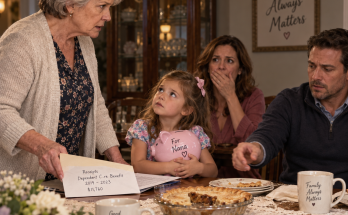
On what Lily called my “last official Nana shift,” she arrived carrying an envelope.
I stared at it.
“No.”
“You don't know what it is.”
“I know this family.”
“Open it.”
Inside was a twenty-dollar bill.
And a note.
FOR NANA.
PAYMENT FOR ALL THE YEARS.
I looked at her.
“Twenty dollars?”
“I'm ten.”
“Fair.”
She grinned.
I held out the bill.
“Keep it.”
“No.”
“Yes.”
“But it's payment.”
“I know.”
“You're supposed to take payment now.”
“Your mother pays me.”
“She said you save it.”
I froze.
Lily smiled triumphantly.
“How do you know that?”
“I heard Mommy talking to Aunt Ruth.”
“Ruth is not your aunt.”
“She says she is.”
“That sounds like Ruth.”
Lily pushed the twenty toward me.
“Take it.”
“No.”
“Why?”
“Because you were never a bill.”
She stared at the money.
“But you said you're not free.”
“Correct.”
“Then how does that work?”
I thought about it.
“You don't have to put a price on something to know it has value.”
She looked skeptical.
“Like love?”
“Yes.”
“Priceless.”
“Exactly.”
She took back the twenty.
Then wrote something on her note.
She handed it to me again.
At the bottom:
NANA — NOT FREE.
NOT FOR SALE EITHER.
I laughed.
“That's better.”
“I know.”
We made sandwiches.
Turkey for her.
Tomato for me.
I still cut hers into triangles because apparently ten-year-olds who considered themselves nearly adults remained unable to tolerate rectangular sandwiches at Nana’s house.
We ate on the porch.
She told me about school.
A girl named Avery who annoyed her.
A science project.
A boy who claimed sharks were mammals.
I corrected that immediately.
Some responsibilities never end.
When Emily arrived, she stood in the doorway.
“So this is retirement.”
“Yes.”
“How does it feel?”
“Excellent.”
Lily shouted from the porch.
“She cried.”
“Traitor.”
Emily smiled.
Then she handed me one final two-hundred-dollar envelope.
I looked at it.
“Last one.”
“Yes.”
I took it.
“Thank you.”
She hugged me.
Not because she was paying.
Not because I had worked.
Because we both understood what those envelopes had come to mean.
A question asked.
An agreement made.
A choice respected.
That Monday, I deposited the final payment into Lily’s college account.
I printed the balance.
Then put it in an envelope labeled FOR LILY — LATER.
No forged signature.
No fake email.
No hidden reimbursement.
Just money I had received legitimately and chosen to give away.
My choice.
Years later, when Lily was sixteen, I finally showed her the account.
She stared at the balance.
“Mom paid you all that?”
“Over time.”
“And you saved it for me?”
“Yes.”
“Why?”
“Because I wanted to.”
“Does Mom know?”
“She does now.”
Emily had discovered the account a year earlier while helping me organize financial papers.
She had been furious for eleven minutes.
Then she cried for twenty.
I considered that a successful disclosure.
Lily looked at the account statement.
“So this is actually Nana money.”
“Yes.”
“Can I spend it?”
“For education.”
“That sounds less fun.”
“It is.”
She laughed.
Then became serious.
“Nana?”
“Yes?”
“Did all that stuff with Daddy happen because of money?”
I considered.
“Money was involved.”
“But?”
“It happened because people decided other people’s choices didn't matter enough.”
She nodded slowly.
“That's worse.”
“Yes.”
She put the statement back in the envelope.
“I'm going to college.”
“I assumed.”
“What if I don't?”
“Then we discuss what the money should become.”
“You won't make me?”
“No.”
She smiled.
“Because choice.”
“Exactly.”
She rolled her eyes.
“You really turned one bad thing into your entire philosophy.”
“Teachers reuse good material.”
She hugged me.
By then the scandal belonged mostly to old files.
Martin had served his sentence.
Harrison’s verification rules remained.
Derek had rebuilt a quieter life.
Emily had built one too.
The story no longer entered the room before we did.
That mattered.
But the lesson remained.
Love could be generous without being blind.
Forgiveness could exist without pretending harm never happened.
Family could survive truth even when a marriage did not.
And a person could walk away from what hurt them without needing to spend the rest of life hating whoever caused the pain.
I had spent years teaching Lily those things.
I did not realize until much later that she had been keeping notes.
Click here to continue reading: PART 20: At Eighteen, Lily Finally Answered the Question She Had Asked About Nana’s Price Twelve Years Earlier
One Innocent Question at Sunday Dinner Made Margaret Wonder Who Had Been Putting a Price on Her Love
Part 19 of 20