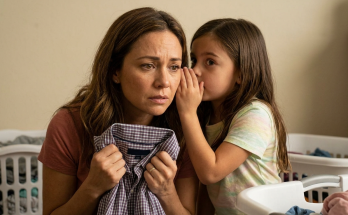
On Friday afternoon, I found my eleven-year-old daughter standing in front of the open refrigerator, eating cold pasta straight from a plastic container as though someone might take it away.
“Sophie?”
She startled hard enough to knock a fork against the shelf. A strand of spaghetti hung from her mouth. She chewed quickly, swallowed, and closed the refrigerator with her hip.
“What?” she asked.
I had been carrying my laptop bag and a roll of architectural drawings under one arm. I put both on the kitchen island. Something about the way she avoided my eyes bothered me.
“Slow down. You’re going to make yourself sick.”
“I’m fine.”
She took another forkful.
The answer was automatic, which made me watch her more carefully. Sophie was small for eleven, all narrow shoulders and long brown hair she usually forgot to brush properly in the morning. She had always been quiet, but she wasn’t secretive. At least I had never thought she was.
“Didn’t you eat lunch?”
Her fork stopped halfway to her mouth.
That tiny pause changed the room.
“Sophie.”
She lowered the fork.
“My account didn’t work.”
I frowned. “Today?”
She shook her head.
The refrigerator hummed behind her. Somewhere outside, a lawn mower started and then coughed into silence. I remember those useless details because my mind seemed determined to notice everything except the answer I was beginning to fear.
“When did it stop working?”
“Monday.”
I stared at her.
It was Friday.
“You haven’t had lunch since Monday?”
She rubbed the edge of the container with her thumb. “Not really.”
“What does not really mean?”
“I didn’t get anything from the cafeteria.”
Five school days.
I pulled out a chair and sat because suddenly standing felt difficult. Every month I loaded money onto Sophie’s school lunch account. The transfer was automatic. I had received no warning that anything was wrong.
“What happened Monday?”
She shrugged, but I waited.
Eventually she spoke.
“I went through the line with Emma and Lucy. When they scanned my number, the lady said my balance was negative.”
“And then?”
“I stepped out.”
“Did you tell her the account was supposed to have money?”
Another shrug.
“Sophie.”
“There were people waiting.”
Her cheeks had begun to color.
I understood then. She hadn’t walked away because nobody would help her. She had walked away because everyone behind her could see that she needed help.
“What did you do during lunch?”
“I sat with my friends.”
“And watched them eat?”
“They didn’t know.”
“How could they not know?”
“I said I wasn’t hungry.”
The answer cut more deeply than I expected.
My daughter had spent five days protecting herself from embarrassment by pretending hunger was a choice.
“Why didn’t you call me?”
“You were working.”
“I am always working. That doesn’t mean you can’t call.”
“I know.”
“Then why didn’t you?”
She looked down at the pasta.
“Because it was just lunch.”
I pushed my chair back and went to her. When I put my hands on her shoulders, she stiffened for half a second before leaning against me.
“No,” I said. “It wasn’t just lunch.”
She was quiet.
“You never need to hide something like this from me.”
“I didn’t want you to get mad.”
“At you?”
She nodded against my shirt.
That hurt almost as much as learning she had been hungry.
“I’m not angry with you.”
“You look angry.”
“I’m angry that this happened. I’m angry I didn’t know.”
That distinction seemed important, so I waited until she looked at me.
“I’m your mother. If you’re hungry, sick, scared, embarrassed, confused—anything—you tell me. Even if I’m in a meeting. Even if I’m standing in front of fifty clients. Understand?”
A reluctant smile appeared.
“What if you’re talking to the mayor?”
“Especially then.”
That earned a small laugh.
I made her a grilled-cheese sandwich even though she had already eaten half the pasta. She finished the sandwich, apple slices, and a glass of milk. Watching her eat made guilt crawl through me in slow, ugly waves.
I had spent that week designing a commercial redevelopment project worth millions of dollars. I had argued about steel costs, reviewed structural calculations, approved lighting plans, and sat through three meetings about a parking garage.
Meanwhile, my daughter had been hungry twelve miles away.
The school office confirmed the problem within twenty minutes. My latest transfer had become stuck during a payment-system update. The woman I spoke with apologized repeatedly and restored the balance while I was still on the phone.
I thanked her because the mistake wasn’t malicious.
Then I sat at the kitchen table after Sophie went upstairs and stared at nothing.
I wanted someone older than me.
That sounds childish, perhaps, but it was true. My father had been dead for six years, and whenever something frightened me about raising Sophie, there were still moments when I instinctively wished I could call him.
Instead, I called my mother.
Margaret Bennett answered on the fourth ring.
“Claire, darling, can I call you back? I’m making a list for Sunday dinner.”
“Mom, something happened with Sophie.”
The rustling on her end stopped.
I expected concern.
“What?”
“Her lunch account malfunctioned. She hasn’t eaten lunch at school all week.”
There was a brief silence.
Then my mother said, “Well, she can take crackers.”
I actually pulled the phone away from my ear.
“What?”
“Crackers. Peanut butter. Something from home.”
“You’re missing the point. I didn’t know.”
“Well, now you do.”
“She went without lunch for five days.”
My mother sighed, the same sigh she had used when I was sixteen and worried about a chemistry exam.
“Claire, children manage. You’re making this much more dramatic than it needs to be.”
I looked toward the stairs.
Sophie’s bedroom door was closed.
“Mom, she was hungry.”
“And she’s fine now, isn’t she?”
Something changed inside me.
It wasn’t explosive anger. I didn’t raise my voice.
Instead, a strange clarity settled over me.
Because while my mother was telling me how little an eleven-year-old needed, I could see another set of numbers in my mind.
Two thousand eight hundred dollars.
Every month.
For groceries.
Her groceries.
After Dad died, Margaret had struggled badly with money. The house where my brother Ethan and I had grown up still carried a mortgage. There were taxes, insurance, repairs, utilities, and debts she said she couldn’t manage alone.
I had stepped in because I could.
At first it was temporary.
Then temporary became normal.
Eventually I was paying nearly everything connected to her house.
The grocery arrangement had come later. Mom complained that carrying bags aggravated her shoulder and that keeping track of household expenses stressed her. I created a card linked to an account I funded each month.
Two thousand eight hundred dollars.
She bought organic produce, premium meat, imported cheese, fresh seafood, expensive olive oil, flowers, wine, and whatever she needed for the elaborate Sunday dinners she loved hosting.
I had never complained.
Not once.
I owned Bennett Architecture. I had worked brutal hours to grow the firm from two employees to thirty-four. I earned enough to help my mother, and after losing Dad, helping her had felt like the decent thing to do.
But now Sophie could survive on crackers.
“Claire?” Mom said.
I realized I had been silent.
“You’re right.”
My voice sounded calmer than I felt.
“Of course I am.”
“People survive.”
“Exactly.”
“I’ll call you tomorrow. I need to finish my shopping list.”
She hung up.
I remained at the table with the phone in my hand.
For six years, whenever my mother needed something, the need became urgent.
A leaking faucet couldn’t wait.
A refrigerator making an odd noise required replacement.
The landscaper increasing his rate by seventy dollars was a crisis.
Her preferred salmon being unavailable at one store justified driving across Columbus to another.
I had accepted all of it because grief had made me protective.
Dad’s death had been hard on everyone, but especially Mom. At least that was what I had told myself.
I opened my banking app.
The grocery account appeared beneath my business and personal accounts.
MARGARET HOUSEHOLD.
Available balance: $1,936.42.
Automatic monthly funding: $2,800.
I stared at it.
I thought of Sophie stepping away from a cafeteria line while children waited behind her.
I thought of her sitting beside friends and saying she wasn’t hungry.
Then I pictured my mother choosing wine for Sunday dinner.
My thumb hovered over the card controls.
I could reduce the allowance.
I could call Mom and explain.
I could give her a month’s notice.
Those were reasonable choices.
They were also choices I had been making for six years: cushioning every consequence before it reached her.
I selected the card.
A confirmation box appeared.
Cancel card?
I pressed yes.
The screen refreshed.
CARD CLOSED.
No thunder. No dramatic music. Nothing outside changed.
I sat in my quiet kitchen looking at two ordinary words.
For the first time in six years, my mother had a financial problem I wasn’t going to solve before she noticed it.
Upstairs, Sophie’s door opened.
“Mom?”
I locked my phone.
“Yes?”
“Can we have pizza tomorrow?”
I smiled despite everything.
“As much as you want.”
She disappeared back into her room.
I looked at the dark screen in my hand.
My mother would discover the canceled card soon enough.
And when she did, I suspected she would finally understand something I had failed to understand myself.
The $2,800 had never merely been grocery money.
It had become proof that no matter what happened, Claire would take care of it.
That proof no longer existed.
Click here to continue reading: PART 2: A Cart Full of Luxury Groceries Reached the Register, and My Mother Finally Discovered the Difference Between Help and Entitlement
Five Silent Lunches, One Empty Account, and the Friday Afternoon That Made Me Question Six Years of Family Generosity
Part 1 of 20