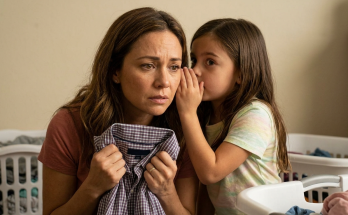
Three years after Danielle told me not to drink Grandma’s tea, she found me in the kitchen on a Saturday morning.
She was eleven.
The investigations had mostly ended.
The major trials were finished.
The restitution process continued because damage lasting decades did not disappear according to a court calendar.
But our house was quiet.
Not the old house.
We sold that one.
I never wanted the basement tunnel, the broken kitchen window or the corner where Rachel’s porcelain jar had stood.
Our new house was smaller.
Sunlight reached the kitchen earlier.
Donald complained about the lack of garage storage.
I considered that a feature.
Danielle entered wearing mismatched socks.
“Are you making tea?”
“No.”
She inspected the mug anyway.
“Coffee.”
“Gross.”
“You’ll understand someday.”
“No, I won’t.”
I smiled.
She opened the refrigerator.
My body was much stronger than it had been three years earlier.
My liver function had improved substantially after the compound stopped.
Some effects lingered.
Certain medications required extra monitoring.
Fatigue still appeared if I pushed too hard.
My joints reminded me of bad weeks.
But I was alive.
That fact had become less dramatic with time.
I liked it better that way.
Charlene remained the person who received every lab result before I trusted myself to celebrate.
When my liver numbers finally stabilized, she called and said, “You are officially becoming medically boring.”
I cried.
She pretended not to notice.
The foundation created from recovered assets had begun funding legal support and medical evaluation for victims of research fraud and nonconsensual experimentation.
We named it after Samuel Carter only after victim representatives approved.
I had resisted.
My father had participated in the early system before trying to expose it.
A name could become another form of simplification.
One of the surviving patients eventually said, “Then put the whole truth on the wall.”
So we did.
The foundation’s public history stated his involvement, his failures, his later whistleblowing and his death.
No saint.
No monster.
A man.
The same standard I had learned to apply to everyone.
My mother served no formal role.
That was intentional.
Evelyn had spent too much of her life inside secret structures.
She volunteered occasionally at public events instead.
She preferred registration tables.
“You can see everyone coming,” she once told me.
I knew what she meant.
Our relationship never returned to what it had been before her supposed death.
How could it?
That relationship had belonged to a daughter who believed her mother died.
We built another.
Slower.
Less automatic.
More honest.
Sometimes I still became angry without warning.
A birthday she missed.
Danielle’s infancy.
The years she watched from across streets instead of knocking on my door.
When I told her, she listened.
She did not say she had done it for me.
Not anymore.
She said, “I know.”
That was better.
Donald and I stayed married.
There had been months when I did not know whether we would.
Love was not the only question.
Trust had been damaged in ways neither of us caused entirely and neither of us could ignore.
He had dismissed some of my concerns because accepting them would have required confronting Rachel.
He had signed documents without reading them because his mother said they were routine.
He had inherited a company without asking enough about its history.
None of those things made him responsible for my poisoning.
They did make him responsible for changing.
He did.
So did I.
We learned to say uncomfortable things earlier.
Sometimes too early.
Once Donald came home and said, “I’m irritated with you, and therapy says I’m supposed to tell you before I become weird about it.”
I laughed so hard I had to sit down.
“What did I do?”
“You reorganized the garage.”
“You don’t even use half the garage.”
“That isn’t the point.”
We argued for fifteen minutes.
It was wonderful.
No hidden ledger.
No poison.
No armed men.
Just two married people disagreeing about shelves.
Donald occasionally spoke with Agustin.
After serving the custodial portion of his sentence, Agustin entered a supervised release program.
He worked with investigators and later with an organization documenting historic medical abuse.
He never called himself a whistleblower.
“I waited too long for that word,” he told me.
Victor remained incarcerated.
Donald did not visit again.
He sent one letter.
I never asked what it said.
Donald told me only that he had stopped trying to get an answer from his father that would make childhood make sense.
Some answers did not exist.
Mercer’s conviction survived appeal.
His name disappeared from clinic signs.
Former patients came forward after seeing the news.
Not all had been deliberately poisoned.
Many described the same behavior I remembered: dismissal, unexplained testing, pressure not to seek second opinions.
The investigation into his practice grew beyond our family.
Rachel remained in prison.
Danielle knew where she was.
We did not lie.
We also did not make Danielle responsible for deciding whether Rachel deserved a relationship with her.
That belonged to adulthood.
Occasionally Rachel sent letters.
Most stayed with me.
Some, when appropriate, I gave to Danielle.
One contained only a birthday card.
No guilt.
No request.
Danielle kept it in a drawer.
One afternoon she asked me, “Do you think Grandma Rachel is bad?”
I thought before answering.
“She did something very bad to me.”
“That’s not what I asked.”
At eleven, she had become annoyingly precise.
“No.”
She waited.
“I think she made terrible choices for a long time. I think she hurt me. I think she loved you. I think she stopped something terrible from reaching you. None of those facts cancel the others.”
Danielle frowned.
“That’s complicated.”
“Yes.”
“I liked things better when villains were just villains.”
“So did I.”
She went back to drawing.
That conversation stayed with me.
Arthur had wanted simple categories too, though in a different way.
Useful people.
Dangerous people.
Evidence.
Leverage.
Subjects.
Descendants.
He had reduced human beings until controlling them became easier.
The master ledger had done something similar.
Names beside numbers.
Payments.
Dosages.
Deaths.
The work afterward had been about reversing that reduction.
Finding the people behind the codes.
Correcting records.
Locating families.
Returning names to the dead.
Giving living participants access to medical information that had been hidden from them.
Some discoveries could never be repaired.
A woman learned that the treatment blamed for her infertility had never been approved.
A man discovered his father had died in a trial the family had been told was routine care.
Three siblings learned their mother’s body had been transported without consent.
Money did not fix those things.
Neither did apologies.
The foundation’s first rule became one I insisted on:
No one would be required to forgive anyone to receive help.
Healing was not a moral performance.
The restitution trust eventually sold the remaining company interests connected to my father and Victor.
A portion of the recovered funds went directly to victims.
Another portion funded independent medical reviews.
Some supported legal efforts to reopen old cases.
The rest went into long-term assistance.
My family did not become rich from it.
That felt correct.
The inheritance my father had meant to leave me was never really money.
It was authority.
And authority was safest when shared.
One Saturday, I went into the storage room and found the wooden music box.
Police had returned it long ago.
I had not opened it in months.
The wood bore scratches from childhood.
A tiny brass hinge had darkened with age.
My mother told me it had belonged to my father before he gave it to me when I was seven.
I remembered winding it at night.
I remembered believing the melody made bad dreams go away.
Years later, beneath its velvet lining, we had found the memory card that helped dismantle a conspiracy.
Objects changed depending on what people put inside them.
Secrets.
Evidence.
Memory.
I carried it downstairs.
Danielle was at the table doing homework.
She looked up.
“Is that the box?”
“Yes.”
“You said I could have it someday.”
“I did.”
“Is today someday?”
I placed it in front of her.
“Yes.”
She touched the lid but did not open it immediately.
“Why?”
“Because I’m tired of it being a hiding place.”
She looked at me.
I sat across from her.
“Your grandfather hid evidence inside it because he thought he had no safe way to tell the truth.”
“Your dad.”
“Yes.”
“My grandpa Samuel.”
“Yes.”
She opened the lid.
The repaired velvet lining was visible.
“Is there another secret thing inside?”
“No.”
“Did you check?”
“Several times.”
She grinned.
Then her expression became serious.
“Why give it to me?”
“Because it belonged to someone who loved me, and now I want you to have it.”
“That’s all?”
“That’s enough.”
She ran one finger along the inside edge.
I added, “And because I want you to remember something.”
She looked suspicious.
“Is this a speech?”
“A short one.”
“How short?”
“Very.”
She sighed dramatically.
“Fine.”
I leaned forward.
“If something feels wrong, you tell me.”
“I know.”
“Even if an adult tells you not to.”
“I know.”
“Even if you think I won’t believe you.”
She looked at me.
“You believed me about the tea.”
“Not quickly enough.”
“Yes, you did.”
Her certainty surprised me.
“You told me once, and I checked.”
From her perspective, perhaps that had been enough.
I had spent years blaming myself for not noticing earlier.
Danielle did not carry that version.
She remembered speaking.
She remembered being heard.
I touched her hand.
“You saved my life.”
She rolled her eyes.
“Mom.”
“You did.”
“I just told you Grandma put powder in your drink.”
“Exactly.”
She considered that.
Then asked, “Can I put jewelry in the box?”
I laughed.
“Yes.”
“No secret memory cards?”
“Please don’t.”
She carried it upstairs.
Donald entered from the garage.
“What did you give her?”
“The music box.”
He looked toward the stairs.
“You sure?”
“Yes.”
He kissed my forehead.
“Good.”
He opened the refrigerator.
“Dinner?”
“Your turn.”
“I cooked yesterday.”
“You reheated soup.”
“That is heat applied to food.”
I smiled.
The argument continued.
Later that month, the foundation held a small gathering marking three years since the federal investigation began.
I almost did not attend.
Public anniversaries made private pain feel ceremonial.
Charlene convinced me.
“You don’t have to give a speech.”
“Someone will ask.”
“Say no.”
So I went.
Victims and families attended.
Investigators.
Attorneys.
Medical advocates.
Ruiz came in plain clothes and looked uncomfortable without a radio.
Marianne was there.
Helen Price was not.
Her health had declined, but she sent a letter acknowledging again that fear had kept her silent.
My mother sat in the second row.
Donald beside her.
Danielle between them.
Someone asked me to speak.
Charlene smiled from across the room.
I glared at her.
Then I stood.
I did not tell the whole story.
It was too large.
Instead I spoke about one morning.
A child watching her grandmother prepare tea.
A white container.
A spoonful of powder.
A warning.
I said that institutions often imagine truth arrives through experts, reports or official channels.
Sometimes it does.
Sometimes it arrives through an eight-year-old who notices an adult doing something strange.
The important part is what happens next.
Do we listen?
Do we look?
Do we ask one more question when the easy answer does not fit?
That was all.
No grand lesson.
No claim that suffering had happened for a reason.
It had not.
People made choices.
Some cruel.
Some frightened.
Some courageous.
Consequences followed.
Afterward, Danielle found me near the exit.
“You said I was eight.”
“You were.”
“I know, but it makes me sound little.”
“You were little.”
“I was almost nine.”
I smiled.
“My apologies.”
She took my hand.
On the drive home, rain began.
Not heavy.
Just enough to blur the streetlights.
Donald drove.
Danielle fell asleep in the back seat.
I watched her reflection in the window.
For years, I had thought the most dangerous people would look dangerous.
Arthur should have looked like a villain.
Mercer should have sounded cruel.
Rachel should have hated me.
Victor should have been incapable of regret.
None of that was true.
Danger had arrived through signatures, medical charts, family loyalty, withheld information and a warm cup placed carefully beside my breakfast.
That knowledge did not make me suspicious of everyone.
Eventually, it did the opposite.
I learned that trust was not pretending doubt never existed.
Trust was being allowed to ask.
To verify.
To disagree.
To leave.
To say no.
To tell the truth without losing your place in the family.
When we reached home, Donald carried sleeping Danielle upstairs.
I went into the kitchen.
For a moment I stood where another kitchen counter had once dominated my mornings.
I could almost see Rachel setting down the cup.
Steam rising.
Her hand around the porcelain jar.
Danielle watching.
Then the memory passed.
I filled a glass with water.
No fear.
No checking.
Just water.
Donald returned.
“You okay?”
“Yes.”
This time, the word was true.
He leaned against the counter.
“Would you change anything?”
The question surprised me.
“About what?”
“Us. Everything.”
I thought about it.
I would have changed hundreds of things if I could.
My father calling the police sooner.
Helen releasing the ledger.
My mother refusing to disappear.
Victor calling the ambulance.
Agustin staying with my father.
Rachel telling me the truth.
Donald reading the papers.
Me questioning Mercer earlier.
But those were other people’s choices, or choices made by an earlier version of me who did not know what I knew now.
So I gave him the only answer that mattered.
“I would have listened to Danielle sooner.”
Donald nodded.
“She didn’t give up.”
“No.”
One small voice had cut through twenty-two years of secrets.
Her warning had exposed the powder.
The powder had exposed Mercer.
Mercer had led us to Victor.
Victor had led us backward through the pharmaceutical network, my father’s death, Arthur’s research and the people who had spent decades hiding what they did.
The investigation cleared the lies around my father’s death.
It reopened cases families thought would never be touched.
It ended Mercer’s medical career.
It broke apart companies built on concealed harm.
It recovered money for people whose suffering had once been treated as an accounting problem.
And it stopped a proposed protocol before anyone could make Danielle its next subject.
None of that made what happened worthwhile.
I would never say that.
Pain did not need to become a gift to justify surviving it.
But truth had consequences too.
Good ones, sometimes.
Upstairs, I heard the music box begin to play.
The melody was faint through the ceiling.
I remembered being seven.
My father sitting at the edge of my bed.
My mother alive beside him.
A life before I understood what adults could hide.
Then Danielle called downstairs.
“Mom!”
“What?”
“The music thing won’t stop!”
Donald laughed.
I headed toward the stairs.
“Coming.”
That was how I wanted to remember the ending.
Not police lights.
Not courtrooms.
Not the ledger.
Not Arthur in handcuffs or Mercer behind glass.
My daughter calling for me.
And me answering.
Because after everything our families had done in the name of protection, I finally understood the simplest form of it.
You listen when someone you love tells you something is wrong.
You do not decide that their fear is inconvenient.
You do not replace their choices with your own.
You do not call secrecy love.
And when the smallest voice in the room tells you to look at the tea, you look.
The End
Read more original stories on Feel Every Story.
My Daughter’s Quiet Warning Turned a Familiar Morning Ritual Into the First Evidence That Someone Inside Our Home Wanted Me Sick
Part 20 of 20