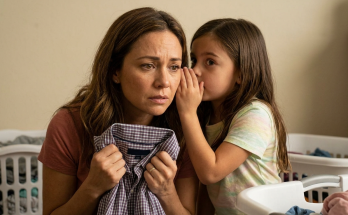
Maggie was seven when she first asked why her father did not live with us.
Not where is my father.
She already knew that.
Children notice names.
Photographs.
Forms.
Other families.
I had never hidden David's existence.
But I had answered questions according to the size of the child asking them.
When she was four:
“Your father made choices that mean he can't live with us.”
At five:
“He hurt me and made unsafe decisions before you were born.”
At six:
“Adults can love people and still behave in ways that make distance necessary.”
At seven, those answers stopped satisfying her.
We were making pancakes on a Saturday morning.
Family tradition had apparently become hereditary.
Dad sat at the table reading the newspaper.
He had retired by then.
Officially.
In practice, he still read judicial opinions and complained aloud about commas.
Maggie flipped a pancake badly.
It folded in half.
“Grandpa.”
“Yes?”
“Don't say anything.”
“I said nothing.”
“Your eyebrows did.”
I laughed.
She unfolded the pancake.
Then, without looking at me, she asked:
“Did Dad want me?”
The spatula stopped in my hand.
Dad lowered the newspaper.
I had known this question would come someday.
Knowing did not make it easier.
“Yes.”
Maggie looked at me.
“Then why didn't he stay?”
There was no answer suitable for seven that was also completely simple.
So I gave her truth without detail she could not carry yet.
“Your father wanted you. He also had serious problems with money and with controlling people when he was afraid.”
“Controlling how?”
“He tried to make decisions for me that were mine to make.”
“Like what?”
“Where I could go. Who I could call. What papers I should sign.”
She frowned.
“That sounds mean.”
“It was.”
“Did he hit you?”
“No.”
That mattered.
“Grandma Sylvia did.”
Maggie knew Sylvia existed too.
She had never met her.
“Why?”
“She was angry because I wouldn't do what she wanted.”
Maggie's face tightened.
“She pushed you when I was in your tummy?”
“Yes.”
She looked down at the pancake.
“That's why I was early.”
“It's part of what happened.”
“Did Dad stop her?”
“No.”
“Why?”
I chose the words carefully.
“Because he was more afraid of his secrets being discovered than he was focused on keeping us safe.”
Maggie became quiet.
Dad remained behind his newspaper, though he had not turned a page in five minutes.
Then she asked:
“Did he love you?”
There it was.
The question I had once begged other adults to answer for me.
Now my daughter was asking.
I turned off the stove.
“Yes.”
Dad looked up.
Maggie seemed confused.
“But he hurt you.”
“Yes.”
“So he didn't love you.”
I pulled out a chair.
“Come sit.”
She did.
I sat across from her.
“One of the hardest things you're going to learn is that love doesn't automatically make someone safe.”
Her forehead wrinkled.
“That's weird.”
“It is.”
“Then what's the point?”
I smiled.
“Love matters. But it isn't the only thing that matters.”
“What else?”
“Respect. Honesty. Freedom. Kindness. Responsibility.”
She counted them on her fingers.
“That's a lot.”
“Good relationships are expensive.”
Dad muttered, “Accurate.”
Maggie pointed at him.
“You're listening.”
“I have ears.”
I continued.
“Your father may have loved me. But when he was afraid of losing money, his career, or control, he repeatedly chose those things over treating me properly.”
“Does he love me?”
I swallowed.
“I believe he does.”
“Do you know?”
“No.”
That answer surprised her.
“Adults don't know everything?”
Dad laughed so hard he coughed.
Maggie glared.
I smiled.
“No. Especially adults.”
She thought about that.
“Can I meet him?”
The question had always been possible.
I felt fear.
Not panic.
Fear could be information without becoming command.
“Maybe someday.”
“Why not now?”
“Because meeting someone is a decision we make carefully when there's difficult history.”
“Do you hate him?”
“No.”
That answer had become easy.
“Are you scared of him?”
I considered.
“Not the way I used to be.”
“Does Grandpa hate him?”
Dad folded the newspaper.
“This interrogation has expanded beyond jurisdiction.”
“Grandpa.”
He sighed.
“I dislike what your father did.”
“That's not what I asked.”
I hid a smile.
Dad looked at me as if blaming my genetics.
Then he answered.
“No. I don't spend enough time thinking about him to hate him.”
Maggie nodded.
That apparently satisfied her.
“Can we eat now?”
Children are merciful that way.
A question that can tear open an adult's past may occupy seven minutes before breakfast becomes more urgent.
We ate pancakes.
The conversation did not end there.
It unfolded over years.
At nine, Maggie learned more about David's financial crimes.
At eleven, she read a simplified account of the Christmas incident with me beside her.
At thirteen, she asked to see the security footage.
I said no.
She was furious.
“You said you wouldn't hide things.”
“I said I wouldn't hide the truth.”
“Same thing.”
“No.”
“That's what people say when they want control.”
The sentence hurt.
Because it sounded like me.
I took a moment.
“You're right to challenge me.”
She blinked.
That was not the answer she expected.
“I still think you're too young to watch footage of your pregnant mother bleeding on a kitchen floor.”
“It's my history too.”
“Yes.”
“And when I'm older?”
“Yes.”
“Promise?”
“I promise.”
At sixteen, she watched it.
Dad offered to leave.
Maggie asked him to stay.
I did too.
The footage had not changed.
Sylvia entered.
I argued.
The shove.
My body struck the counter.
I fell.
Blood.
David arrived.
My voice asking for an ambulance.
His refusal.
The phone breaking.
The threats.
Then the moment.
Call my father.
Maggie stopped the video.
She looked at Dad.
“You?”
Dad nodded.
“Me.”
She stared at the frozen image of her father.
“Did he really not know who Grandpa was?”
I explained the fuller truth.
David knew.
He mocked me because he believed I would not actually reach out.
Maggie sat silently.
Then she looked at me.
“So the important part wasn't who Grandpa was.”
“No.”
“It was that you called.”
My eyes filled.
“Yes.”
She understood at sixteen what took me years to understand.
Dad's title had made the story dramatic to outsiders.
Chief Justice.
Power.
Influence.
A frightened son-in-law discovering the family he underestimated.
But that was never the real turning point.
The turning point happened before Dad answered.
It happened when I decided David no longer had authority over whom I could ask for help.
Maggie watched the rest.
Mark calling emergency services.
The paramedics.
The hospital.
Then I stopped the recording before later material.
She sat beside me.
“Dad could have killed us.”
“Yes.”
The words hurt.
Truth sometimes did.
“Did he know?”
“Yes.”
She cried.
Not loudly.
I held her.
After a while, she asked, “Can I write to him?”
David had been out of custody by then for some time under continuing legal restrictions and supervision that had evolved over the years.
He had never attempted unauthorized contact.
He had never challenged the agreements concerning Maggie.
Through appropriate channels, he sent occasional birthday cards.
I saved them.
I did not give them to her when she was small.
When she became old enough to ask, I showed them.
No manipulation.
No demands.
Mostly brief messages.
Happy birthday.
I hope school is going well.
I am glad you are healthy.
No response expected.
He had built no entitlement into the silence.
Perhaps prison changed him.
Perhaps consequences did.
Perhaps age.
Perhaps nothing fundamental had changed and distance merely limited the harm he could do.
I did not know.
And I had finally become comfortable not knowing what I could not prove.
“If you want to write,” I told Maggie, “we'll talk to Rachel and make sure it's handled safely.”
“I don't need Grandpa's permission?”
Dad answered from the doorway.
“Absolutely not.”
Maggie smiled.
“Mom's?”
“For now,” I said.
She groaned.
“Oppression.”
Dad whispered, “Appeal available at eighteen.”
“Both of you are terrible.”
She wrote.
Three pages.
She did not show me every word.
That was deliberate.
Her relationship with truth did not require me to possess all of it.
David responded through the approved channel.
Maggie read his letter alone.
Then she came downstairs.
“I'm not ready to meet him.”
“Okay.”
“You're not going to ask why?”
“No.”
She sat beside me.
“I might someday.”
“Okay.”
“You'd come?”
“If you wanted.”
“Grandpa?”
“If you wanted.”
From the kitchen, Dad called, “I am being volunteered without consultation.”
Maggie shouted back, “You'd come.”
“Yes.”
We laughed.
Dad remained my closest friend for the rest of his life.
Not because we stopped disagreeing.
We disagreed constantly.
He believed I drove too fast.
I believed he gave Maggie too much money.
He believed retirement entitled him to reorganize my bookshelves.
I threatened legal action.
He asked whether I had competent counsel.
Rachel refused to represent either of us.
Years after that first peaceful Christmas, Dad became ill.
Nothing dramatic.
Age.
Then more age.
Then the slow accumulation of things medicine could manage but not reverse.
Maggie was in college.
She came home whenever she could.
One evening, Dad sat on the same porch where we had talked after my divorce.
His hands had become thinner.
His voice softer.
“Anna.”
“Yes?”
“Do you remember Christmas?”
“Which one?”
He smiled.
“The terrible one.”
“I try not to call it that anymore.”
“What do you call it?”
I thought.
“The last one before I stopped disappearing.”
He nodded.
“Better.”
We sat quietly.
Then he asked, “Do you still think I saved you?”
I laughed.
“You've been waiting decades to revisit this?”
“I like closure.”
“You're a judge. You like final opinions.”
“Former judge.”
“Worse.”
He smiled.
I took his hand.
“You helped save me.”
He accepted that.
“And Mark.”
“Yes.”
“Rachel.”
“Yes.”
“Mom, apparently from beyond the grave.”
Dad laughed.
“Yes.”
“But you were right.”
“About?”
“I made the first decision.”
He squeezed my hand.
“You believed yourself.”
“Yes.”
The evening light softened around us.
I looked at him.
“Still, I'm glad you answered.”
His eyes filled.
“There was never a world where I wouldn't.”
Dad died the following spring.
At home.
Maggie beside him.
Me on the other side.
No courtroom.
No title.
No audience.
Just family.
For months afterward, I reached for my phone whenever something happened.
Good news.
Bad news.
An absurd article he would have hated.
A question about Mom.
Then I remembered.
Grief did not arrive once.
It arrived every time instinct reached for someone reality could no longer provide.
Maggie grieved differently.
She wore one of his old watches even though it was too large.
She kept his annotated copy of the Constitution on her desk.
She also inherited his ability to argue for twenty minutes after clearly losing.
I considered that his revenge.
Years passed.
I never remarried.
People sometimes treated that fact as evidence David permanently damaged my ability to love.
They were wrong.
I dated.
I cared for people.
I ended relationships that were good but not right.
I learned the difference between being alone and being lonely.
Marriage stopped being a measure of recovery.
I did not need another husband to prove David had failed to destroy me.
My life was already full.
Maggie.
Friends.
Work.
Rachel, who eventually stopped billing me and became impossible in entirely new ways.
Charles, who remained at the edges of our family with humility until his death.
Mom's photograph.
Dad's terrible jokes.
Christmas pancakes.
Every year, whoever came to our house cooked together.
Friends.
Neighbors.
Maggie's college roommates.
Later, the young man she brought home one December and warned me not to interrogate.
I did anyway.
Dad would have expected nothing less.
Nobody ate standing because there were not enough seats.
If there were too many people, we found another chair.
If the table was too small, we added another table.
That tradition became so ordinary that Maggie did not understand why I cared about it until she was older.
One Christmas, she caught me counting chairs.
“Mom.”
“What?”
“There are enough.”
“I know.”
“You count every year.”
I smiled.
“Habit.”
She came beside me.
“Grandma Margaret's note?”
“Partly.”
She looked around the room.
“There's always room.”
“Yes.”
She hugged me.
“Because you make room.”
I thought of Mom's words.
If a table has no room for her, she can make a better one.
“I had help.”
That evening, after everyone left, Maggie and I cleaned the kitchen.
She was grown by then.
Confident.
Sharp.
Kinder than I had been at her age because she did not mistake kindness for surrender.
She had eventually met David.
Once.
Then several times.
Carefully.
Slowly.
Their relationship became something I did not define for her.
He was her father.
Not mine anymore.
She was allowed to decide what that meant within boundaries that kept her safe.
David never regained his law license.
His professional life remained permanently altered.
The financial investigation uncovered more than anyone first expected, and restitution consumed much of what he later earned.
Sylvia's assault conviction and financial wrongdoing followed her for the rest of her life.
The consequences were not theatrical.
They were durable.
The house remained mine.
The trust remained protected.
Maggie's generational trust became hers under the safeguards Mom created, and when she was old enough, I explained every provision instead of hiding it.
She asked questions.
I answered.
Mom would have approved.
One night, long after Dad was gone, Maggie found me on the porch.
She sat beside me.
“Can I ask you something?”
“Always.”
“Would you have left Dad if Grandpa wasn't Chief Justice?”
I smiled at the wording.
“You mean David.”
“You know what I mean.”
“Yes.”
I thought about it.
The answer mattered.
“I hope so.”
She frowned.
“You don't know?”
“No.”
“Why?”
“Because pretending I know what a frightened version of me would have done in a different life isn't truth.”
She considered that.
“But Grandpa's job helped.”
“Yes.”
“It scared Dad.”
“Yes.”
“It gave you resources.”
“Yes.”
“So why do you always say his title wasn't what saved you?”
I looked through the window at the dining table.
Mom's photograph stood nearby.
“Because power can open doors.”
Maggie waited.
“But somebody still has to walk through.”
She leaned against my shoulder.
“That's annoyingly Grandpa.”
“I know.”
I remembered Christmas night again.
The cold tile.
Blood.
David's shoe near my hand.
Sylvia insisting I slipped.
Mark hesitating.
My daughter's silence inside me.
Then my own voice.
Call my father.
For years, people who heard the story focused on what happened next.
The Chief Justice answered.
David panicked.
The ambulance came.
Evidence surfaced.
The house was protected.
The financial scheme collapsed.
Charges followed.
Those were consequences.
The choice came first.
I had spent years believing survival began when someone powerful arrived.
It did not.
Survival began when I stopped helping the people hurting me maintain their version of events.
I called Dad.
Mark called the ambulance.
I told the doctors what happened.
I let Rachel ask questions.
I watched the recording.
I stopped signing what I did not understand.
I stopped confusing endurance with loyalty.
Most importantly, I stopped asking David whether my pain was legitimate.
Maggie lifted her head.
“What are you thinking?”
“That your father made one enormous mistake.”
“Only one?”
I laughed.
“One underneath all the others.”
“What?”
“He believed knowing my weaknesses meant he knew what I would do.”
She waited.
“He knew I hated asking Dad for help. He knew I wanted my marriage to work. He knew I was afraid of public embarrassment. He knew I questioned myself.”
“So?”
“He thought those things guaranteed I would stay controllable.”
Maggie smiled slightly.
“He was wrong.”
“Yes.”
That was the ending people rarely understood.
David did not lose control because my father was powerful.
He lost control because I finally stopped giving it to him.
Dad's title frightened him.
Evidence exposed him.
Courts held him accountable.
But none of those things could have chosen for me.
I had to choose.
Myself.
My daughter.
Reality.
The people who could love me without requiring me to become smaller.
Inside the house, the clock struck midnight.
Christmas.
Again.
Maggie stood.
“Pancakes in the morning?”
“Obviously.”
“Grandpa burned them.”
“Tradition does not require historical accuracy.”
She laughed.
We went inside.
Before turning off the dining-room light, I looked once at the table.
Enough chairs.
Always enough chairs.
Mom smiling from the photograph.
Dad's old watch on Maggie's wrist.
My daughter alive.
My home quiet.
Nothing about that peace had been handed to me by a title.
My father had answered because he was my father.
He came because I was his daughter.
He stood beside me because love, when it is healthy, does not demand ownership in exchange for protection.
And I survived not because I was the Chief Justice's daughter.
I survived because, on the worst night of my marriage, I finally believed I deserved help before anyone powerful told me I did.
David had planned for my money.
My isolation.
My fear.
My pregnancy.
My silence.
He had planned for almost everything.
He had simply never planned for me to choose myself.
The End
Read more original stories on Feel Every Story.
By Christmas Dinner, Anna Could Barely Stand, Yet Her Husband Was More Afraid of Embarrassment Than Her Pain
Part 20 of 20