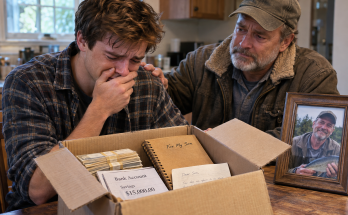
Several months after the funeral, Hank took me fishing.
I brought the rod I had kept from Dad's belongings.
Hank examined it before we left.
He adjusted something near the reel and showed me how it worked.
I listened carefully.
I didn't know much about fishing.
Dad had never taught me.
There had been opportunities, of course.
But neither of us had taken them.
Now I was learning from the person who had spent so many weekends beside him.
We arrived early.
The air was cool, and the water was nearly still.
Hank carried his equipment toward a familiar spot.
He told me that he and Dad had often come there.
I looked around.
It wasn't particularly remarkable.
But I could imagine why somebody who worked long shifts might enjoy sitting there for a few hours.
There were no household bills waiting to be paid.
No demands.
No complicated conversations unless somebody chose to begin one.
Hank showed me how to prepare the fishing line.
I made several mistakes.
He corrected them without becoming impatient.
Eventually, I managed to do what he had shown me.
"Not bad."
I smiled.
We settled down beside the water.
For a while, neither of us spoke.
The silence felt different from the silence Dad and I had shared.
There was no tension in it.
No expectation that somebody ought to say something.
It was simply quiet.
I realized that silence itself had never been the problem.
It was what our silence had concealed.
After some time, Hank pointed toward the water.
"Your dad once sat here nearly all morning without catching a thing."
I laughed.
"Did he admit it was a bad spot?"
"Absolutely not."
That sounded familiar.
Hank told me how Dad had insisted on staying there while everyone else moved farther along.
Eventually, he caught something small.
Apparently, that one fish was enough to convince him he had been right the entire time.
I laughed harder than I expected.
For a moment, I could imagine Dad standing nearby, defending himself.
I wished he had been there.
But the wish didn't ruin the morning.
I was beginning to understand that remembering somebody didn't always have to hurt.
Sometimes it could be pleasant.
Sometimes the pain and pleasure arrived together.
We remained beside the water for several hours.
I didn't catch much.
I didn't particularly care.
Before we left, I looked at the rod in my hands.
I thought about the evening Dad had brought home that expensive fishing equipment.
I remembered sitting in the kitchen with my damaged shoe.
The resentment I had felt then had been real.
I wasn't ashamed of it anymore.
I had been struggling.
I had misunderstood where the money was going, but my exhaustion hadn't been imaginary.
Now the fishing rod represented something different.
It was an opportunity to experience a small part of Dad's life that I had never understood.
I was grateful for that opportunity.
I only wished we could have shared it.
On the drive home, Hank asked whether I would come fishing again.
"Sure."
"Good."
He kept his eyes on the road.
Then he spoke again.
"He would've liked seeing you out there."
I looked through the window.
"I would've liked seeing him."
Hank nodded.
Neither of us said anything for a while.
When I arrived home, I put the fishing rod away carefully.
Then I went upstairs and changed my clothes.
My work shoes were beside the bedroom door.
They had begun showing signs of ordinary use.
But they were still comfortable.
The soles were intact.
I had already decided that when they eventually wore out, I would replace them.
No glue.
No unnecessary suffering.
I didn't need another reminder of how long I could tolerate discomfort.
I had learned that lesson well enough.
The following week, I finalized arrangements for a training course that fit around my work schedule.
I had researched the costs and considered how the course might improve my employment prospects.
It wasn't a guaranteed path to a better life.
I understood that.
But it was a reasonable opportunity.
I paid the necessary expense from the savings Dad had left me and recorded it in my notebook.
Most of the money remained untouched.
I wanted to preserve enough for emergencies and future decisions.
Still, using some of it for something constructive felt right.
I thought Dad would have approved.
Then I caught myself.
His approval mattered to me.
But it wasn't the only reason I needed to do something worthwhile.
I was allowed to make decisions because they were good for me.
That was something I was still learning.
My life gradually became busier.
There was work.
There were classes.
There were household responsibilities.
Some evenings, I was tired enough to understand why Dad had preferred sitting quietly after coming home.
There were moments when I wanted nothing more than to eat something and be left alone.
I recognized that feeling now.
But when Hank called, I tried to answer.
When someone asked how I was doing, I tried to give an honest response.
And when I needed rest, I explained that instead of disappearing emotionally.
I didn't always succeed.
Old habits were difficult to change.
Sometimes I caught myself behaving exactly as Dad had.
Someone would begin telling me something, and my thoughts would wander toward the things I needed to accomplish.
Then I would remember how it felt to speak to a person who wasn't really listening.
I would put down whatever I was holding.
I would pay attention.
It was a small choice.
But those small choices had been missing from much of my childhood.
I wanted them to become ordinary parts of my adult life.
One afternoon, I returned home with several bags of groceries.
Rain had begun falling while I was at the store.
I hurried from the car to the front door.
By the time I reached the entrance, my jacket was damp.
I looked down at my shoes.
My feet were dry.
For some reason, that simple fact brought the old memory back.
I could see the damaged shoes I had carried into the kitchen when I was young.
I could remember Dad telling me to wear thicker socks.
For years, remembering that conversation had made me angry.
This time, I felt something quieter.
Sadness, mostly.
I wished someone had understood what I needed that afternoon.
I wished Dad had stopped whatever he was doing and taken care of me.
There was no way to change that memory.
But there were things I could do with what it had taught me.
I began thinking about children who might be experiencing similar problems.
Children whose families couldn't easily afford replacement shoes.
Children who learned to stop asking for things because they knew money was tight.
I knew my situation hadn't been identical to theirs.
Dad had been capable of providing more kindness than he sometimes offered.
Other parents might desperately want to provide things they simply couldn't afford.
But the discomfort of walking around in wet shoes was the same.
I decided to set aside a small amount of money for a local community effort that helped families obtain basic necessities.
I made sure it was an amount I could reasonably afford.
I wasn't trying to give away Dad's savings.
I wasn't making a dramatic gesture.
I simply wanted to help someone get something they needed.
When the opportunity came to contribute toward children's shoes, I did.
I received no personal recognition.
I didn't need any.
The thought of a child walking to school with dry feet was enough.
Afterward, I returned home and wrote the contribution in my notebook.
Beside it, I wrote a few words.
Something useful.
I looked at the entry.
Dad's notebook had contained columns documenting money he had quietly preserved for me.
Mine now contained money I had chosen to use for another person.
There was something meaningful about that connection.
But I had no intention of keeping my kindness secret from the people closest to me.
If I cared about somebody, I wanted them to know.
I didn't want them discovering it through paperwork after I was gone.
As the months passed, the house became brighter.
I painted some walls.
I replaced a few worn household items.
I made Dad's former bedroom into a simple space where I could study.
His boots remained inside the closet.
The cardboard box remained in the kitchen cupboard.
The important documents were stored safely, and his letter was kept separately.
I still read it occasionally.
Not as often as before.
There had been a time when I needed to examine every sentence because I was afraid the revelation might somehow disappear.
Now I believed it.
I believed that Dad had loved me.
I believed he had wanted me to have a secure future.
I also believed that he had handled important parts of our relationship badly.
Those beliefs no longer seemed incompatible.
I could appreciate his intentions without praising every method he had used.
I could acknowledge the financial gift without pretending the emotional cost hadn't existed.
And I could miss him without forgetting why I had once wanted to leave.
That was how forgiveness began for me.
Not with a sudden feeling.
Not with a decision that everything was acceptable.
It began when I stopped demanding that the past become different before I allowed myself to move forward.
One Sunday, I visited my parents' graves.
I brought flowers for Mom.
I stood quietly for a while.
Then I moved closer to Dad's resting place.
There were things I had imagined saying on that visit.
I had prepared entire conversations in my head.
But standing there, I found that I didn't need most of those words.
"I know about the money, Dad."
My voice sounded strange in the open air.
I looked down.
"Hank brought me the box."
I smiled slightly.
"You certainly used enough tape."
For a moment, I almost laughed.
Then my eyes began burning.
I told him that I had stayed in the house.
I told him about the course I was taking and how I was still working.
I told him that Hank had taken me fishing.
I wondered what Dad would have said about my poor performance.
Probably something practical.
Probably something about being patient.
I would have liked hearing it.
I stood quietly for another moment.
Then I told him what I had been carrying for years.
"You hurt me."
The words were difficult to say.
Even there.
"I needed you to talk to me. I needed you to tell me what I meant to you."
I wiped my face.
"I shouldn't have had to wait until you died."
There was no response.
Of course there wasn't.
But I needed to speak those words anyway.
I looked toward Mom's grave.
"I missed her too, Dad."
My voice broke.
"I wish we'd talked about her."
That was the conversation I regretted losing most.
Not the conversation about rent.
Not the one about the bank account.
The one in which a father and his child might have sat together and admitted how badly they missed the same person.
I stayed there until I felt ready to leave.
Before walking away, I said one more thing.
"I love you."
I didn't say it because he had saved the money.
I didn't say it because I had discovered that every mistake he made had a noble explanation.
I said it because it was true.
Then I went home.
Hank came over for dinner that evening.
I had prepared enough food for both of us.
He brought something to drink, and we sat at the old kitchen table.
We talked about work and my classes.
He told me about another fishing trip he was considering.
I asked him questions.
At one point, I looked across the table and remembered Dad counting the first rent payment.
The memory was clear.
His hands moving over the bills.
The folded money.
The absence of any expression of pride.
For years, that scene had represented everything I believed was wrong with my relationship with him.
Now there were other scenes connected to the same table.
Hank opening the notebook.
My father's letter.
The coffee that went cold while we talked about Mom.
The first dinner I cooked with music playing.
Those memories hadn't erased the original one.
They had given it company.
After dinner, Hank helped me wash the dishes.
Before leaving, he asked whether everything was going well.
I told him about a few things I was finding difficult.
I didn't pretend that every problem had been solved.
He listened.
Then he reminded me that I could call if I needed help.
"I know."
This time, I meant it.
After he left, I returned to the kitchen.
The house was quiet again.
I opened the cupboard and took out the cardboard box.
The tape marks were still visible.
Some of the cardboard had torn when I opened it.
I unfolded the flaps and looked inside.
Empty.
The contents were elsewhere now.
The money was helping me establish a more secure life.
The financial records were stored safely.
The letter was upstairs.
And the meaning of everything Dad had left me no longer belonged exclusively inside that box.
It influenced the choices I made.
The way I treated myself.
The way I listened to people.
The way I understood the difference between providing something and being present.
I closed the flaps and returned the box to the cupboard.
Then I checked the date.
It was the first day of another month.
I smiled.
I transferred my chosen amount into savings.
Afterward, I turned on some music and made myself a cup of coffee.
I sat in Dad's chair.
For a long time, I had believed that the fifteen thousand dollars was the answer to the mystery of my father's behavior.
It wasn't.
It was only one part of the answer.
He had loved me in a way he understood.
He had failed to love me in some of the ways I needed.
Both truths would remain with me.
I didn't have to choose between them anymore.
I finished my coffee and went upstairs.
Before entering my bedroom, I stopped beside the room where Dad's boots were stored.
I opened the closet.
The boots looked exactly as they had when I moved them.
I touched one of them briefly.
Then I closed the door.
I no longer felt that putting them away meant abandoning him.
And I no longer felt that keeping them meant I couldn't move forward.
They were simply something that had belonged to my father.
Something I wasn't ready to discard.
Perhaps I never would be.
Back in my bedroom, I placed my shoes beside the door and prepared for work the next morning.
I thought about the eighteen-year-old who had cried while holding a folded note containing a number.
I wished I could have offered that person some comfort.
I couldn't go backward.
But I could live differently now.
I could make sure that the people I cared about didn't spend years guessing whether they mattered.
I could be generous without making generosity a secret.
I could teach responsibility without withholding affection.
And whenever someone I loved needed to hear something important, I could say it while they were still there to hear me.
My father had left me enough money to begin a new chapter.
His greatest mistake had taught me how I wanted to live it.
I turned off the light and settled into the same bed I had slept in for years.
The room was familiar.
The house was familiar.
But the feeling was different.
I wasn't staying because I couldn't afford to leave.
I wasn't staying because somebody had demanded a payment.
I was staying because I had chosen to.
For the first time in my adult life, I went to sleep without feeling that I owed somebody for the privilege of being home.
The End
Read more original stories on Feel Every Story.
My Father Never Asked Whether I Was Happy, but on My Eighteenth Birthday, He Finally Told Me What He Expected
Part 10 of 10