The next morning, I almost carried Dad's boots back downstairs.
I had become so accustomed to seeing them beside the front door that their absence bothered me.
I stood outside his bedroom closet for a moment.
Then I closed the door.
They were safe where I had put them.
There was no reason to make them wait for someone who wasn't coming home.
I went downstairs and prepared breakfast.
While the coffee was brewing, I opened the notebook containing my plans for the future.
There were figures I needed to update.
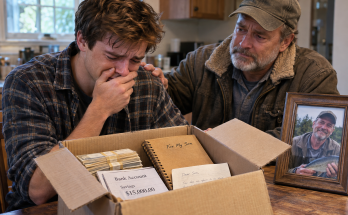
The bank had completed the transfer of the savings Dad had arranged for me.
The fifteen thousand dollars, together with the accumulated interest, was now available.
I had deliberately kept it separate from the money I used for everyday expenses.
I wanted to think carefully before making any significant decisions.
There was a time when I would have considered that balance the solution to every problem in my life.
Now I understood that it could solve certain problems.
Others required something different.
I checked my work schedule and calculated what I could reasonably contribute toward household expenses.
Then I wrote down the amount I wanted to maintain as emergency savings.
The numbers were encouraging.
For once, I wasn't calculating how long I could survive if something went wrong.
I was making plans for things that might go right.
I finished my coffee and went to work.
During my break, I received a call regarding the remaining estate arrangements.
I had been waiting for a clearer understanding of what would happen to Dad's house.
The necessary paperwork was progressing, and I learned that the property would pass to me once the estate obligations were settled.
I listened carefully.
I asked questions about the expenses involved and the responsibilities I would be taking on.
When the conversation ended, I remained seated for several minutes.
The house would become mine.
The bedroom I had paid to occupy for five years would no longer belong to somebody else.
I thought about the note Dad had pushed across the kitchen table on my eighteenth birthday.
Two hundred and fifty dollars.
It seemed strange that something as small as a piece of paper could influence so many years of a person's life.
I put my phone away.
My break was almost over.
There were boxes waiting for me in the storeroom.
I returned to work.
That evening, I called Hank.
He answered while I was standing in the kitchen.
"I heard about the house today."
"Everything going all right?"
"It looks like it's going to be mine."
There was a short silence.
"That's good news."
"Yeah."
He noticed the uncertainty in my voice.
"Still thinking about moving?"
"A little."
Hank didn't immediately offer an opinion.
Instead, he asked whether I had considered the ongoing cost of maintaining the property.
I told him I was working through those figures.
Insurance.
Utilities.
Taxes.
Repairs.
Things that Dad had taken care of for years without involving me.
Owning the house wouldn't mean living there for nothing.
But it offered a degree of stability I had never experienced before.
I could make improvements gradually.
I could build my savings.
I could decide whether to remain there after giving myself enough time to think.
Hank suggested that I avoid making permanent decisions while everything still felt so recent.
I agreed.
Before ending the call, I asked whether he wanted to come over during the weekend.
He said he would.
Afterward, I walked through the house.
I wasn't looking for anything in particular.
I simply wanted to see it without thinking about how quickly I could leave.
In the living room, I noticed how much space the furniture occupied.
The kitchen needed some attention.
There were small marks on the walls and ordinary signs of years of use.
None of it bothered me the way it once had.
I began imagining modest changes.
A fresh coat of paint.
Different curtains.
A table that could accommodate people visiting for dinner.
I wanted the house to feel lived in rather than merely maintained.
There was a difference.
Dad had done a good job keeping the property functional.
But somewhere along the way, we had stopped making it feel welcoming.
I wasn't blaming him for every faded curtain or empty room.
I simply wanted something different.
Upstairs, I stood inside my bedroom.
I looked at the furniture I had used since childhood.
There were things I could replace now.
But I realized I didn't particularly want to replace everything.
Some of those belongings had nothing to do with the rent.
They reminded me of being young.
Of Mom.
Of a life that existed before the kitchen table became a place where money changed hands.
I decided to keep the furniture for the time being.
Then I opened the curtains.
The room looked brighter immediately.
I laughed at myself.
For years, I had imagined freedom requiring a different address.
Opening a curtain wasn't freedom.
But making a choice without worrying about somebody else's reaction felt like a beginning.
On Saturday, Hank arrived wearing an old jacket.
He brought some basic tools after I mentioned wanting to make a few small repairs.
We spent the morning looking around the house.
He pointed out things I could handle myself and others that would be better left to someone with the proper experience.
I wrote down his suggestions.
Dad probably would have approached the work in much the same practical way.
But Hank explained what he was doing.
He asked what I preferred.
He didn't make me feel foolish when I didn't know something.
I enjoyed working beside him.
Around lunchtime, we stopped and made sandwiches.
Hank sat in the chair across from me.
I looked at him and realized that we had shared more meals in the past several weeks than we had during all the years he visited Dad.
"I'm glad you kept coming over."
He smiled.
"Somebody has to make sure you don't make a mess of those repairs."
I laughed.
Then his expression softened.
"Your dad was worried about leaving you alone."
I looked down at my plate.
"He could have spent more time with me when he was here."
Hank nodded.
"He could have."
There was no argument.
I appreciated that we could speak honestly about Dad without either of us feeling required to defend every decision he had made.
After lunch, we continued sorting through the fishing equipment.
I had decided to give Hank several items that meant something to him.
He protested at first.
I insisted.
"You'll actually use them."
He examined one of the rods.
"Your dad liked this one."
"Then you should take it."
Hank held it carefully.
For a moment, he didn't speak.
I recognized that expression.
It was the same expression I sometimes wore when handling Dad's belongings.
Grief could appear without warning.
Even when you were doing something ordinary.
I decided to keep one fishing rod myself.
I didn't know whether I would use it often.
But I wanted the opportunity.
Hank noticed me setting it aside.
"You thinking about coming fishing sometime?"
"Maybe."
"I can show you a few things."
"I'd like that."
He smiled.
It wasn't a promise to become a different person overnight.
It was simply an invitation.
And I had accepted it.
Later that afternoon, we carried some boxes out of Dad's room.
There were clothes and belongings I had decided to donate.
I checked each box before closing it.
The work boots remained in the closet.
I wasn't ready to part with them.
Hank didn't ask me to.
When we finished, the room looked less crowded.
I stood in the doorway.
I expected to feel guilty.
Instead, I felt tired and strangely peaceful.
I could finally imagine using the room for something other than preserving everything exactly as Dad had left it.
Perhaps a place to study.
Perhaps somewhere a guest could stay.
There was no immediate need to decide.
I went downstairs and washed my hands.
Hank was looking at the kitchen table.
"You going to keep this?"
I ran my hand along the edge.
"I think so."
He nodded.
"It's been here a long time."
I knew.
Mom had used it.
Dad had used it.
I had eaten countless meals at it.
It had witnessed some of the worst conversations of my life, along with some of the most important.
I didn't want its last meaningful purpose to be receiving Dad's rent payments.
I wanted to create better memories around it.
That evening, after Hank left, I took Dad's notebook from the cupboard.
I opened it to the first entry.
My eighteenth birthday seemed impossibly distant.
I could almost see myself standing beside the table, trying to understand what my father was asking of me.
I wanted to tell that younger version of myself what I knew now.
That the money wasn't disappearing.
That Dad had been paying attention.
That I would eventually have enough to make choices.
But I also wanted to tell that younger person something more important.
That struggling didn't make me inadequate.
That wanting kindness from my father hadn't been unreasonable.
That I didn't need to earn affection through exhaustion.
I closed the notebook.
Then I opened my own.
The letter I had written Dad was still there.
I read portions of it.
Some of the anger felt less immediate now.
Other parts remained painfully accurate.
I didn't change anything.
The person who wrote those words had meant them.
I wasn't going to revise my feelings just because time had softened some of them.
Instead, I turned to a fresh page.
I began making another plan.
I had been thinking about taking classes that might help me qualify for better employment.
For years, additional training had seemed difficult to arrange.
There was always the question of money.
Now I could investigate the possibility seriously.
I didn't intend to spend the entire savings account on education.
I wanted to compare costs and understand what opportunities were available.
But for the first time, I wasn't dismissing the idea before learning anything about it.
I wrote down the information I needed to find.
Then I added a few household improvements.
Nothing expensive.
Nothing that couldn't wait if necessary.
Finally, I wrote something that wasn't a financial objective.
Spend more time with people.
I looked at those words.
They seemed almost embarrassing beside the practical items.
But I knew why they belonged there.
Dad had planned carefully for my financial future.
What he hadn't planned for was the loneliness that could develop when practical responsibilities became the only things we discussed.
I didn't want to repeat that mistake.
I wanted to work.
I wanted to save.
I wanted to become more secure.
But I also wanted to enjoy being alive while those things were happening.
Over the following weeks, I began making small changes.
I invited Hank over more often.
I talked to coworkers instead of immediately disappearing during every break.
I allowed myself to buy things I genuinely needed without calculating how much suffering I could endure before replacing them.
None of those changes would have seemed impressive to somebody else.
To me, they mattered.
One evening, the first day of the month arrived.
I noticed the date while checking my phone.
For a moment, I experienced the familiar tightening in my stomach.
Then I remembered.
Nobody was waiting for the rent.
I stood in the kitchen and looked at the table.
I didn't have to count out two hundred and fifty dollars.
I didn't have to explain why I needed to keep more money that month.
The obligation was finished.
I opened my banking information and transferred money into my own savings.
It was an amount I had chosen.
I knew what it was for.
I knew I could adjust it if an emergency arose.
And I knew it belonged to me.
Afterward, I prepared dinner.
I turned on some music.
The kitchen filled with the sound.
I thought about my mother singing while washing dishes.
I thought about Dad sitting quietly in his chair.
Then I thought about myself.
I had spent years believing my future would begin when I finally walked away from that house.
Instead, it had begun when I stopped treating the house as a place where my worth had to be proven.
Once the estate arrangements were complete, I decided to keep it.
At least for the foreseeable future.
Not because Dad would have wanted me to.
Not because I was afraid to leave.
Because, after considering the expenses and my plans, staying was the choice I wanted to make.
I wrote that decision in my notebook.
Then I put the notebook away.
There would be other choices later.
I didn't need to make all of them at once.
For the first time since I was eighteen, the place where I slept felt like my home.
Click here to continue reading: PART 10: I Finally Forgave My Father Without Pretending He Had Been Right, and His Last Gift Became Something Neither of Us Had Expected
My Father Never Asked Whether I Was Happy, but on My Eighteenth Birthday, He Finally Told Me What He Expected
Part 9 of 10