I hardly slept that night.
Dad's letter was on the small table beside my bed.
I had carried it upstairs with me because I didn't want to leave it downstairs inside the box.
Several times, I reached for it.
I would read a few lines, put it down, and close my eyes.
Then another sentence would come into my mind.
I would turn the light back on.
By morning, I knew certain passages almost by heart.
The strange thing was that I could hear Dad saying them.
Not in the cold voice he used when discussing money.
In the quieter voice he occasionally used when he was tired.
I wished I had heard that voice more often.
When I went downstairs, I noticed his boots again.
I stopped beside them.
Yesterday, they had represented everything I had lost.
Now they also reminded me of everything I hadn't known.
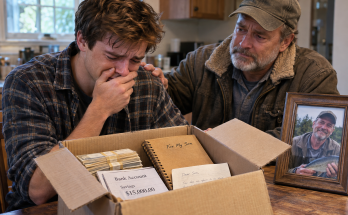
I went into the kitchen and opened the cardboard box.
The papers looked less mysterious in daylight.
They were documents.
Ordinary financial records.
Yet I couldn't look at them without remembering the moment I discovered what they represented.
I took out the notebook.
There was something I wanted to do.
I found a calculator and began adding the entries myself.
Not because I doubted Hank.
Not because I thought Dad had made a mistake.
I simply needed to see the numbers accumulate.
Two hundred and fifty dollars.
Another two hundred and fifty.
Then another.
I continued until I reached the final entry.
The principal amounted to fifteen thousand dollars.
I sat back.
I had spent years thinking about that number as something Dad had taken from me.
Now I was being told it was something he had preserved.
The amount hadn't changed.
Only my understanding of it had.
I called Hank later that morning.
He answered almost immediately.
"How are you doing?"
"I'm not sure."
"That's fair."
I told him I wanted to take care of the bank arrangements.
He agreed to accompany me.
There were documents we needed to gather first.
Dad's death certificate and other records would be required, and the bank would have to verify the arrangements he had made.
I appreciated having something practical to concentrate on.
There were forms to complete.
Questions to ask.
Documents to organize.
For a while, I understood why Dad had preferred dealing with such things.
Paperwork was easier than grief.
A form told you what information was missing.
It gave you a place to put the answer.
Nothing about grief worked that way.
When the necessary documents were ready, Hank and I went to the bank.
I carried them in a folder.
Dad's notebook was inside.
So were the statements he had left in the box.
I held the folder tightly while we waited.
Hank sat beside me.
Neither of us talked very much.
Eventually, an employee invited us into a small office.
I explained why we were there.
I felt uncomfortable saying that my father had died.
It was still such a new sentence.
Every time I said it, I expected the other person to tell me there had been a misunderstanding.
The employee examined the documents.
She asked for identification.
I handed it over.
She reviewed the account information and confirmed that Dad had arranged for me to receive the balance upon his death.
The arrangements were valid.
The account was real.
And the money was there.
I looked at Hank.
He gave me a small nod.
The employee turned her screen slightly so I could see the balance.
There was the amount Dad had saved, along with the interest that had accumulated.
I stared at it.
I had never possessed that much money.
Not even temporarily.
For several seconds, I couldn't think of anything to say.
The employee seemed to assume I was pleased.
Of course she did.
From her perspective, I had received an unexpected financial benefit.
She couldn't know how complicated it was.
"Would you like to review the account history?"
I said yes.
She showed me the deposits.
The records matched the documents Dad had placed inside the box.
There were no withdrawals for his own use.
Nothing had been taken out to pay for his fishing equipment or his beer.
I knew that already.
Seeing the official records made it harder to hold on to certain accusations I had made in my head.
I asked about the first deposit.
She showed me the date.
It had been made shortly after my first rent payment.
I remembered that day clearly.
I had gone upstairs feeling humiliated.
Dad had apparently gone to the bank.
Two completely different experiences connected to the same money.
I wondered what he had been thinking as he made that first deposit.
Had he felt satisfied?
Had he believed he was doing something clever?
Had he considered how much our conversation had hurt me?
I would never know.
The employee explained the remaining steps.
I listened carefully.
I signed the required forms and provided the information she requested.
When everything was finished, I had confirmation of the funds that would become available to me.
I placed the documents back inside my folder.
"Thank you."
It seemed like an inadequate thing to say.
Outside the bank, Hank asked whether I wanted to get something to eat.
I shook my head.
Then I changed my mind.
We went somewhere nearby and ordered a simple lunch.
I wasn't particularly hungry.
But I knew I needed to eat.
Hank looked at me across the table.
"What are you thinking?"
I unfolded the paper confirming the account balance.
"I could have left years ago."
He nodded.
"Maybe."
"If I'd known this was here, I could have made different decisions."
He didn't disagree.
I appreciated that.
A part of me wanted somebody to tell me that the arrangement had been brilliant.
That everything I had endured had served a necessary purpose.
Then perhaps I could have stopped feeling angry.
But that wouldn't have been true.
Dad's decision had produced a useful amount of savings.
It had also kept me struggling longer than necessary.
Both things were true.
"I don't know what I'm supposed to feel about him."
Hank took a drink.
"You don't have to decide today."
I looked down at my hands.
I had become accustomed to making decisions quickly because I couldn't afford to waste money.
Now somebody was telling me that I could take my time.
It was unfamiliar advice.
Hank told me that Dad hadn't always been so difficult to understand.
He remembered him before Mom became the center of our household.
He remembered a man who enjoyed making plans and who could become enthusiastic about ordinary things.
Then he remembered the period after her death.
Dad had continued working.
He had continued doing what needed to be done.
But he had gradually stopped talking about anything that frightened or upset him.
I listened.
There was comfort in discovering that my father hadn't always been the person I remembered.
There was sadness in it too.
I had known him mostly during the years when he was grieving.
Perhaps he had known me mostly during those same years.
We had both missed important parts of each other's lives.
After lunch, Hank drove me home.
I thanked him for coming.
He told me to call whenever I needed anything.
I almost gave him my usual answer.
That I would be fine.
Instead, I simply thanked him again.
I was beginning to understand how often I used those words to prevent people from getting close.
Inside the house, I placed the folder beside the cardboard box.
Then I went upstairs and took my work shoes from beside the bedroom door.
I turned one of them over.
The glue had hardened unevenly around the edge.
There was another small opening in the sole.
I had been planning to repair it before my next shift.
I sat on the bed holding the shoe.
For years, I had treated replacing things as a last resort.
Every unnecessary expense threatened the little progress I had made toward independence.
But the shoe was worn out.
It had served its purpose.
There was nothing admirable about continuing to wear it until walking became uncomfortable.
I put it down.
That afternoon, I went to buy a new pair.
It wasn't a dramatic purchase.
I didn't choose the most expensive shoes in the store.
I looked for something durable and comfortable enough for standing through long shifts.
I tried on several pairs.
When I found one that fit properly, I walked a short distance across the floor.
Nothing shifted underneath my feet.
There was no loose sole.
No hard ridge of dried glue.
I looked down.
For some reason, I thought about my mother.
I remembered being nine years old.
I remembered those wet socks.
I had to turn away from the employee for a moment.
"Everything all right?"
"Yes. These are good."
I bought the shoes with the money I already had available.
I didn't need to wait for the savings account to be transferred to make that modest purchase.
What had changed was my willingness to spend anything on myself.
I no longer felt as though buying a necessary pair of shoes represented a personal failure.
When I returned home, I placed the new shoes beside the old ones.
The difference was almost ridiculous.
I had made the damaged pair last far longer than I should have.
I thought about throwing them away immediately.
Instead, I decided to keep them for a little while.
I wasn't sure why.
Perhaps I needed something physical to remind myself that the years of struggle had actually happened.
They hadn't disappeared just because the money had been returned.
That evening, I opened the notebook again.
I turned to the last completed page.
Beneath Dad's final entry, there was empty space.
I took a separate sheet of paper and began making a plan.
I didn't want to rush into buying things simply because I finally had some financial security.
I needed to consider my future carefully.
There were housing expenses to think about.
Transportation.
Emergency savings.
The possibility of further training or education.
And the practical question of what would happen to the house.
Dad's estate still needed to be settled.
I couldn't assume that everything would be straightforward.
I wrote down the questions I needed answered.
Then I looked at the list.
For the first time, my financial planning wasn't entirely centered on surviving until the next first day of the month.
I could think beyond it.
That felt good.
It also made me unexpectedly sad.
I wished Dad had been sitting across from me.
I wished we could have looked at the numbers together.
He would probably have been pleased that I was taking the process seriously.
Perhaps he would have offered advice.
Perhaps we would have disagreed about something.
I would have welcomed even that.
Instead, I had his notebook.
I had the records of his decisions.
And I had the freedom to make my own.
I decided that I wouldn't spend the savings recklessly.
But I also wouldn't treat myself the way I had been treated for years.
I would not make discomfort a condition of being responsible.
I could save money and still buy shoes when I needed them.
I could work hard without believing that exhaustion was evidence of good character.
I could accept help without feeling ashamed.
Those were things Dad hadn't taught me directly.
I would have to teach myself.
Before going upstairs, I placed his letter back in its envelope.
I didn't return it to the cardboard box.
I wanted it somewhere separate from the financial records.
The money was important.
The letter mattered differently.
I turned off the kitchen light and walked toward the stairs.
Dad's boots remained near the entrance.
My new shoes were upstairs waiting for my next shift.
For years, I had believed the first real sign of independence would be walking away from that house.
That evening, independence meant something smaller.
I had bought something I needed.
And I hadn't apologized to anyone for doing it.
Click here to continue reading: PART 7: I Began Sorting Through the House I Had Spent Years Trying to Escape, and Found Myself Understanding Its Silence Differently
My Father Never Asked Whether I Was Happy, but on My Eighteenth Birthday, He Finally Told Me What He Expected
Part 6 of 10