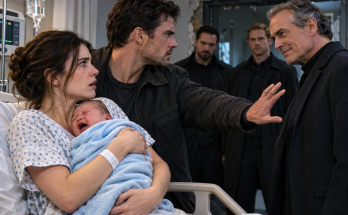
I was frightened when the investigator arrived.
He didn't look threatening.
He wore an ordinary suit, introduced himself as Thomas Reed, and waited until Rachel told him we were ready.
Still, my hands wouldn't stop shaking.
I had learned to distrust people who arrived carrying identification and asking questions.
Rachel noticed.
"You can take a break whenever you need one."
I nodded.
Thomas placed his notebook on the table.
"Mrs.—"
"Just Joanna."
He corrected himself immediately.
"Joanna, I'd like you to describe what happened in your own words."
I looked toward Noah.
He was asleep beside Logan.
"Before I begin, can I ask you something?"
"Of course."
"Are you here because somebody thinks I've neglected my baby?"
"No."
The answer was immediate.
"I'm here to investigate the allegations concerning the hospital, the proposed transfer, and the historical research records."
I breathed out.
"Nobody's taking him?"
"That's not why I'm here."
I nodded again.
Rachel remained beside me.
I began describing the night of Noah's birth.
This time, I remembered details I hadn't included before.
The admissions clerk looking at the computer.
Her fingers stopping above the keyboard.
The telephone call.
The words that had seemed insignificant at the time.
She's here.
Thomas wrote them down.
"You're certain that's what she said?"
"Yes."
"Did she identify the person she was speaking with?"
"No."
He didn't ask me to speculate.
He moved on.
I described Evelyn's questions about my adoption and Logan's marking.
Then I described Dr. Mercer's examination.
"Did he obtain your consent?"
"I allowed him to examine Noah while I held him. I didn't agree to research."
"Did he explain the purpose of his questions?"
"No."
"What happened when you asked?"
"He didn't really answer."
Thomas made another note.
I watched the movement of his pen.
For years, somebody had been writing about me without my knowledge.
Now I was sitting beside the person recording my words.
And he was asking permission to continue.
That difference mattered.
When I described the men entering the hospital room, my voice began shaking.
I remembered the damaged door.
The medical cart.
The stranger's expression.
I remembered how Noah had cried against me.
Thomas offered to stop.
I shook my head.
"I want to finish."
He waited until I was ready.
I repeated what the stranger had said about the naturally conceived baby.
Then I explained the confusion surrounding Logan's identification number.
Thomas turned toward him.
"You believed yourself to be C-17?"
"Yes."
"For how long?"
"As long as I can remember knowing about the marking."
"And the man identified you as C-18?"
"Yes."
Rachel provided the relevant records.
Thomas examined them carefully.
He asked Logan to describe his childhood recollections separately.
Logan agreed.
I listened while he described the white rooms.
The other children.
The examinations.
The way adults spoke about them as though they couldn't hear.
At one point, he stopped.
His fingers tightened around the edge of his chair.
I reached for his hand.
He continued.
When he finished, Thomas asked whether he remembered particular names.
Logan mentioned Dr. Mercer.
He explained that some memories were clearer than others.
Thomas didn't pressure him to make uncertain recollections sound definite.
He recorded what Logan could honestly provide.
Then Evelyn entered with her own attorney.
She had spent the morning preparing to give her account.
Before sitting down, she looked at me.
"I won't leave anything out deliberately."
I nodded.
I wasn't ready to absolve her of what she had done.
But I was grateful she had come.
Thomas began asking about her employment.
Evelyn produced the old identification card.
She described the research facility and the people she had worked with.
She acknowledged the limits of her knowledge.
When asked why she hadn't reported her concerns earlier, she didn't blame anybody else.
"I was afraid of losing my job."
She paused.
"And I was afraid of what might happen if I challenged the people in charge."
Thomas looked at her.
"Did you understand that the children might be harmed?"
"Eventually, yes."
"And you remained employed there?"
"For a period of time."
"Why?"
She looked down.
"Because I kept finding reasons not to act."
I felt anger rising inside me.
It would have been easier if she had offered some extraordinary excuse.
Instead, she described something painfully ordinary.
A person who knew something was wrong and convinced herself that somebody else would deal with it.
I wondered how many people had done the same thing.
Nurses.
Doctors.
Administrators.
People typing information into computers.
People filing documents.
People looking at children and choosing not to ask another question.
No single person had needed to know everything.
The silence of enough people had been sufficient.
Thomas asked about the placement program.
Evelyn described what she remembered.
Daniel supplied the supporting documents.
Then Rachel presented the letter from my mother.
Thomas read it slowly.
"Did your mother ever mention this correspondence to you?"
"No."
"Did she express concerns about your medical history?"
"Not that I remember."
He handed the copy back.
I held it against my chest for a moment.
I wished she could have known that her little letter would matter someday.
After the interview, Thomas explained that the allegations would require further investigation.
Records needed to be obtained and verified.
Witnesses needed to be interviewed.
The circumstances of Noah's proposed transfer needed to be examined independently.
He couldn't promise immediate arrests or final conclusions.
I appreciated that.
I had spent enough time listening to people pretend they knew exactly how everything would end.
"Will you investigate the other children?" I asked.
He looked at the photograph.
"These records raise concerns extending beyond your family."
"Please don't forget them."
"We won't disregard that evidence."
It wasn't a guarantee that everyone could be found.
But it was a beginning.
After Thomas left, I went into the bedroom.
I sat on the edge of the bed and cried.
Not because the interview had gone badly.
Because it had gone well.
For the first time, somebody with the authority to investigate had listened to what happened without treating me like an inconvenience.
Logan sat beside me.
"You did good."
"So did you."
He looked toward Noah.
"I don't feel like I did."
I understood.
Telling somebody about his childhood hadn't returned those years to him.
It had simply made him speak about things he had spent most of his life trying not to remember.
I leaned my head against his shoulder.
We sat quietly until Noah woke.
Over the following days, our lives settled into a strange routine.
Medical appointments.
Telephone calls.
Feeding Noah.
Reviewing documents.
Washing clothes.
Sometimes I would be reading about a childhood examination when Noah began crying.
I would put the papers down and change his diaper.
Those interruptions became important.
They reminded me that I was living a life, not merely examining one that had already happened.
Rachel kept us informed about the hospital's response.
The institution maintained that its employees had acted out of medical concern.
However, questions were emerging about the basis for Noah's proposed transfer.
There were discrepancies between the documented clinical findings and the stated urgency of the request.
I remembered Dr. Bennett telling us that Noah appeared healthy.
I was grateful we had obtained independent care.
Daniel continued examining the historical records.
One afternoon, he called us into the living room.
He had several pages arranged across the table.
"I think we're beginning to understand what the original research objective was."
Logan sat down.
I remained standing for a moment.
Then my legs reminded me that I was still recovering.
I lowered myself into a chair.
Daniel pointed toward a section of the original proposal.
It described efforts to observe whether particular experimentally influenced biological characteristics could persist across generations.
There were references to developmental outcomes and long-term reproductive viability.
I looked at Logan.
"What does that mean for us?"
Daniel answered carefully.
"The researchers appear to have wanted to establish whether characteristics associated with their original subjects could be passed naturally to their children."
"Without medical intervention?"
"That seems to have been a central objective."
I looked at Noah.
"Did they know what they had done to us?"
"They had their own theories and measurements. We don't yet know which of their scientific claims, if any, were actually valid."
That answer surprised me.
For days, I had assumed these people possessed extraordinary knowledge about our bodies.
Daniel was reminding me that they might simply have believed they did.
"Then Noah might not be different?"
"There's no established evidence before us that he's anything other than a normal child."
I felt enormous relief.
Not because I would have loved Noah less if he had been different.
Because the strangers' certainty had frightened me.
They had spoken as though his future had already been written.
Perhaps they didn't know nearly as much as they wanted us to believe.
Daniel turned to a later document.
The original program had apparently failed to establish the outcome it sought.
There were repeated references to unsuccessful follow-up.
Incomplete data.
Unconfirmed reproductive outcomes.
Then, nearly twenty-nine years after the program began, there was an entry associated with my pregnancy.
Daniel pointed toward it.
"Your pregnancy appears to have been viewed as a new opportunity to validate the research."
I stared at the page.
"An opportunity?"
He nodded.
"For them."
I wanted to tear the paper in half.
I wanted to throw the entire folder into the trash.
Instead, I moved it away from me.
I remembered the first time I felt Noah move.
I had been sitting on the sofa with a cup of tea.
Logan had placed his hand against my stomach and waited patiently until the movement happened again.
We had laughed.
He had called the baby our little troublemaker.
That moment had been ours.
I couldn't bear the thought that somebody else had been recording my pregnancy as the possible completion of an experiment.
Logan looked furious.
"They were waiting for her to deliver."
Daniel nodded.
"The sequence of records strongly suggests that."
"And taking me away three months ago?"
"We need more evidence to establish their precise purpose in doing that."
Logan shook his head.
"They knew I wouldn't cooperate if I knew what they wanted."
I looked at him.
He had spent three months separated from me.
I had spent three months believing he had abandoned us.
Whatever the program's exact intentions, its people had already damaged our family.
Rachel arrived later with information concerning Dr. Mercer.
He had been formally questioned about his involvement in the current events and his connection to the historical research.
He disputed allegations of wrongdoing.
He maintained that his interest in Noah had been medically and scientifically justified.
I stared at Rachel.
"He admitted he was interested in the research?"
"He acknowledged that the historical findings influenced his assessment of the situation."
"What findings?"
"That remains disputed."
Rachel explained that Mercer had characterized Noah's potential significance in terms of an unusual long-term research outcome.
He appeared to believe that the birth presented an exceptional opportunity for observation.
"Observation?"
The word made me angry.
That was how Evelyn had described the program's treatment of placed children.
Observe them.
Record them.
Follow their development.
See what happens when they grow older.
It sounded harmless until I remembered that nobody had asked our permission.
"Did anybody ask him whether I had consented?"
Rachel nodded.
"The issue of consent is central to the ongoing review."
"And what did he say?"
"He appears to dispute the interpretation of the proposed transfer. That will need to be examined against the records and witness accounts."
I looked down at Noah.
He was asleep in my arms.
"He's not their opportunity."
Rachel met my eyes.
"No. He's your child."
I understood something then.
I had been waiting for somebody to prove that Noah wasn't special.
That there was nothing extraordinary in his blood.
That the program had made a mistake.
But that wasn't the point.
Even if those researchers had been right about everything, they still wouldn't have owned him.
His rights didn't depend on being ordinary.
His freedom didn't depend on disappointing them.
He was a human being.
That should have been enough from the beginning.
Later that evening, I asked Rachel whether anything could be done immediately to protect Noah from unauthorized research contact.
She explained the legal protections available and the steps she was pursuing in light of the evidence.
She had requested that relevant institutions preserve their records.
She had also made our position concerning unauthorized research and transfers unmistakably clear.
Any further action would depend on lawful proceedings and the findings of the investigation.
I asked whether we could eventually go home.
"That's something we should assess carefully as the situation develops."
I nodded.
I missed my apartment.
My kitchen.
The changing table I had assembled.
The little things I had prepared before Noah arrived.
I wanted him to sleep in the place I had imagined bringing him.
That night, Logan and I sat beside the borrowed bassinet.
Noah moved his mouth in his sleep.
Logan smiled.
"He's got your nose."
"You can't possibly tell that yet."
"I can."
I laughed.
He leaned closer.
"And your stubbornness."
"That might be yours."
He looked at me.
For a moment, we weren't discussing inheritance in the way those documents did.
We were talking like parents.
Wondering which of us our child resembled.
Imagining his personality.
Making affectionate guesses about someone we were still getting to know.
Nobody needed to record those guesses.
Nobody needed to measure them.
They were simply ours.
Before going to sleep, I opened the brown suitcase.
I took out the copied photograph.
The transfer notice.
My mother's letter.
The statement I had signed after Noah's examination.
I looked at them together.
Each represented a different stage of my life.
A childhood I couldn't remember.
A danger I would never forget.
A mother who had defended me.
A decision I had made for my own child.
I returned the papers to the suitcase.
Then I took out the little blue blanket.
I folded it carefully and placed it beside the bassinet for when Noah needed it while I was holding him.
Logan switched off the lamp.
The room became quiet.
I could hear our son's soft breathing.
For twenty-nine years, strangers had waited for a particular outcome.
They had built files around it.
Moved children between institutions.
Hidden information.
Assigned numbers.
And when that outcome finally appeared, they believed it belonged to them.
They were wrong.
Noah had not been born to complete their research.
He had been born to live his own life.
The investigators could establish what had happened.
The attorneys could pursue accountability.
The records could finally be examined by people who weren't interested in keeping their contents hidden.
I would cooperate with all of it.
But I would also feed my baby.
Hold him when he cried.
Take him to his appointments.
Celebrate his birthday.
Teach him that his name was his own.
I wasn't going to spend the rest of his childhood waiting for permission to be his mother.
I already was.
Click here to continue reading: PART 9: The Evidence Finally Reached the People Who Could Stop Dr. Mercer, but One Question About My Beginning Still Remained Unanswered
I Arrived at the Hospital With Nobody Beside Me, but the Nurse Who Read My Admission Papers Already Knew My Name
Part 8 of 10