
Gail didn't call me the next morning.
Or the morning after that.
For several days, my phone remained unusually quiet.
I found myself checking it more often than I wanted to admit.
Not because I intended to reconsider my decision.
Because I was waiting to see whether their interest in me would survive my refusal.
There was something painful about that realization.
Even after everything, a small part of me hoped they might call simply to ask how I was doing.
Vince eventually sent a message.
Your mother needs some time.
I read it while standing in my kitchen.
Then I put my phone away.
I had needed thirty years.
Nobody had seemed particularly concerned about giving me that time.
A week later, Tori called.
She sounded tired.
But she was calmer than she had been during our meetings.
“How are you?” I asked.
“Managing.”
She told me she had another medical appointment coming up.
Her doctors were continuing to monitor her condition and work through her treatment options.
Nothing had been resolved yet.
She admitted that the uncertainty was difficult.
I listened.
When she finished, I asked whether there was anything practical I could help with.
She hesitated.
“Would you mind talking sometimes?”
“No.”
“About normal things?”
I smiled.
“I think I can manage that.”
We spoke for almost an hour.
Not about Saint Jude’s.
Not about compatibility.
Not about surgery.
She wanted to know what I enjoyed doing on weekends.
I told her about my visits to Michael and Olivia.
She laughed when I described Michael's determination to repair Olivia's favorite cup.
It felt strange hearing her laugh.
Strange, but nice.
For the first time, we sounded like two people getting to know each other rather than participants in a family dispute.
Before ending the call, Tori apologized again.
“You don't have to keep apologizing for what they did,” I told her.
“I know.”
She paused.
“I think I'm apologizing for what I believed.”
I appreciated that distinction.
“You were told a story.”
“And I never questioned it.”
“You were a child when they started telling you.”
She became quiet.
Then she thanked me.
After we hung up, I realized I had spent an entire conversation with my biological sister without feeling like I was being assessed for usefulness.
That was new.
A few days later, Vince asked to meet me alone.
I agreed.
We met at the café where I had first spoken privately with Tori.
He arrived wearing a tired expression.
He sat across from me and folded his hands.
“Thank you for coming.”
I nodded.
He looked uncomfortable.
I didn't try to make things easier for him.
Finally, he spoke.
“I've been thinking about what you asked me.”
“Which question?”
“Why I didn't come back.”
I waited.
He stared at his hands.
“I should have.”
I nodded slowly.
“Yes.”
“I could have stopped what happened.”
“Yes.”
He swallowed.
“I let Gail make decisions I should have questioned.”
I looked at him.
“Leaving me was your decision, too.”
He nodded.
“I know.”
There was no attempt to argue.
No insistence that he had been powerless.
For the first time, he appeared willing to acknowledge his own part in what happened.
“I thought about you,” he said.
“When?”
“Over the years.”
I looked toward the window.
“Did you ever try to find out whether I was okay?”
He hesitated.
“No.”
That answer hurt more than I expected.
He could remember me.
He could think about me.
But thinking hadn't required him to do anything.
I looked at him again.
“Why?”
“I was ashamed.”
I nodded.
I understood shame.
But I also understood that he had allowed his shame to become another reason to leave me alone.
“Being ashamed didn't help me when I was five.”
“I know.”
“And it didn't help me when I was six.”
He lowered his eyes.
“Or seven.”
He wiped his face.
“I'm sorry, Annie.”
I let the words settle.
He wasn't asking about a kidney.
He wasn't telling me that Gail was upset.
He was finally talking about what he had done.
I appreciated that.
But I couldn't pretend an honest conversation had suddenly made him my father.
“I hear your apology.”
He looked hopeful.
“Does that mean you forgive me?”
“I don't know.”
His expression fell slightly.
I continued.
“I don't want to tell you something that isn't true just because it would make this easier.”
He nodded.
“That's fair.”
We finished our coffee.
Before leaving, I asked about the television interview.
Vince said he had discussed it with Gail.
“She doesn't want to make another public statement.”
“Why?”
“She's embarrassed.”
I almost smiled.
Of course she was.
For thirty years, her version of events had protected her.
The documents had taken that protection away.
“What about you?” I asked.
He looked confused.
“Me?”
“You can correct the story without waiting for her permission.”
He considered that.
Then he nodded.
“I suppose I can.”
I didn't tell him what to say.
I had spent enough time explaining his responsibilities.
If he wanted to acknowledge the truth, he would have to do it himself.
Two days later, he called.
He told me he had contacted the television program that had aired Gail's interview.
He had explained that I hadn't disappeared and that they had knowingly placed me at Saint Jude’s.
The program had agreed to review the information.
I thanked him for telling me.
I didn't congratulate him.
Correcting a false account of my childhood was necessary.
It wasn't an extraordinary act of generosity.
A little later, a correction appeared through the program's public channels.
It acknowledged that the original account had been inaccurate.
The program confirmed that my biological parents had known where I was when they left me.
I had given permission for the necessary records to be examined, provided that unrelated personal information remained private.
Seeing those words in public was a strange experience.
I had expected to feel vindicated.
Instead, I felt quiet.
The correction couldn't return the years I had lost.
It couldn't comfort the little girl who had waited for someone to collect her.
But at least the lie was no longer standing unchallenged.
Gail called that evening.
Her voice was cold.
“I hope you're satisfied.”
I sat down.
“I'm glad the information was corrected.”
“People are asking questions.”
“I imagine they are.”
“Do you realize how humiliating this is?”
I looked at the folder on my desk.
“Yes.”
She waited.
“Being abandoned was humiliating, too,” I said.
“Annie.”
“I spent years wondering what was wrong with me.”
She didn't respond.
“I was a child, Gail.”
My voice trembled slightly.
“You were the adult.”
For once, I heard no immediate explanation.
Then she sighed.
“I don't know what you expect me to do.”
“Nothing.”
“What?”
“I'm not asking you to become someone you're not.”
She seemed confused.
I continued.
“I'm not going to spend the rest of my life asking you to love me properly.”
There was silence.
I looked at the framed photograph of Michael and Olivia nearby.
“I already have parents.”
Gail made a small sound.
Then she asked whether I was still refusing to become Tori's donor.
I closed my eyes.
Even now.
Even after the correction.
Even after everything we had discussed.
She had returned to the same question.
“My decision hasn't changed.”
She ended the call shortly afterward.
I sat in my chair for several minutes.
Then I blocked her number.
I didn't do it dramatically.
I didn't send a final message.
I simply decided that I no longer wanted her to have immediate access to me whenever she felt frightened, angry, or disappointed.
I told Tori what I had done.
She understood.
I told Vince that if something genuinely important happened, he could contact me.
But I wouldn't participate in conversations designed to pressure me.
He agreed.
Over the following months, Tori and I stayed in contact.
Some days were difficult for her.
Other days, she wanted to discuss anything except her health.
I respected both.
When she needed company during an appointment and asked whether I could come, I went.
I sat beside her.
I brought her a drink when she was allowed to have one.
I listened when she was frightened.
There were many ways to show up for another person.
I had finally understood that becoming an organ donor wasn't the only one.
One afternoon, Tori told me that another potential donor was being evaluated.
She was cautiously hopeful.
I reminded her that nothing was guaranteed until the medical team completed its assessment.
“I know,” she said.
“I've learned not to get ahead of myself.”
I hoped it would work out.
For her sake.
Not because it would somehow prove that my decision had been acceptable.
My decision hadn't needed that proof.
Several weeks later, she called again.
Her voice was brighter than I had heard it in a long time.
The transplant team had identified a suitable donor, and arrangements were moving forward.
I sat down as she explained.
I felt tears gathering.
“That's wonderful.”
She began crying.
So did I.
For several minutes, we could barely speak.
When the day of her surgery arrived, I waited for news.
I wasn't present for every moment.
I wasn't entitled to information she didn't choose to share.
But she had promised to let me know how things went.
Vince eventually contacted me.
The procedure had been completed.
Tori was recovering under the care of her doctors.
There would be further monitoring and a long recovery, but the immediate news was encouraging.
I thanked him.
Then I called Olivia.
“She made it through.”
“Oh, honey.”
I cried again.
Relief was an extraordinary feeling when it came without the need to justify yourself.
Weeks afterward, Tori invited me to visit.
She was still recovering.
We kept the visit short.
She looked tired, but she smiled when she saw me.
“I wanted to thank you.”
I sat beside her.
“For what?”
“For not disappearing.”
I swallowed.
“You didn't deserve to be abandoned,” I told her.
“Neither did you.”
We looked at each other.
Then she reached for my hand.
I let her take it.
Our relationship wasn't perfect.
We still had thirty years of unfamiliar history between us.
There were subjects that made both of us uncomfortable.
There were things we might never understand about each other.
But whatever relationship we built would be built honestly.
Not through guilt.
Not through an obligation created by blood.
And not through the exchange of something from my body.
Later that year, Tori asked whether she could meet Michael and Olivia.
I discussed it with them.
They were happy to welcome her.
We arranged lunch at their house.
When Tori arrived, Olivia greeted her warmly.
Michael showed her where to hang her coat.
There was no interrogation.
Nobody demanded that she explain her parents' behavior.
We sat around the kitchen table and ate together.
At one point, Tori noticed Olivia's old cup.
The handle Michael had repaired was still attached.
“Is that the famous cup?”
Michael laughed.
“Unfortunately.”
Olivia gave him a look.
“It's perfectly good.”
Tori smiled.
I looked around the table.
For a moment, I remembered being seven years old and wondering whether I was really allowed to stay.
Now I understood that the home Michael and Olivia had given me was never dependent on my usefulness.
They hadn't adopted me because they expected something in return.
They hadn't welcomed Tori because they owed her anything.
They simply understood how to make room for another person without making somebody else feel unnecessary.
After lunch, Tori helped Olivia with the dishes.
Michael and I remained at the table.
“You all right?” he asked.
I nodded.
“Better than I expected.”
He smiled.
“Good.”
I reached across the table and took his hand.
“Thank you, Dad.”
He looked at me.
“For what?”
“For coming back.”
His expression softened.
“We weren't going anywhere.”
I knew that.
But hearing him say it still mattered.
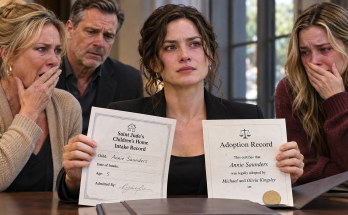
That evening, I returned home and opened my folder.
The Saint Jude’s intake record was still there.
So was the adoption paperwork.
I studied the two documents side by side.
One recorded the arrival of a child whose biological parents had decided they could no longer keep her.
The other recorded the beginning of a family that had chosen to make that child their own.
Neither document told the entire story.
There were thirty years between the frightened little girl and the woman sitting at my desk.
Thirty years filled with ordinary moments.
Love.
Mistakes.
Learning.
Growing.
Living.
I returned the documents to the folder and put it away.
I didn't destroy them.
They belonged to my history.
But I no longer needed to keep looking at them to understand who I was.
Gail and I never developed the relationship she had suddenly claimed to want.
Vince and I occasionally exchanged messages.
I accepted that he was trying to acknowledge his mistakes, but I maintained my boundaries.
Tori continued recovering and receiving medical care.
We remained in each other's lives.
Not because our biological parents had arranged it.
Because we had chosen it ourselves.
Sometimes I still thought about the word Gail had used.
Extra.
I wished I could return to Saint Jude’s and sit beside that little girl.
I wished I could explain that what was happening wasn't a measure of her worth.
That she would meet Michael and Olivia.
That she would have a home.
That she would grow into a woman capable of making decisions nobody could take away from her.
I couldn't go back.
But I could live the rest of my life knowing those things were true.
My biological parents had returned because they wanted a kidney.
They had expected me to provide something valuable enough to justify my place in their family.
Instead, I had kept my kidney.
I had kept my dignity.
And I had kept the right to decide what love would mean in my life.
My name was Annie Kingsley.
I was thirty-five years old.
I was Michael and Olivia's daughter.
I was Tori's sister because we had decided to build a relationship, not because somebody had demanded it.
And I was nobody's spare part.
I had never been extra.
The End
Read more original stories on Feel Every Story.
My Mother Had Spent an Entire Week Telling People She Lost Her Daughter, but the Documents in My Hands Told a Different Story
Part 10 of 10

0 Comments on “PART 10 – Thirty Years After They Left Me Behind, I Finally Understood That Being Wanted for What I Could Give Was Never the Same as Being Loved”