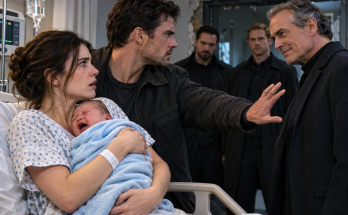
The following morning, Rachel called before I had finished feeding Noah.
Logan answered my telephone.
He listened for a moment, then handed it to me.
"She needs to speak with you."
I pressed the phone against my ear.
"Hello?"
"Joanna, the hospital has responded to our correspondence."
My stomach tightened.
"What did they say?"
"They dispute your description of the attempted transfer."
"Of course they do."
"They're also maintaining that additional medical evaluation was recommended for your newborn."
I looked down at Noah.
He was perfectly content.
His little hand rested against my skin.
"Recommended by whom?"
"Dr. Mercer appears to have been involved."
I closed my eyes.
"That man wasn't even the doctor who delivered him."
"I know."
Rachel explained that she had requested copies of all relevant medical documentation and communications relating to the proposed transfer.
She had also notified appropriate authorities about the more serious allegations.
"What happens now?"
"We continue to cooperate with legitimate inquiries, and we insist on independent review."
I looked at Logan.
He was watching my face.
Rachel continued.
"The important thing is that Noah receives appropriate medical care and that nobody confuses your objection to unauthorized research with refusal of necessary treatment."
"I would never refuse something he needed."
"I understand."
After the call ended, I sat there for several minutes.
I had never imagined needing an attorney to explain that I loved my own child.
Logan brought me breakfast.
Scrambled eggs.
Toast.
An apple cut into slices.
I looked at the apple.
For some reason, I remembered the grocery list still attached to our refrigerator.
The one from the morning he disappeared.
"Do you remember what you were supposed to buy that day?"
He stopped.
"What day?"
"The day you left."
He nodded slowly.
"Milk, bread, and apples."
I began crying.
It was such a small thing to remember.
And for three months, I had wondered whether he had forgotten everything about me.
He placed the plate beside my bed.
"I thought about that list every day."
I wiped my face.
"Why?"
"Because I kept thinking about you waiting for me to come home."
He sat beside me.
"I thought about how I'd promised to make dinner."
I remembered that promise.
We had planned to eat together and assemble the baby's changing table.
Instead, I had eaten alone.
The changing table remained in its box for nearly two weeks.
Eventually, I put it together myself.
I had been proud of that.
And miserable.
"I don't want you making decisions like that for me again," I told him.
"I won't."
"Even if you think you're protecting me."
He nodded.
"I understand."
It wasn't forgiveness.
Not yet.
But it was the beginning of an agreement between two people who had spent too much of their lives having choices made for them.
Daniel arrived later that morning.
He carried another folder.
The sight of it made me uneasy.
"I've found something concerning your adoption."
I put my breakfast aside.
Logan moved closer.
Daniel explained that certain archived records had been identified through documentation connected to the program.
Among them were references to placements made during the period when I was adopted.
He opened the folder.
The first page contained my adoptive parents' surname.
I recognized it immediately.
My hands went cold.
"Where did you get this?"
"From the records we've been reviewing."
He showed me a copy of a placement document.
It contained my first name, an approximate age, and a reference to a private placement organization.
There were signatures near the bottom.
I recognized my father's handwriting.
I would have recognized it anywhere.
He used to write my name on the inside of my schoolbooks.
His capital letters always leaned slightly backward.
I touched the signature.
"That's him."
Daniel nodded.
"There are additional forms."
I didn't want to see them.
I wanted to see them more than anything.
He turned the page.
The next document described my placement as part of a long-term medical observation arrangement.
I read the sentence slowly.
Then again.
"Did they agree to that?"
Daniel pointed toward a section outlining the information provided to the receiving family.
It referred to routine pediatric follow-up and a previous history of institutional care.
There was no explicit mention of experimental research.
No explanation of a multigenerational study.
Nothing suggesting that my adoptive parents understood the full purpose behind my placement.
I looked at Evelyn.
"Is this what you meant?"
She nodded.
"The families weren't always told the truth."
Daniel showed me another document.
It was a copy of a letter sent to the placement organization several years after my adoption.
My mother's name appeared at the top.
I recognized the way she began formal letters.
To Whom It May Concern.
She had used that phrase whenever she complained about a utility bill or questioned a school policy.
I read the letter.
She had objected to repeated requests for additional medical information about me.
She wanted to know why a former placement agency was still requesting details about a child whose adoption had been finalized.
She had asked whether there was any legal obligation to provide those details.
My eyes began filling.
"She questioned them."
Daniel nodded.
"Apparently."
I continued reading.
My mother had written that her daughter was healthy and receiving appropriate medical care.
Her daughter.
Those two words hurt more than the rest of the page.
She hadn't called me a subject.
She hadn't referred to a number.
She had called me her daughter.
At the bottom, she requested that unnecessary contact concerning my medical history cease.
I put the letter down.
For a moment, I couldn't speak.
Logan rested his hand on my shoulder.
I thought about all the times I had wondered whether my parents had known something they hadn't told me.
Now I had evidence that my mother had pushed back when she recognized something unusual.
She hadn't understood everything.
But she had protected me in the ways she could.
"I wish she was here."
My voice broke.
Evelyn looked away.
I cried until my chest hurt.
Daniel didn't rush me.
He left the documents on the table.
When I finally picked them up again, I noticed something else.
There was an internal annotation associated with the correspondence.
FAMILY RESISTANT TO CONTINUED REPORTING.
I let out a small, bitter laugh.
My mother would have hated that description.
She had been stubborn about things that mattered.
She once argued with a school administrator for nearly an hour because a teacher had embarrassed me in front of my classmates.
Apparently, she had argued with these people, too.
Daniel showed me the next page.
The requests for information had become less frequent.
Eventually, the formal correspondence stopped.
But the internal references to my subject number continued.
"Does that mean they were still watching me?"
Daniel folded his hands.
"It means they continued maintaining records associated with you. We don't yet know the full extent of their access to information."
I appreciated the distinction.
I was frightened enough without imagining strangers standing outside every window of my childhood home.
"What about Logan?"
Daniel looked toward him.
"I found transfer records associated with C-18."
Logan sat down.
The pages listed several institutional placements over the years.
Some dates matched fragments of his childhood memories.
He recognized the name of one facility.
"That's where they used to take us for examinations."
Daniel made a note.
Another record referred to his eventual release from supervised care.
There were restrictions and administrative references that nobody had ever explained to him.
Logan stared at the pages.
"Did they know where I went afterward?"
Daniel looked at him.
"Some records appear to have been updated after you left."
Logan leaned backward.
He looked exhausted.
I wondered whether he was remembering every apartment he had lived in.
Every job.
Every attempt to start over.
"Why didn't they just let me disappear?" he asked.
Daniel pointed toward a section discussing future reproductive outcomes.
"They considered your biological history relevant to their ongoing objectives."
Logan laughed once.
There was no amusement in it.
"I was a grown man."
I took his hand.
"You still are."
He looked at me.
"They don't get to change that."
Daniel then showed us something neither of us expected.
A chronology of information associated with our relationship.
There were references to our shared address.
A notation concerning my pregnancy.
And a later entry describing an unassisted conception between individuals connected to the original research cohort.
I read it several times.
"Did they arrange for us to meet?"
Daniel shook his head.
"We haven't found evidence establishing that."
"But they knew we were together."
"At some point, yes."
I looked at Logan.
The grocery store.
The broken pasta sauce jar.
The coffee afterward.
I wanted to keep those memories.
I didn't want to surrender them to suspicion.
"Could it have been an accident?" I asked.
"Your meeting?"
"Yes."
"Absolutely."
I breathed out.
Daniel continued.
"The evidence indicates that your relationship became significant to the program once they learned about it. That doesn't establish that they created it."
Logan looked at me.
I squeezed his hand.
It wasn't absolute certainty.
But it was a reason to stop blaming ourselves for something nobody had proved.
That afternoon, Rachel returned.
Daniel showed her the placement documents and the letter from my mother.
She read them carefully.
"This is useful."
I looked at the letter.
"Useful doesn't seem like the right word."
Rachel nodded.
"I understand."
She explained how the records might help establish what information had been withheld from my adoptive family.
They could also help connect the historical program with the current interest in Noah.
I asked whether the authorities had responded.
"An investigator has been assigned to review the allegations."
"Will we speak with them?"
"Yes, if you're willing."
I nodded.
Evelyn looked nervous.
Rachel reminded her that she should have independent legal advice before providing detailed testimony about her own conduct.
Evelyn accepted that.
She didn't withdraw her promise.
"I'll still tell them what happened."
Rachel looked at her.
"Then make sure you tell them accurately."
Later, I received an ordinary appointment confirmation for Noah's follow-up examination.
I stared at the message.
It contained his name, the appointment time, and the doctor's contact information.
Nothing about a research designation.
Nothing about extraordinary biological characteristics.
Just a medical appointment for a little boy.
I showed Logan.
He smiled.
It was the first real smile I had seen from him since he arrived at the hospital.
We took Noah to the appointment with arrangements Rachel had helped coordinate.
Dr. Bennett examined him again.
She checked his weight, feeding, and general condition.
She also checked on me.
I answered every question.
I agreed to the follow-up care she recommended.
When she finished, she documented her findings.
"You're doing a good job with him."
I began crying again.
By then, I seemed capable of crying at almost anything.
Dr. Bennett handed me a tissue.
"Being a new mother is difficult enough without everything else you're dealing with."
I nodded.
I had forgotten that ordinary motherhood was supposed to be challenging.
Sleepless nights.
Feeding.
Learning what different cries meant.
Nobody should have had to add twenty-nine years of concealed history to those responsibilities.
Back at the house, I changed Noah's clothes.
One of the tiny socks from my suitcase slipped beneath the sofa.
Logan got down on his knees to retrieve it.
He held it up.
"How do something this small and somebody this little create so much laundry?"
I laughed.
It surprised both of us.
For a few seconds, I felt normal.
Then Logan smiled.
I wanted more moments like that.
Not because they erased what had happened.
Because they reminded me what we were fighting to preserve.
That evening, I placed my mother's letter beside the photograph of the children.
One document showed how my childhood had begun.
The other showed a woman who had refused to let strangers decide what belonged to her daughter.
I read the letter one more time.
Then I put it inside the suitcase.
I could no longer ask my mother what she had known.
But I had found something of her that had survived.
Her voice.
Her stubbornness.
Her refusal to treat me as anything other than her child.
I looked at Noah sleeping beside me.
I hoped that someday, if he ever needed to examine the records of his beginning, he would find the same thing.
Evidence that somebody had stood up for him.
Evidence that somebody had said no.
Click here to continue reading: PART 8: When the Investigators Finally Asked Dr. Mercer to Explain the Program, I Learned What He Believed My Son Had Been Born to Prove
I Arrived at the Hospital With Nobody Beside Me, but the Nurse Who Read My Admission Papers Already Knew My Name
Part 7 of 10