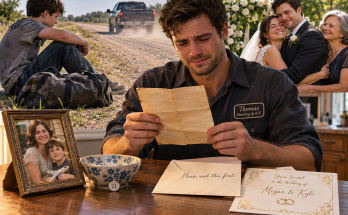
I arrived twenty minutes early on Saturday.
The coffee shop was on a quiet street near my office, between a pharmacy and a little bookstore that opened at ten.
I chose a table near the window.
From there, I could see the entrance.
Old habits.
I ordered coffee and took my phone from my pocket.
Megan had sent a message saying she was five minutes away.
I wondered whether I would recognize her.
Photographs were one thing.
Meeting someone who shared half your blood was another.
When the door opened, a young woman wearing a cream-colored sweater stepped inside.
She looked around the room.
Then she saw me.
“Thomas?”
I stood.
“Megan?”
She smiled nervously.
For a moment, neither of us knew whether to shake hands or hug.
We settled for sitting down.
She placed her handbag beside her chair and tucked a loose strand of hair behind her ear.
There was something familiar about that movement.
My father used to push his hair back when he was uncomfortable.
I wished I hadn't noticed.
“Thank you for coming.”
I nodded.
“Thank you for asking.”
She ordered a coffee and returned to the table carrying two napkins she didn't need.
She folded one while we talked.
“How's your business?”
“Busy.”
“That's good, right?”
“Most of the time.”
She smiled.
I could tell she was trying to find somewhere safe to begin.
So was I.
She asked about Diane.
I told her that my aunt was doing well.
Then Megan looked down at her coffee.
“I've been thinking about what you said on the phone.”
I waited.
“About Dad.”
There it was.
The reason we were sitting together.
I placed both hands around my cup.
“What exactly did he tell you?”
She looked uncomfortable.
“That you were angry after your mother died.”
I nodded slowly.
“What else?”
“That you became difficult to handle.”
I looked through the window.
A man was walking a small dog along the sidewalk.
I watched them pass before looking back at her.
“Anything else?”
“He said Aunt Diane encouraged you to leave.”
I almost laughed.
Not because it was funny.
Because I could imagine him saying those words without ever mentioning the truck.
Megan continued.
“He said you didn't want to be part of our family.”
I looked directly at her.
“I was thirteen.”
“I know.”
“I didn't have a choice.”
She stopped folding the napkin.
“What happened?”
I told her about that summer.
About the two weeks with Diane.
About the drive.
I told her how my father had turned onto a road I didn't recognize and ordered me out.
She listened without interrupting.
When I described him driving away, she placed her coffee cup on the table.
“He actually left you there?”
“Yes.”
“Completely alone?”
“Yes.”
She stared at me.
I could see her trying to fit those words into everything she believed about her father.
“How far were you from home?”
“I didn't know.”
“Did you have a phone?”
“No.”
“Money?”
“A little change, probably.”
Her mouth opened.
Nothing came out.
I continued.
I told her about walking until I reached the gas station.
About the woman behind the counter.
About Diane arriving and taking me home.
When I finished, Megan was crying.
She wiped her face quickly.
“I'm sorry.”
I shook my head.
“You don't need to apologize.”
“But he told us something completely different.”
“I figured.”
She looked toward the entrance.
“Did he ever come to Diane's house?”
“No.”
“Did he call?”
“No.”
“Not once?”
“Not once.”
She lowered her head.
I gave her a minute.
People had reacted to my story before.
Some became angry.
Some tried to explain my father's behavior.
Others told me that time healed everything.
Megan didn't do any of those things.
She simply sat there and cried.
Eventually, she spoke.
“He always told me family was the most important thing.”
I looked at my coffee.
“Maybe it was important when he got to decide what family meant.”
She nodded.
Then she said something that surprised me.
“I used to wonder why you hated me.”
I looked up.
“What?”
“When I was younger.”
She rubbed the edge of the napkin between her fingers.
“I thought maybe you were upset because Dad married my mom.”
I shook my head.
“I never hated you.”
“He said you didn't want a little sister.”
I felt something tighten inside my chest.
“I didn't even know you properly existed until years later.”
She looked at me.
“Really?”
“Really.”
For a moment, she appeared relieved.
Then she became angry.
Not with me.
With the years she had spent believing something that wasn't true.
“He could've just told me.”
I didn't answer.
There wasn't much to add.
She reached into her handbag and removed a small photograph.
“I brought this.”
She slid it across the table.
It showed my mother sitting on the front steps of our old house.
I was standing beside her, holding a plastic airplane.
I remembered the airplane.
One wing had broken.
My mother had repaired it with glue.
“Where did you find this?”
“In the same box as the letter.”
I picked up the photograph.
My mother was smiling.
I couldn't remember the last time I had seen a photograph of her looking so healthy.
“Can I keep it?”
“Of course.”
I slipped it carefully into my wallet.
Megan watched me.
“There are more pictures.”
I looked at her.
“Dad has them?”
“Yes.”
“Does Cheryl know?”
“I think so.”
She hesitated.
“Mom doesn't like talking about anything that happened before she married him.”
That sounded familiar.
Cheryl had always treated my mother's memory as something belonging to a different household.
Something that had no place in the one she was building.
Megan took another sip of coffee.
“Can I ask you something?”
“Sure.”
“Was my mom mean to you?”
I thought carefully before answering.
“She wasn't cruel in the same way Dad was.”
Megan waited.
“But she never protected me, either.”
Her expression changed.
I continued.
“She knew I was unhappy. I think she decided it wasn't her responsibility.”
Megan looked down.
I didn't enjoy telling her that.
Cheryl was her mother.
Whatever Cheryl had failed to give me, she might have given Megan everything.
I didn't want to punish Megan for that difference.
“She loves me,” Megan said quietly.
“I believe you.”
“She was always there when I needed her.”
I nodded.
“I'm glad.”
And I meant it.
That surprised me.
Years earlier, hearing those words might have made me bitter.
Now I understood that Megan having a good childhood wouldn't have made mine worse.
My father had made his own choices.
So had Cheryl.
Megan hadn't made either of them.
She asked about my mother.
I told her about the ceramic bowl with blue flowers.
About the books we read together.
About the orange juice I spilled when I tried to make breakfast.
Megan laughed softly.
“She sounds lovely.”
“She was.”
“Do you remember her voice?”
I took a moment.
“Sometimes.”
That answer hurt more than I expected.
There were things I remembered clearly.
Others had become faint.
I knew my mother had laughed easily.
But sometimes I couldn't remember exactly what that laughter sounded like.
Megan reached across the table.
She stopped before touching my hand.
I noticed that.
She was giving me the choice.
I turned my hand over.
She held it briefly.
Then she let go.
We talked about ordinary things after that.
Her job.
Her wedding.
The apartment she shared with Kyle.
She told me Kyle worked for a construction company and was terrible at remembering where he left his keys.
I told her about my service vans.
She laughed when I explained that one of them seemed determined to bankrupt me.
For the first time that morning, we weren't discussing our father.
We were simply two people getting acquainted.
It felt good.
Unexpectedly good.
Eventually, Megan looked at her phone.
“I should probably get going.”
I nodded.
She began gathering her things.
Then she stopped.
“There's something else I need to tell you.”
I waited.
“Dad found out I invited you.”
My shoulders tightened.
“How?”
“He saw your name on the guest list.”
“What did he say?”
She looked uncomfortable.
“He told me to remove it.”
I wasn't surprised.
“Did you?”
“No.”
She looked straight at me.
“It's my wedding.”
I smiled slightly.
“That sounds reasonable.”
“He said inviting you would make everyone uncomfortable.”
I looked toward the window again.
Of course it would.
For eighteen years, my absence had allowed him to control the explanation.
My presence would make that harder.
Megan continued.
“I told him I wanted to meet you.”
“And?”
“He said you'd fill my head with lies.”
I laughed once.
A short, unpleasant sound.
“That's convenient.”
She nodded.
“I thought so, too.”
She placed her handbag over her shoulder.
“I'm not asking you to come to the wedding if you don't want to.”
“I appreciate that.”
“But I'd like you there.”
I looked at her.
“Why?”
“Because you're my brother.”
Four simple words.
I wasn't prepared for them.
She hadn't said because it would make Dad happy.
She hadn't said because appearances mattered.
She hadn't said because family members were supposed to forgive one another.
She simply called me her brother.
I looked down at the table.
“I'll think about it.”
“That's enough.”
Outside, we stood beside our cars.
This time, when she opened her arms, I hugged her.
It was awkward.
Neither of us quite knew how long it should last.
But it was real.
Before she left, she asked whether she could call me again.
“Yes.”
She smiled.
“Good.”
I watched her drive away.
Then I sat inside my van for several minutes.
I took the photograph from my wallet.
My mother was looking toward whoever had taken the picture.
I was looking at the airplane.
I wondered if my father had taken it.
Perhaps he had.
Perhaps there had been a time when he had been happy watching us together.
I didn't know.
I drove to Diane's house.
She was watering the plants beside her porch.
When she saw me, she turned off the hose.
“Well?”
I climbed out.
“I like her.”
Diane smiled.
“That's good.”
I handed her the photograph.
She examined it.
“Oh, I remember that airplane.”
“You do?”
“Your mother spent half an afternoon fixing it.”
I laughed.
Diane looked at the picture again.
“I'm glad you have this.”
We went inside.
She made lunch while I told her about Megan.
I explained what my father had told her.
Diane stopped cutting a tomato.
“He said I kept you away?”
“Yes.”
She shook her head.
“I gave him every opportunity to contact you.”
I looked at her.
“What do you mean?”
She set down the knife.
“When I received custody, I told him he could arrange contact through me if he was willing to behave responsibly.”
“He never asked?”
“Not once.”
I sat down.
There was something terrible about hearing it confirmed again.
Diane opened a kitchen drawer and removed a small notebook.
She had always kept records of telephone numbers, appointments, and important conversations.
She turned several pages.
Then she pointed to an old entry.
There was my father's name.
A date.
A short description of a telephone conversation.
It recorded her offer to arrange supervised contact.
Beside it, she had written that Ray declined.
I looked at the date.
It was three weeks after he abandoned me.
“Why did you keep this?”
“Because I was responsible for you.”
I touched the page.
My father's version had been a lie from the beginning.
He hadn't been prevented from seeing me.
He had chosen not to.
Diane closed the notebook.
“Would you like a copy?”
“Yes.”
She nodded.
“I'll make one.”
That evening, Megan sent me a message asking whether I had arrived home safely.
I smiled when I read it.
Someone from my father's household had finally asked me that question.
Eighteen years late.
But this time, it wasn't him I had been waiting to hear from.
Click here to continue reading: PART 6: My Father Called After Eighteen Years of Silence, but the First Thing He Asked About Was Not How I Had Been
My Father Left Me on an Empty Road When I Was Thirteen, but Leaving Him Behind Took Much Longer
Part 5 of 10