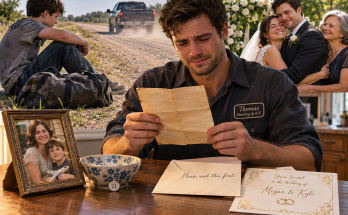
For a long time, I thought my father would come back for me.
That was the hardest thing to admit.
Not that he had abandoned me.
Not that he had driven away while I stood beside a dirt road with everything I owned stuffed into a blue duffel bag.
It was that I had waited.
Even after everything he had done, I had waited for him.
“Get out, Thomas.”
I looked at my father.
His truck was still running, and his right foot was pressed against the brake.
“What?”
“You heard me.”
I glanced through the passenger window.
There was a wooden fence, a field of dry grass, and a road that seemed to disappear into the August heat.
“Where are we?”
“Get out of the truck.”
I was thirteen years old.
I knew when my father was angry, but I didn't always understand why.
That afternoon was one of those times.
My duffel bag was between my feet.
I picked it up.
“Dad?”
He finally turned toward me.
“Do I need to tell you again?”
I opened the door.
The heat reached me before my shoes touched the gravel.
I pulled my bag out and stood beside the truck.
My father leaned toward the open passenger door.
“Walk home. Maybe you'll learn something about being a man.”
I couldn't think of anything to say.
He reached across, pulled the door shut, and drove away.
Just like that.
I watched the back of his truck until it disappeared around a bend.
There was dust everywhere.
Some of it settled on my shoes.
I remember looking down at them and thinking Aunt Diane would be disappointed because she had helped me clean them that morning.
A ridiculous thing to worry about.
But I was thirteen, and I was trying to make sense of something that didn't make sense.
I stood there for a while.
I expected him to turn around.
Maybe this was supposed to frighten me.
Maybe he wanted me to understand how much trouble I was in before he came back.
I would apologize.
I would promise to behave differently.
I would stop visiting Aunt Diane if that was what he wanted.
I was prepared to promise almost anything.
Another few minutes passed.
Then a few more.
No truck.
No father.
Just the sound of insects coming from the field.
I put my duffel bag over my shoulder and started walking.
My father's name was Ray.
He was a roofer who could spend ten hours working beneath the summer sun and still find enough energy to complain about the way I held a fork.
He had strong hands.
I remember that about him.
When I was little, I used to put my hand inside his and marvel at how much larger his fingers were.
I thought hands that big could protect me from anything.
My mother had believed something similar once.
Her name was Laura.
She died when I was eight, after being diagnosed with ovarian cancer.
She was thirty-one.
Most of my memories of her were ordinary ones.
The way she folded towels.
The sound of her slippers moving down the hallway.
How she used to cut an apple into thin slices because I didn't like biting into the whole thing.
She had a small ceramic bowl with blue flowers painted around its edge.
She kept loose buttons in it.
Sometimes I sat beside her while she repaired my father's work shirts.
“People throw too many things away,” she once told me.
“If something can be fixed, you should try.”
I remembered those words for years.
Probably longer than I should have.
Toward the end of her illness, she spent most afternoons in bed.
I brought books into her room and read quietly beside her.
Sometimes she fell asleep.
Sometimes she asked me to keep reading even when I knew she wasn't paying attention.
I didn't mind.
Being near her was enough.
The morning she died, Aunt Diane came into my bedroom.
She sat on the edge of my mattress and took my hand.
I knew something was wrong because she didn't tell me to get dressed.
She told me my mother wasn't hurting anymore.
I asked when she was coming home.
Diane closed her eyes.
That was when I understood.
At the funeral, I cried so hard that my shirt collar became damp.
My father stood beside me without touching me.
Later that evening, after everyone had left, he called me into the kitchen.
“You embarrassed me today.”
I thought I had misunderstood him.
“What did I do?”
“All that crying.”
I looked at the floor.
“She was my mom.”
“And she was my wife.”
He opened the refrigerator.
“You didn't see me carrying on like that.”
I went to my bedroom and shut the door.
That night, I cried into my pillow so he wouldn't hear me.
It became a habit.
My father didn't like noise unless he was the one making it.
He didn't like questions unless he already knew the answers.
And he particularly disliked anything that reminded him I was still a child.
I learned to keep my problems small.
If I fell at school, I cleaned the scrape myself.
If I needed money for a field trip, I waited until the last possible moment to ask.
When I received a good report card, I left it on the kitchen table instead of bringing it directly to him.
Sometimes he signed it.
Sometimes I had to remind him.
There was never much conversation about what I wanted to become.
He assumed I would eventually work with my hands.
I liked reading.
I liked figuring out how things worked.
I liked sitting somewhere quiet with a book and forgetting where I was.
To him, that meant I was avoiding real life.
“You won't earn a living hiding behind paper.”
He told me that more than once.
When I was ten, my father married Cheryl.
She was younger than him, wore her hair just above her shoulders, and always seemed concerned about keeping the house presentable.
I remember meeting her at a restaurant.
She smiled when my father introduced us.
“Your dad tells me you're a good student.”
I nodded.
My father laughed.
“He's good at sitting still.”
Cheryl smiled again, although she didn't seem to know whether she was supposed to find that funny.
She wasn't openly cruel to me.
That almost made things more confusing.
She bought groceries.
She washed my clothes.
She reminded me to put my dishes in the sink.
But she never sat beside me simply because I looked unhappy.
She never asked what I remembered about my mother.
When she rearranged the living room after moving in, several photographs disappeared.
One of them showed my mother holding me at a picnic.
I found it inside a cardboard box in the hall closet.
I took it to my bedroom.
Nobody noticed.
Or nobody cared enough to mention it.
Aunt Diane was different.
She was my mother's older sister and lived in a little house near a lake.
The front steps needed painting.
The screen door stuck in damp weather.
Her kitchen smelled like coffee almost every morning.
I loved that house.
At Diane's table, I could speak without rehearsing everything first.
She asked questions because she wanted answers.
“How was school?”
“Fine.”
“Only fine?”
I would tell her about something that happened in class.
Then something else.
Sometimes I talked until my breakfast was cold.
She never told me I was wasting her time.
One Saturday morning, she taught me to cook scrambled eggs.
I turned the burner too high.
The eggs stuck to the pan.
I waited for her to become angry.
Instead, she handed me a wooden spoon.
“Lower heat next time.”
That was all.
I stared at her.
She noticed.
“What?”
“Nothing.”
We ate toast instead.
When I was older, I realized how much that morning had mattered.
She had allowed me to make a mistake without making me feel like one.
My father didn't approve of the time I spent with her.
He said she interfered.
He said she encouraged me to feel sorry for myself.
Sometimes he complained about her while I was standing right there.
“Your aunt thinks she knows everything about raising children.”
I didn't answer.
“She's never had any of her own.”
I wanted to say she was doing a better job than he was.
I never did.
I was frightened of him.
That summer, when I was thirteen, Diane invited me to spend two weeks at her house.
We went fishing.
We visited the library.
She helped me work through math problems that had confused me during the previous school year.
For two weeks, I almost forgot what it felt like to be afraid of coming home.
Then my father arrived.
I had already packed my duffel bag.
Diane walked me outside.
“Call me when you get home.”
My father heard her.
“He doesn't need to report to you.”
She looked at him.
“I just want to know he arrived safely.”
“He's with his father.”
There was something in the way he said it that made her uncomfortable.
I could see it.
She squeezed my shoulder before I climbed into the truck.
“I'll see you soon, sweetheart.”
My father pulled out of her driveway before I had fastened my seat belt.
We drove in silence.
I looked out the window and watched the familiar buildings become fields.
After a while, he spoke.
“Did you have fun?”
“Yes, sir.”
“Bet you wish you lived there.”
I didn't know what answer he wanted.
“No, sir.”
“Don't lie to me.”
I swallowed.
“I wasn't.”
He tightened his grip on the steering wheel.
We didn't speak again for a long time.
Then he turned onto a narrow road I didn't recognize.
And eventually, he told me to get out.
As I walked along that road, I kept moving my bag from one shoulder to the other.
My shirt stuck to my back.
Small stones worked their way into my shoes.
I stopped once beneath a tree, but there was barely enough shade to cover my feet.
I didn't have a phone.
I didn't know exactly how far I was from home.
I knew only that continuing seemed better than standing still.
Nearly two hours later, I saw a gas station.
There was a faded advertisement beside the road and an ice freezer near the entrance.
I nearly cried when I saw the building.
Inside, a woman stood behind the register.
She looked at my red face and dusty clothes.
“Are you all right, honey?”
I nodded automatically.
Then I shook my head.
“Can I use your telephone?”
She brought it across the counter.
I dialed Diane's number from memory.
When she answered, I struggled to speak.
“It's Thomas.”
“Sweetheart?”
I told her where I was.
She asked whether I was hurt.
I said I wasn't.
“Stay right there.”
I expected her to ask what had happened.
She didn't.
The woman behind the counter gave me a cup of water and told me I could sit near the window.
I held the cup with both hands.
Eventually, Diane's car appeared.
I recognized it before she turned into the parking lot.
She came through the door so quickly that the little bell above it rattled twice.
She looked at me.
Then at my bag.
Then at my shoes.
“Oh, Thomas.”
I stood up.
“I'm sorry.”
Her expression changed.
“What are you apologizing for?”
I couldn't answer.
She placed both hands on my shoulders.
“You haven't done anything wrong.”
I started crying.
Not quietly.
Not carefully.
I cried in front of her, the woman behind the counter, and a customer who had just walked inside.
Diane held me.
She didn't look embarrassed.
When I finally stopped shaking, she picked up my duffel bag.
“We're going home.”
I wiped my face.
“Is Dad going to be there?”
“No.”
She looked directly into my eyes.
“You're coming home with me.”
Click here to continue reading: PART 2: My Aunt Gave Me a Place to Call Home, While My Father Made a Decision I Spent Years Trying to Understand
My Father Left Me on an Empty Road When I Was Thirteen, but Leaving Him Behind Took Much Longer
Part 1 of 10