I had always imagined that the happiest day of my life would be the day I became a mother.
I never imagined that, before my baby was even born, I would have to confront how little I knew about the future.
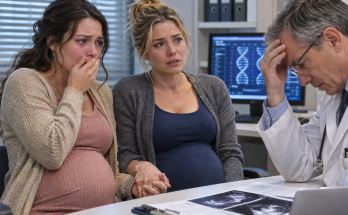
I was sitting in the genetics clinic beside Emily.
The doctor's computer was still displaying our test results.
Two pregnancies.
One sperm donor.
Two babies we had wanted more than anything.
And a medical finding that nobody had yet explained conclusively.
I kept looking at the screen.
Part of me expected the answer to become obvious if I stared long enough.
But nothing changed.
I couldn't understand the information.
And I couldn't force myself to understand it.
The doctor had already told us that the findings were unusual.
He had said confirmation was necessary.
He had explained that the results could have important implications for our children's future.
That was all.
No confirmed diagnosis.
No established explanation.
No certainty about what would happen next.
I thought about how different that was from the future I had imagined.
For years, motherhood had been something I hoped would happen.
Something that seemed to move farther away every time a relationship ended.
My marriage had failed five years earlier.
I had spent so much time rebuilding my life afterward that I sometimes wondered whether I would ever have the family I wanted.
Then Emily suggested something extraordinary.
We could become mothers together.
We could use the same donor.
And our babies could share the same biological father.
I remembered laughing when she first said it.
The idea had seemed impossible.
But she was serious.
And slowly, I began to see the future she was describing.
Two mothers who had been best friends for twenty-five years.
Two children growing up close together.
A family connection created through the same biological father.
It had seemed like a beautiful way to continue the friendship that had shaped our lives.
Our mothers had always said we behaved like sisters.
Emily wanted our children to have the biological relationship we didn't share ourselves.
I wanted that too.
We made our decision.
We completed medical consultations and tests.
And after months of preparation, we chose Daniel.
He was thirty-five years old.
He had been described as healthy.
He had agreed to become a donor.
I remember how relieved I felt when everything was arranged.
I believed we had been careful.
I believed we had asked the right questions.
And I believed the medical process had helped us make a responsible decision.
Then both pregnancies happened.
Three weeks apart.
I had never been so happy.
Emily and I talked constantly about our babies.
We imagined names.
We bought little clothes.
We discussed how our children might grow up together.
I thought the hardest part was behind us.
I thought all that remained was waiting for our babies to arrive.
But then the fifth month came.
And the genetics clinic called.
I could still remember the nurse's voice.
The hesitation when I asked whether something was wrong.
The request for both Emily and me to come in.
The feeling in my stomach when I realized she wasn't going to explain anything over the phone.
I remembered entering the doctor's office.
I remembered seeing our test results side by side.
I remembered the way he looked at them.
Then at us.
Then back at the screen.
I remembered him closing the door.
And I remembered the question that made my heart pound.
Was the same donor used for both pregnancies?
Yes.
Of course.
That was our plan.
But our answer did not reassure him.
He looked pale.
He asked whether we understood what the genetic similarities might mean.
And suddenly, the connection we had celebrated became something I was afraid to discuss.
I wanted to know whether our babies were sick.
I wanted him to tell me they weren't.
But the findings still needed confirmation.
That uncertainty remained.
I looked at Emily.
She was still sitting beside me.
For twenty-five years, we had faced so much together.
School.
First love.
Heartbreak.
The difficult years when adulthood didn't turn out as we expected.
She had never been just another friend.
She was the person I called when something wonderful happened.
And the person I wanted beside me when something went wrong.
Now we were sitting together in one of the most frightening moments of our lives.
And neither of us knew what to say.
I wanted to promise her everything would be all right.
I wanted to tell her that our children would be healthy.
That the results were nothing to worry about.
That we would soon return to shopping for baby clothes and discussing names.
But I couldn't promise any of those things.
I didn't know.
That was the truth.
And for once, I was willing to admit it.
I thought about how often I had tried to reassure myself during pregnancy.
Daniel was healthy.
We had followed the medical process.
We had completed consultations and tests.
We had both become pregnant.
Each fact had given me confidence.
But none of them could guarantee that every future medical finding would be straightforward.
I understood that now.
I had wanted to believe that doing everything carefully meant nothing unexpected could happen.
But pregnancy didn't work that way.
Neither did life.
I should have known.
My divorce had already taught me that plans could change.
It had taught me that wanting a particular future wasn't the same as being promised one.
Yet somehow, when Emily and I became pregnant, I had forgotten that lesson.
I had started imagining years ahead.
I imagined our children playing together.
I imagined them sharing birthdays and ordinary childhood memories.
I imagined them growing up knowing they were related.
I had made their future so clear in my mind that it almost felt real.
But it wasn't.
Not yet.
The only things that were real were the pregnancies.
The babies growing inside us.
And the responsibility we already carried.
I looked down at my stomach.
For the first time that morning, I stopped trying to imagine everything that might happen.
I thought about the child I was carrying.
Not as the baby who would complete the family I wanted.
Not as Emily's baby's future sibling.
Not as proof that our unusual plan had succeeded.
Simply as my child.
A person I had not met.
A person whose life would be more complicated and more important than any dream I had created.
I felt tears in my eyes again.
I didn't try to stop them.
I had spent the morning trying to be composed.
Trying to understand.
Trying not to frighten Emily.
But I was frightened too.
And I didn't need to pretend otherwise.
I reached for her hand.
She held mine.
There was no speech.
No promise.
Nothing dramatic.
Just two women sitting together because neither wanted the other to face that moment alone.
I remembered the first time we talked about becoming mothers as young girls.
We had imagined the happiness.
The babies.
The families we would one day have.
We hadn't imagined medical uncertainty.
We hadn't imagined waiting for genetic findings to be confirmed.
We hadn't imagined how frightening it could be to love children before they were born.
But perhaps that was part of what becoming a mother meant.
Not knowing everything.
Not controlling everything.
And still being willing to face what came next.
I thought about the way I had treated our children's biological connection as something almost magical.
I had believed shared genes would give them a bond stronger than ordinary friendship.
But Emily and I had spent twenty-five years proving that love didn't need a biological explanation.
We weren't related.
We didn't share a father.
We didn't share a mother.
Yet she had been part of nearly every important stage of my life.
I had never needed a genetic test to understand what she meant to me.
So why had I placed so much importance on that for our children?
I considered the question carefully.
The biological relationship still mattered.
It was part of their history.
Part of the decision we had made.
But it wasn't the whole story of who they would become.
They would have their own personalities.
Their own feelings.
Their own relationships.
They might grow close.
They might become very different people.
And they deserved the freedom to discover that for themselves.
I realized that I had been treating their future as though Emily and I could write it before they were born.
We couldn't.
We could make decisions about how to care for them.
We could support them.
We could tell them the truth about their origins.
But we couldn't decide every part of their lives.
And we certainly couldn't make medical uncertainty disappear by wanting a happy outcome.
I looked at the doctor again.
He had not provided the final answer we needed.
The genetic findings were still unconfirmed.
I didn't know whether they would eventually reveal a medical problem.
I didn't know whether the concern would be resolved.
And I didn't know exactly what the unusual results meant.
Those questions remained open.
I couldn't honestly turn them into an ending that had not happened.
I couldn't say our babies were healthy when no confirmed results had been provided.
I couldn't say something terrible was coming.
And I couldn't claim that an unexpected discovery had changed everything when I didn't know what that discovery was.
All I could do was face what we actually knew.
We were both pregnant.
We had used the same donor.
Our genetic results had raised an unusual concern.
And a doctor with twenty-seven years of experience believed the findings required confirmation.
That was serious.
It deserved careful attention.
But it wasn't yet an explanation.
I took comfort in making that distinction.
Not because it removed the fear.
It didn't.
But because it gave me something solid to hold on to.
Facts.
Not guesses.
Not imagined disasters.
Not promises nobody could make.
I thought about the way the nurse had spoken when she called.
At the time, her silence had seemed like proof that something terrible had happened.
Now I understood that a person could hesitate because an answer was complicated or not yet available.
Silence wasn't a diagnosis.
Concern wasn't confirmation.
And uncertainty didn't automatically mean the worst outcome.
I wished those thoughts made me feel completely calm.
They didn't.
My hands were still tense.
I was still afraid for my baby.
I was still afraid for Emily's.
But I no longer wanted to fill the uncertainty with frightening possibilities.
I wanted accurate information.
I wanted the findings to be properly confirmed.
And I wanted us to understand what they actually meant before making decisions.
That was the only reasonable path I could see.
I looked at Emily.
I remembered how confident we had been when our pregnancies were confirmed.
We had celebrated as though the future had finally rewarded us for everything we endured.
In a way, it had.
We were going to become mothers.
That was still something extraordinary to us.
But I no longer believed happiness meant nothing difficult would happen.
It meant that something precious had entered my life.
Something worth protecting.
Even when protecting it required patience.
Even when I didn't have all the answers.
Even when I had to listen to something frightening and wait for the evidence to become clearer.
I wanted Emily to understand that I wasn't abandoning our dream.
I still wanted our children to grow up together.
I still wanted them to know they shared the same biological father.
I still wanted the closeness we had imagined.
But I no longer wanted that dream to come before their individual needs.
If the confirmed medical findings required us to think differently about their future, we would need to listen.
Not because our original intentions were bad.
But because the children mattered more than our expectations.
I thought about the baby clothes we had bought.
The names we had discussed.
The ordinary little details that had made our pregnancies feel so real.
Those things hadn't become meaningless.
They were still reminders of how much we wanted our babies.
But they couldn't answer the medical questions.
They couldn't tell us whether the unusual genetic findings were important.
They couldn't guarantee an outcome.
I had to let them remain what they were.
Signs of hope.
Not evidence.
That was difficult for me.
I had spent so much of my life trying to make things work according to a plan.
I had planned a marriage.
It ended.
I had imagined becoming a mother through that marriage.
It didn't happen.
Then Emily and I created another plan.
And this time, we both became pregnant.
I had begun to believe the second plan would unfold exactly as we hoped.
Now I was learning to separate what I could choose from what I couldn't control.
I could choose to love my child.
I could choose to seek reliable medical guidance.
I could choose to be honest with Emily.
I could choose not to blame anyone without evidence.
But I couldn't choose what the genetic tests would eventually show.
I couldn't choose how our babies would develop.
And I couldn't choose every part of the future.
I found that frightening.
Then, slowly, I found it clarifying.
Because there was one responsibility that remained the same no matter what the results revealed.
I needed to care for my baby as a person.
Not as the ending to my own story.
Not as a second chance at the family I had lost.
Not as a symbol of my friendship with Emily.
As my child.
I thought about that distinction for a long time.
For years, I had said I wanted to become a mother.
Now I understood that I would have to keep learning what those words meant.
They weren't only about happiness.
They were about responsibility.
They were about telling the truth when it was difficult.
They were about accepting that love did not give me control over another person's future.
And they were about being willing to seek help when I didn't understand something important.
I looked toward Emily again.
She was the same woman who had been beside me for twenty-five years.
The same friend who had imagined motherhood with me.
The same person who had made me believe we could choose a different path when our relationships didn't give us the families we wanted.
I still trusted her.
I still loved her.
But I no longer believed our friendship could solve every problem.
We needed medical knowledge for this one.
We needed confirmed information.
And we needed to make sure that whatever conclusions we reached were based on evidence rather than fear.
The doctor's warning had changed how I looked at our decision.
I no longer saw our shared donor arrangement as something that guaranteed a beautiful future.
I saw it as an important choice we had made.
One that was now part of our children's medical and family history.
A choice we needed to understand as fully as possible.
I didn't know whether I would eventually regret any part of it.
I didn't have enough information to answer that question.
And I wasn't going to pretend otherwise.
I had already spent too much of that morning imagining conclusions before I understood the facts.
I wanted to stop.
I wanted to listen.
I wanted to learn.
And I wanted to be the kind of mother who could face an uncomfortable truth without looking away.
I took another breath.
Emily's hand was still in mine.
The doctor's computer was still open.
The results still needed confirmation.
Nothing about the medical uncertainty had been resolved simply because I had changed the way I thought about it.
That was important to admit.
A personal realization couldn't replace a diagnosis.
It couldn't tell us whether our babies were healthy.
And it couldn't explain the unusual genetic findings.
Those answers remained beyond what we knew.
But I had stopped demanding an immediate happy ending to a question that was still being investigated.
For the first time since the clinic called, I could separate my fear from the facts.
I was frightened.
That was true.
I loved my baby.
That was true too.
Emily loved hers.
And both children deserved careful decisions based on accurate information.
I looked down once more.
I thought about the heartbeat I had once been so excited to hear.
After the clinic called, I had become frightened even by the thought of receiving medical news about my baby.
I wanted every result to be reassuring.
I wanted every appointment to end with someone telling me everything was fine.
But I knew now that the purpose of medical care wasn't simply to reassure me.
It was to help us understand what was happening.
Even when the answer was difficult.
Even when more information was needed.
That understanding didn't make me brave.
Not entirely.
But it gave me a reason to keep listening.
I turned toward Emily.
For years, we had imagined our children growing up as siblings.
I still hoped they would have that chance.
I still hoped we would share the ordinary moments we had talked about since childhood.
But I no longer believed we could promise those moments in advance.
We could only do our best with the information available to us.
And when new information appeared, we would have to take it seriously.
I thought about what had brought us into that office.
A nurse's call.
An experienced doctor's concern.
Two sets of genetic results.
A question about Daniel.
And findings that had not yet been confirmed.
I didn't know the final medical outcome.
I didn't know what the unusual results would eventually mean.
And I couldn't honestly claim that our fears had been resolved.
What I knew was that our dream had become real enough to demand something more from us than excitement.
We were going to be responsible for two children.
Two separate lives.
And their needs would have to come before the picture we had created of our future.
I looked at Emily one last time.
I didn't see a woman who had led me into a mistake.
I saw my oldest friend.
A woman who wanted to become a mother.
A woman who was frightened for her baby.
And a woman who, like me, was still waiting for an answer.
I squeezed her hand.
She squeezed mine.
The genetic findings remained unexplained.
The doctor's warning remained serious.
And the outcome was still unknown.
But I understood one thing more clearly than I had when we entered the clinic.
Our children didn't need us to have predicted their entire future.
They needed us to care about the truth of it.
Whatever that truth turned out to be.
The End
Read more original stories on Feel Every Story.
I Thought Sharing a Father Would Bring Our Children Closer, Until One Doctor Made Me Question Everything We Had Planned
Part 10 of 10