
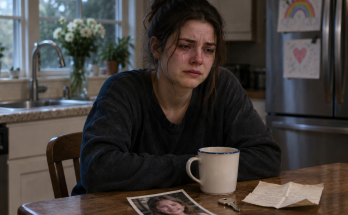
The number stayed on my kitchen table all weekend.
Eighteen thousand dollars.
I had written it at the bottom of a sheet of paper, then underlined it twice.
Every time I walked past, I looked at it.
I wanted to believe I had made a mistake.
Perhaps I had counted something twice.
Perhaps some of the charges were ordinary household purchases I had agreed to cover.
But I had checked the statements carefully.
The total was real.
And that was only part of what I had spent.
There were the transfers to Jeffrey's bank account.
The money toward the children's appointments.
The groceries I bought when Oliver and Stella came over.
The small payments that had seemed harmless because I considered each one separately.
I had never added them together before.
That bothered me.
Bruce and I had been careful people.
We had saved receipts.
Compared insurance costs.
Kept track of the mortgage.
When Jeffrey was young, we planned our spending around what we could afford.
We didn't have a great deal of spare money.
But we tried not to borrow from tomorrow to make today more comfortable.
Somehow, after Bruce died, I had stopped following the very habits that had protected us.
Not when it came to Jeffrey.
I could tell you what I spent on groceries.
I knew the approximate cost of heating the house.
I could remember what I paid for my last pair of shoes.
But I couldn't tell you how much money I gave my son's family each month.
That was what frightened me most.
Not simply the total.
The fact that I had chosen not to know it.
On Sunday evening, I put the statements in a folder.
I wrote down the questions I needed answered.
How much could I reasonably spend every month?
How much was left for the future?
What would happen if I became seriously ill?
And what changes did I need to make now?
I knew who could help.
Elaine Porter had worked with Bruce and me for almost twenty years.
She understood our retirement plan.
She remembered how carefully Bruce had approached every financial decision.
She also remembered how much we wanted to remain independent as we grew older.
I hadn't seen her as often as I should have after Bruce's death.
There was always a reason to postpone an appointment.
A family obligation.
Something involving the children.
Or simply a day when I couldn't bear to discuss money that reminded me of my husband.
The following Monday, I went to her office.
I carried the folder under my arm.
It felt heavier than it was.
Elaine greeted me warmly.
She asked how I had been.
I told her I was managing.
The answer came so easily that I almost didn't notice it.
Managing.
That had become my favorite word.
It meant I didn't have to explain anything.
Elaine invited me to sit down.
Then she asked what had brought me in.
I opened the folder.
For a moment, I couldn't speak.
There were so many ways I could have begun.
I could have told her about Jeffrey's restaurant bill.
I could have explained that Monica had missed my birthday because of a supposed migraine.
I could have complained about the argument on my porch.
But those weren't the questions I had come to answer.
I told Elaine I was worried about how much money I had been giving my son.
She listened.
I explained that Jeffrey and Monica had used a credit card connected to my account.
I told her they had relied on me for household expenses.
I mentioned the children.
The mortgage.
The car.
The various requests that had become part of my routine.
Then I showed her the statements.
Elaine didn't interrupt.
She looked through the papers while I sat across from her.
I watched her expression.
She didn't seem shocked.
That almost made it worse.
I had expected her to tell me I was foolish.
Instead, she asked whether I knew the monthly total of everything I contributed.
I looked at my hands.
I said I didn't.
Not exactly.
She nodded.
Then she turned toward her computer.
We began reviewing my finances.
There was my pension.
The income from my investments.
The savings Bruce and I had accumulated.
The money remaining from his life insurance.
Then the expenses.
Property costs.
Utilities.
Groceries.
Insurance.
Medical needs.
Home maintenance.
Things that would probably become more expensive as I grew older.
Elaine arranged the numbers so I could see them together.
I had expected the results to be disastrous.
They weren't.
That should have been comforting.
She explained that my retirement income and savings could support a reasonable life if I managed them carefully.
I was not facing immediate financial ruin.
But the ongoing payments to Jeffrey's household were reducing my ability to protect myself.
I looked at the screen.
There was my retirement.
Not as an idea.
As a collection of figures that had to last.
Elaine reminded me that I might live another twenty or thirty years.
I knew that in theory.
I had never thought about it while paying for Monica's shopping.
I had never considered what another decade of those payments could mean.
There would be birthdays.
Holidays.
Unexpected repairs.
Possibly expensive medical care.
And ordinary years when I wanted to live rather than merely get by.
My money had to cover all of them.
Elaine gave me time to absorb what she was showing me.
Then she asked why I had continued giving so much.
I began with the explanations I always used.
Jeffrey worked hard.
The children had needs.
Everything cost more than it once had.
Elaine listened.
Then she asked something different.
Did I actually want to provide all that support?
I opened my mouth.
Nothing came out.
Of course I wanted to help my family.
That was the answer I had been giving everyone for years.
But she wasn't asking whether I loved them.
She was asking why I kept doing something that had begun to frighten me.
I looked down at the folder.
I thought about Jeffrey's late birthday message the year before.
I thought about my empty dining room.
And the call from Bellini's.
I remembered how quickly I had answered when I saw his name on my phone.
How pleased I had been that he was calling.
Even after he had canceled dinner.
I felt foolish remembering it.
Elaine waited.
Finally, I told her the truth.
I was afraid Jeffrey would stop coming around if I stopped paying for things.
There.
I had said it.
I expected to feel ashamed.
Instead, I felt tired.
As though I had been carrying that sentence around for three years.
Elaine didn't tell me I was wrong to want my family close.
She didn't tell me to stop loving my son.
She simply helped me separate the two things I had joined together.
My family relationships.
And my financial responsibilities.
They were not the same.
I could care about Oliver's schooling without taking over his parents' bills.
I could love Stella without purchasing every convenience her household wanted.
I could want Jeffrey in my life without paying him to stay.
That was a difficult thing for me to accept.
Because I had spent so long believing that saying no would make me selfish.
I told Elaine about the locks.
She asked whether I felt more comfortable in my home afterward.
I thought about that question.
I did.
For the first time in a long while, I knew that nobody could simply arrive and let themselves in without my agreement.
It wasn't a decision against my grandchildren.
It wasn't a declaration that Jeffrey was no longer my son.
It was a decision about my own home.
I told her I wanted the same clarity with my money.
We went through the accounts carefully.
Elaine explained which arrangements needed attention and which questions required advice from the appropriate professionals.
I made notes.
I asked her to repeat things I didn't understand.
When Bruce had been alive, he often helped with those conversations.
Without him, I sometimes felt embarrassed asking basic questions.
This time, I asked anyway.
It was my money.
I needed to understand it.
We discussed the credit cards.
I had already blocked the card Jeffrey had tried to use at Bellini's.
But a temporary restriction wasn't enough.
I needed to end the authorized-user arrangements that allowed Jeffrey and Monica to make purchases on my account.
I also needed to examine any other access I had permitted over the years.
Elaine encouraged me to make deliberate decisions rather than respond to every angry conversation.
I appreciated that.
I didn't want revenge.
I didn't want to frighten Jeffrey into apologizing.
I wanted financial arrangements that would not depend on whether somebody happened to be pleased with me.
Over the following weeks, I worked through those changes.
The additional cards were canceled.
I reviewed my accounts.
I checked the people who had access to financial information and services.
Where arrangements were no longer appropriate, I ended them.
I also sought independent legal advice about my estate documents.
That was harder than I expected.
Thinking about wills and long-term plans made me miss Bruce.
I remembered how we had once sat together at the kitchen table and discussed what should happen if one of us died.
Neither of us enjoyed those conversations.
We knew they were necessary.
Now I had to make decisions without him.
I reminded myself that protecting my future was not a betrayal of Jeffrey.
Nor was reviewing my estate plan a punishment.
It was part of being responsible for my own affairs.
I had a right to know what my documents said.
I had a right to decide how my property should be managed.
And I had a duty to make those choices while I was able.
When the account changes were finished, I began working on a budget.
I hadn't created a proper personal budget since Bruce died.
I had spent years living as though the household would take care of itself.
The mortgage was gone.
I had a pension.
There was money saved.
I assumed that meant I would always be comfortable.
But security wasn't something I could take for granted.
I wrote down the necessary expenses first.
Housing.
Food.
Health care.
Transportation.
Insurance.
Repairs.
Then I added money for future savings and emergencies.
I wanted room for gifts, too.
I hadn't suddenly become someone who hated giving.
I still wanted to buy presents for Oliver and Stella.
I wanted to contribute to causes I cared about.
I wanted to treat Jeffrey to dinner occasionally if I chose.
But I wanted those gifts to be gifts.
Not obligations.
Not payments somebody had already decided I would make.
When I finished the basic budget, there was one category left.
I had almost forgotten it.
Myself.
I sat with the paper in front of me.
It seemed ridiculous that I had trouble writing it down.
I was sixty-eight years old.
I had worked for decades.
I had raised a child.
I had helped care for Bruce when he was ill.
I had spent years making sure everyone else had what they needed.
And I still felt uncomfortable setting money aside for something I wanted.
I thought about the furnace.
That was a practical necessity.
The porch needed repairs too.
But the garden was different.
I wanted it because looking at flowers made me happy.
There was no emergency.
No obligation.
Nobody else's need to justify.
I simply wanted to enjoy my own yard.
Then there was the trip Bruce and I had talked about.
New England in the autumn.
We had imagined driving through little towns, seeing the trees change color, and eating lobster near the water.
We had discussed it so many times that it almost felt like a memory.
But we never went.
Bruce became ill.
The doctors' appointments multiplied.
Then everything revolved around helping him through one more treatment, one more difficult day.
After he died, I couldn't bear to think about traveling without him.
I put the idea away.
Now I wondered whether I had been using my family obligations to avoid facing a life I had to live alone.
The thought made me uncomfortable.
Because it was probably true.
I added a modest travel allowance to the budget.
Then I stared at the page.
I felt excited.
And guilty.
I hadn't expected both feelings at once.
During those weeks, Jeffrey didn't call.
I noticed the absence every day.
Sometimes I picked up the phone without thinking.
I would look for his name.
Then remember our last conversation on the porch.
I wondered what he was saying about me.
I wondered whether Monica had told the children I didn't want them visiting.
There was no evidence of that.
Still, I worried.
I missed Oliver.
I missed Stella's voice.
I missed the ordinary feeling of having a family come through my kitchen.
On certain afternoons, the house seemed quieter than it had been before my birthday.
I considered calling Jeffrey.
More than once.
I even began typing a message.
I wanted to ask about the children.
I wanted to know whether everyone was well.
But the message always became an apology before I had finished.
I caught myself writing things such as hoping they weren't too upset with me.
As though the problem had been my refusal rather than the years that led to it.
I deleted the words.
Then I put the phone down.
I wasn't trying to make Jeffrey suffer.
I wasn't refusing to speak with him.
But I wanted our next conversation to be different.
I wanted him to understand that I meant what I had said.
I wasn't going to reopen the credit card.
I wasn't going to resume the car payment because the silence made me uncomfortable.
I wasn't going to buy my way back into his good graces.
One afternoon, I took the Lenox china out of the dining room.
The plates had been sitting in the hutch since I cleaned up after my birthday.
I checked each one before putting it away properly.
Bruce had always liked that set.
He used to say it was too nice to spend its whole life behind glass.
I smiled at the memory.
Then I looked at the empty dining room.
The birthday decorations were gone.
The table was clean.
The cake had finally been finished.
For a while, I had avoided going into that room because I remembered the five empty places.
Now I could walk past without feeling the same sharp hurt.
Not because I had forgotten.
Because I had begun doing something about the reason it hurt.
I put a small vase of flowers in the center of the table.
Nothing expensive.
Just flowers I liked.
The room looked less like a place where something terrible had happened.
More like my home.
Nearly two weeks passed.
I continued taking care of my accounts.
I spoke with Elaine when I had questions.
I began making a list of home repairs and estimating what I could afford.
The old furnace had to come first.
The porch would follow.
I still wanted the garden.
And I was beginning to believe that the New England trip might actually happen.
Then, one Sunday afternoon, the doorbell rang.
I was in the kitchen.
For a moment, I assumed it was someone delivering something.
I went to the window.
Jeffrey stood on the porch.
He was alone.
No Monica.
No children.
Just my son, looking at the door he could no longer unlock with his old key.
I stood there for several seconds.
My heart was beating so hard that I could feel it in my throat.
I wanted to open the door.
I also wanted to know why he had come.
The last time he stood on that porch, he wanted money.
This time, he wasn't holding a bill.
He wasn't carrying a folder.
He hadn't called ahead with a request.
I took a breath.
Then I opened the door.
Click here to continue reading: PART 4: When My Son Returned Alone After Two Weeks of Silence, I Heard the Apology I Had Stopped Expecting Him to Give
I Prepared a Birthday Dinner for My Family, but One Phone Call Revealed What My Son Really Expected From Me
Part 3 of 10

One Comment on “PART 3 – I Took My Bank Statements to an Old Family Adviser and Finally Admitted Why I Had Been Giving My Son So Much”