The call came during the fifth month of my pregnancy.
I remember the sound of the nurse's voice more clearly than anything else about that morning.
She was trying to sound professional.
But something about the way she spoke made my stomach tighten.
She asked for me by name.
Then she said the doctor wanted to see both Emily and me.
As soon as possible.
I didn't understand.
We had already spent months following medical instructions, attending consultations, and completing tests.
We had done everything we believed we were supposed to do.
And now the genetics clinic was calling.
I asked whether the appointment concerned our babies.
The nurse didn't answer immediately.
That silence frightened me more than an explanation would have.
I waited.
She finally repeated that the doctor needed us to come in.
Both of us.
I remember how strange that sounded.
Not just me.
Not just Emily.
Both of us together.
The same two women who had spent twenty-five years sharing nearly every important moment of their lives.
We had made the decision together.
We had chosen Daniel together.
And now somebody wanted to speak to us about our pregnancies at the same time.
I wanted to believe it was routine.
I wanted to believe there was a simple explanation.
But I couldn't forget the hesitation in the nurse's voice.
I called Emily.
I told her what the clinic had said.
For a moment, neither of us seemed to know what to make of it.
We had been so happy.
Only recently, we had been discussing baby names and imagining our children growing up together.
Now I couldn't concentrate on any of those things.
I kept thinking about the clinic.
The tests.
The fact that the doctor wanted both of us in his office.
Emily tried to remain calm.
So did I.
We had always been good at reassuring each other.
When one of us worried, the other usually found something sensible to say.
But this time, I didn't have an explanation.
Neither did she.
We had both become pregnant using sperm from the same donor.
That had been our plan from the beginning.
We wanted our children to have the same biological father.
We wanted them to grow up as siblings.
Nothing about that decision had changed.
Yet suddenly I found myself wondering why the clinic needed to discuss our results together.
I had never thought there was anything frightening about our babies sharing genes.
It had been the very reason we chose Daniel.
He was thirty-five.
He had been described as healthy.
He had agreed to be a donor.
We had believed those facts, along with the medical process, gave us reason to feel comfortable.
I kept repeating them to myself.
As though remembering every careful step would somehow protect us from whatever the doctor wanted to say.
By the time we arrived at the clinic, I could feel my heartbeat.
I was frightened.
I didn't want Emily to see how frightened.
But after twenty-five years, pretending in front of her was almost impossible.
She knew me too well.
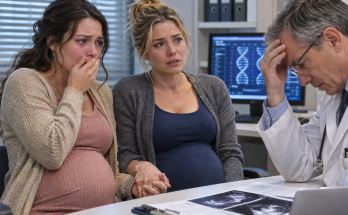
We entered the doctor's office together.
And the first thing I noticed was his computer.
He was sitting in front of it.
Our genetic test results were displayed on the screen.
Both sets.
Side by side.
I recognized that they concerned us, although I couldn't make sense of the information.
The doctor looked at the screen.
Then he looked at us.
For a few moments, he didn't explain anything.
I had expected him to begin talking as soon as we entered.
Instead, he seemed to be studying the results again.
I waited for him to say that everything was fine.
That there had been some confusion.
That the clinic simply needed to clarify something.
But he said none of those things.
He continued looking at the information.
I glanced at Emily.
She was watching him too.
I wanted her to say something.
I wanted somebody to interrupt the silence.
But neither of us spoke.
Then the doctor stood.
He walked toward the door.
And closed it.
That small movement changed the feeling in the room.
Until then, I had been trying to convince myself that we were there for an ordinary medical conversation.
But watching him close the door made everything seem more serious.
He returned his attention to us.
Then he asked a question I hadn't expected.
He wanted to know whether we were completely sure that the same sperm donor had been used for both pregnancies.
I almost felt relieved.
It was a question I knew how to answer.
Of course we were sure.
That was the entire reason we had made the arrangement.
Emily and I answered together.
Yes.
The same donor.
Daniel.
I watched the doctor's face.
I thought our answer would help him understand.
Instead, he looked more troubled.
The color seemed to leave his face.
I felt something cold settle inside me.
I had expected him to explain why he was asking.
But his expression made me afraid of the explanation before I had heard it.
He looked at the results again.
Then he spoke about the genetic similarities between our babies.
I knew what those words meant to us.
Our children would share a biological father.
That was the connection Emily and I had wanted.
We had spent years imagining our future children growing up together.
When Emily first suggested using the same donor, I had laughed because the idea seemed so unusual.
But then we had talked.
We had considered it carefully.
We had chosen to proceed.
And now we were both pregnant.
Three weeks apart.
The plan had worked.
So why was the doctor looking at us that way?
He asked whether we understood what those genetic similarities might mean.
I didn't know how to answer.
I had thought I understood.
I had thought sharing a father meant our babies would be half-siblings.
Something that would connect them throughout their lives.
I had never imagined those similarities could become the subject of such a frightening conversation.
I tried to listen carefully.
But my thoughts had already turned toward the worst possibility I could imagine.
The babies.
Our babies.
I asked him whether they were sick.
I couldn't stop myself.
I needed to hear an answer.
I had entered that office carrying a child I had wanted for years.
I had spent months believing I was moving toward the happiest moment of my life.
And suddenly, I was afraid that something might be wrong.
The doctor looked at me.
Then at Emily.
He didn't immediately tell us that our babies were ill.
But he didn't offer the reassurance I was desperately hoping for either.
He explained that he had worked in genetics for twenty-seven years.
Twenty-seven.
Nearly as long as Emily and I had known each other.
He said he had rarely seen findings like the ones displayed on his computer.
I stared at him.
I wanted to understand what made our results so unusual.
I wanted to know whether the same donor had somehow created a problem neither of us had anticipated.
But I didn't know enough to interpret what I was hearing.
I was a mother-to-be.
Not a geneticist.
I had trusted the consultations.
I had trusted the testing.
And I had trusted the decision Emily and I made together.
Now all three of those things felt uncertain.
The doctor was careful with his words.
He said the findings still needed confirmation.
That mattered.
I heard it.
I held on to it.
Nothing had been confirmed yet.
But he also said that if the results were confirmed, there was something extremely important we would need to understand about our children's future.
Our children's future.
Those words hurt more than I expected.
Because that was what Emily and I had been planning all along.
Not just pregnancy.
Not just two babies born close together.
A future.
We had imagined our children knowing each other as family.
We had thought about names and clothes and the ordinary years ahead.
Now the doctor was telling us that the results might change what we needed to understand about that future.
I looked at Emily.
For the first time since we had decided to become mothers together, I couldn't think of anything reassuring to say.
I remembered our childhood.
How our mothers had called us sisters.
How we had spent twenty-five years believing our friendship could survive anything.
I remembered the evening Emily had suggested our children could share a biological father.
I remembered laughing.
And then realizing I wanted the same thing.
We had never meant to place our children in danger.
We had wanted to give them a connection.
A family.
Something lasting.
I turned back toward the doctor.
The results were still on his screen.
Two pregnancies.
One donor.
Two babies whose future suddenly seemed far less certain than it had that morning.
I thought about the baby growing inside me.
I wanted to know that everything was all right.
I wanted to hear that the doctor's concern would turn out to be nothing.
But he had not said that.
He had only told us that the findings were unusual and needed confirmation.
I realized that I had spent months treating our decision as though careful planning meant we understood every possible outcome.
Now I knew we didn't.
And sitting beside Emily in that quiet office, I faced a truth I had never expected.
We had succeeded in becoming pregnant together.
But we still didn't know what the genetic results meant for our babies.
Click here to continue reading: PART 6: I Had Trusted Every Medical Test Before Pregnancy, but One Unconfirmed Genetic Finding Made Me Question What We Really Knew
I Thought Sharing a Father Would Bring Our Children Closer, Until One Doctor Made Me Question Everything We Had Planned
Part 5 of 10