
I’ll continue from the last part of the story:
PART 2 — THE THINGS DANIEL DIDN’T KNOW
Patricia nodded once.
“Good. Keep it that way.”
Those four words stayed with me longer than any legal advice she gave me that morning.
Because for seventy-one years, I had believed silence was something weak people did.
I was wrong.
Sometimes silence was the only place where a person could finally hear themselves think.
Patricia opened the folder in front of her.
“Mrs. Briggs, before we discuss the trust, the claim, and the property arrangements, I need you to understand something.”
I looked at her.
“What?”
“Your biggest risk is not the money.”
I frowned.
“What do you mean?”
“The money is protected. The paperwork is protected. The legal structure is protected.”
She tapped the folder gently.
“But families are complicated. People behave differently when they believe they are entitled to something.”
I looked down at my hands.
Hands that had washed dishes for forty years.
Hands that had held Daniel when he was sick.
Hands that had signed school forms, mortgage papers, hospital paperwork, and birthday cards.
Hands that everyone had needed.
Until they didn’t.
“Patricia,” I whispered, “if they knew… would they love me?”
She did not answer immediately.
That was how I knew the answer mattered.
“Some people will,” she finally said.
“And some people will love what they think you can provide.”
The room became very quiet.
Because deep down, I already knew.
I just needed someone else to say it.
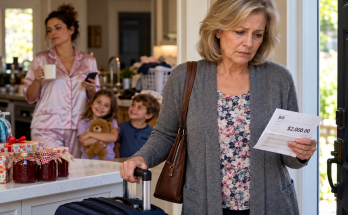
When I returned to Daniel’s house that afternoon, everything looked exactly the same.
The white cabinets.
The black countertops.
The expensive furniture nobody was allowed to touch.
Renee was sitting on the couch scrolling through her phone.
She looked up.
“You were gone a long time.”
I placed my purse on the chair.
“Doctor appointment ran late.”
It was the first lie I had ever told her.
And strangely…
It did not feel wrong.
It felt like survival.
“Oh,” she said.
Then she went back to her phone.
No questions.
No concern.
No “Are you okay?”
Nothing.
That evening, Daniel came home from work.
He kissed Renee on the cheek.
He asked the children about school.
He complained about traffic.
He talked about a meeting.
Normal things.
The kind of things people do when they believe the world will always stay arranged exactly the way they left it.
Then he saw me sitting at the table.
“Mom, can you make those chicken enchiladas tomorrow?”
I looked at him.
“Why?”
He laughed.
“Because everyone likes them.”
Everyone.
A word that somehow never included me.
I smiled.
“Sure.”
And he walked away.
He never noticed that I had stopped writing down grocery lists for the family.
He never noticed that I had stopped planning meals around everyone’s preferences.
He never noticed that I had started packing my own emotional bags long before I packed my real ones.
Three weeks passed.
Three weeks of watching.
Not spying.
Not plotting.
Just seeing clearly.
I saw how Renee treated people who could benefit her.
The neighbor with the luxury car?
Warm hugs.
The mother from school who organized fundraisers?
Endless compliments.
The elderly woman who lived across the street and had nothing to offer?
Barely a hello.
I watched Daniel copy her behavior.
And that hurt more than anything.
Because Renee was not my child.
Daniel was.
One night, I found an old photo album in the closet.
I sat on the floor and turned through the pages.
Daniel at five years old.
Missing teeth.
Messy hair.
Holding my hand.
Daniel at sixteen.
Standing beside Harold’s truck.
Proud because his father let him change the oil.
Daniel at twenty-two.
Graduation gown.
Smiling so wide his cheeks hurt.
I touched the photograph.
“I remember you,” I whispered.
“I remember who you were.”
The saddest thing about losing someone is sometimes realizing they are still alive.
Just different.
The next morning, something happened.
Something small.
But important.
Renee walked into the kitchen while I was making coffee.
“Actually,” she said, “I wanted to talk to you.”
I turned around.
Her voice was softer than usual.
Careful.
“I’ve been thinking.”
That sentence immediately made me cautious.
“I think maybe we should discuss your future.”
My hand stopped around the coffee mug.
“My future?”
“Yes.”
She sat down.
“You know, Daniel and I have been under a lot of pressure.”
There it was.
Not an apology.
An explanation.
“I understand,” I said.
She nodded.
“I just think maybe you would be happier somewhere else.”
Somewhere else.
Not home.
Not with family.
Somewhere else.
“I see.”
“You know, there are wonderful senior communities.”
Senior communities.
The polite phrase people used when they wanted someone to disappear.
“And you could make friends.”
I almost laughed.
Because I had spent two years living in their house surrounded by people who shared my last name.
And somehow I had never been more alone.
Before I could answer, Daniel walked in.
“Mom?”
He looked between us.
“What’s going on?”
Renee immediately changed her expression.
The one she wore when she wanted to look reasonable.
“We were just talking.”
Daniel looked at me.
“Mom, maybe this is actually a good idea.”
A good idea.
The words hit harder than anger would have.
Because anger meant emotion.
This was convenience.
“Daniel,” I said quietly.
“Yes?”
“Do you remember when your father died?”
His face changed.
A little.
“Yes.”
“You told me I would never be alone.”
He looked down.
“I know.”
“You said we were family.”
“We are.”
I nodded slowly.
“Then why does everyone keep trying to find me another place to belong?”
Neither of them answered.
Because there was no answer that sounded good.
That night, I made one more decision.
I was not leaving quietly because they wanted me gone.
I was leaving because I finally wanted somewhere better.
The next morning, Patricia received my call.
“I found the house,” I told her.
There was a pause.
“Are you sure?”
I looked through the window at the backyard that had never felt like mine.
“Yes.”
“Then let’s make it yours.”
And for the first time in years…
Someone said that word about me.
Not useful.
Not convenient.
Not necessary.
Mine.

One Comment on “PART2: At 71, I won $89 million and kept it silent. Then my son said, “Mom, when are you finally moving out?””