
I had spent most of my life trying to avoid being difficult.
That morning, I began to wonder what the word meant.
Difficult.
Was a person difficult because she asked a question?
Because she said an arrangement didn't seem fair?
Because she refused a demand nobody had explained beforehand?
I had always been careful not to make people uncomfortable.
Especially family.
I would rather do another chore than point out that I was tired.
I would rather solve a problem than ask why someone else hadn't handled it.
I would rather say everything was fine than risk an argument.
For years, those habits had seemed kind.
And sometimes they were.
But kindness could become something else when it had no limits.
I was beginning to see that.
The week at Bianca's house had not changed my love for Maisie and Oliver.
That was the first thing I wanted to keep clear.
I didn't regret going because I loved them.
I didn't regret bringing the jam.
I didn't regret wrapping their presents.
I didn't regret giving them my time.
Those things came from my heart.
They were not part of a bargain.
I didn't want to turn them into one now.
The bill was different.
I hadn't expected it.
I hadn't agreed to it.
And I couldn't pretend it belonged naturally at the end of a week spent helping.
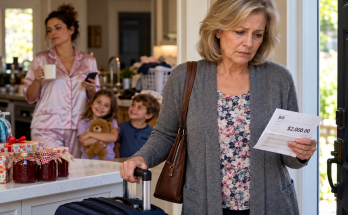
I took it out of my purse once more.
The paper had softened along the folds.
I opened it.
I looked at the number.
Two thousand dollars.
The shock had worn off.
What remained was a feeling of distance.
I could still picture Bianca sliding the paper toward me.
I could still remember how I had struggled to understand it.
I could still hear my own voice saying I would take care of everything in the morning.
At the time, I hadn't known exactly what that meant.
Now I did.
I would deal with the matter.
But I would not let someone else decide what I owed merely by writing down a number.
That wasn't how family should work.
And it wasn't how agreements worked, either.
An agreement required understanding.
It required both people knowing what was expected.
I hadn't known.
I thought back to the evening Bianca called.
She had sounded worried about Graham leaving.
She had said she couldn't manage alone.
She had mentioned Maisie and Oliver.
I had agreed to come.
Nothing in that conversation had prepared me for the paper on the table.
I didn't have to pretend otherwise.
I folded the bill.
Then I opened it again.
I was tired of the thing.
Tired of the number.
Tired of trying to discover some reasonable explanation without actually hearing one.
The paper couldn't tell me what Bianca had been thinking.
Only Bianca could do that.
And until she explained herself, I wasn't going to fill in the blanks for her.
That was a change.
Usually, I was quick to make excuses for people.
I had done it throughout the week.
The dishes were piled up because Bianca was busy.
The laundry was everywhere because children created work.
The cooking fell to me because I knew how to handle it.
The shopping needed doing, so I did it.
I had treated every task as something I could quietly solve.
And perhaps that was why I had reached the end feeling so unprepared.
I had solved everything except the question of what my role actually was.
Was I a visiting grandmother?
Was I the adult responsible for keeping the household running while Graham was away?
Was I simply someone Bianca knew would say yes?
I couldn't answer those questions with certainty.
But I knew what I had believed.
I had believed I was family.
I had believed I was there to help.
And I had believed my help was welcome.
That should have been enough to keep money out of the ending.
Yet here I was.
Sitting with a bill.
Trying to understand why the week had become something I needed to defend.
I thought about how much I wanted to go home.
I wanted my own kitchen.
My own chair.
My own ordinary routine.
I wanted to make a cup of something warm and sit without worrying about the next chore.
I wanted to stop feeling responsible for everything in the house.
Most of all, I wanted to be able to think about my grandchildren without immediately remembering the charge.
That was the damage the bill had done.
It had attached an unpleasant feeling to a week that should have been about family.
I didn't want to carry that feeling forever.
But I knew I couldn't simply ignore it.
Pretending nothing happened wouldn't make the relationship feel normal again.
It would only teach me to hide the hurt.
And I had done enough hiding.
I put the paper down.
I looked at my hands.
They were the same hands that had washed the dishes during the week.
The same hands that had folded laundry.
Prepared meals.
Carried shopping.
Looked after Maisie and Oliver.
They weren't special hands.
They were ordinary.
They had done ordinary work.
But ordinary work still took time.
It still took effort.
It still mattered.
I had never needed someone to pay me for caring about my family.
I still didn't.
What I needed was for that care not to be treated as something without value.
There was a difference between giving freely and being expected to give endlessly.
I understood that now.
I wished I had understood it before the week began.
Maybe I would have asked Bianca what she actually needed.
Maybe I would have explained what I was able to do.
Maybe I would have told her that I wanted to spend time with the children, not become responsible for every household task.
Those would have been healthy conversations.
Not arguments.
Not accusations.
Just ordinary honesty between adults.
But I had been afraid of seeming unhelpful.
So I had said yes to everything.
That part belonged to me.
I could learn from it.
I didn't have to blame Bianca for every choice I had made.
But I also didn't have to accept responsibility for her unexpected demand.
That part belonged to her.
The realization helped me separate the two things.
My willingness to help was my decision.
The bill was hers.
I could feel compassion for someone overwhelmed by children and household work.
I could understand the difficulty of having a husband away on business.
I could appreciate that Bianca had needed help.
And I could still say that handing me a two-thousand-dollar bill afterward was unacceptable.
All those things could be true together.
I didn't need to choose one and deny the others.
I thought again about Graham.
I wanted him to know the truth without being forced into an argument.
I wanted him to understand that I hadn't come looking for trouble.
I had come because his wife called.
Because his children missed me.
Because I loved them.
Those reasons were enough.
And if he asked why I was upset, I could tell him.
I didn't need to make a dramatic speech.
I didn't need to describe every unpleasant minute of the week.
I could explain the invitation.
I could explain the work.
I could show him the paper.
Then I could let him respond.
I had to trust that a truthful account would be enough.
For too long, I had believed that keeping the peace meant doing all the emotional work myself.
I would swallow disappointment.
I would excuse thoughtless behavior.
I would decide not to mention something painful.
Then I would tell myself that everyone was getting along.
But peace built on silence wasn't always peace.
Sometimes it was simply a problem nobody had been allowed to discuss.
I didn't want that anymore.
Not in my own family.
I wanted something better.
I wanted Maisie and Oliver to know that their grandmother loved them.
I wanted Graham to know that I cared about his family.
And I wanted Bianca to understand that asking for help did not entitle her to disregard the person providing it.
Those were not competing wishes.
They belonged together.
I looked toward my packed suitcase.
It was ready.
The week had been completed.
The invitation had run its course.
I had done what I promised.
That gave me a certain peace.
I didn't have to wonder whether I had abandoned anyone.
I hadn't.
I had stayed for the full seven days.
I had done the cooking, cleaning, shopping, and childcare.
I had helped the household through the time Bianca said she couldn't manage alone.
No one could take that away.
Whatever happened next, I could look back and know I had acted out of love.
That mattered to me.
It still matters.
But I was no longer going to confuse loving someone with agreeing to everything they wanted.
That was the lesson beginning to take shape.
I wasn't entirely comfortable with it.
I had spent too many years believing that a good mother made sacrifices without complaint.
A good grandmother gave what she could.
A good family member didn't keep score.
I still believed in generosity.
I still believed in showing up.
But I no longer believed those things required accepting an unfair charge.
I picked up the bill.
I read the amount one final time.
Then I folded it along the creases Bianca had never expected to matter so much to me.
I slipped it back into my purse.
I would keep it.
Not as a reminder to be angry.
As a reminder that I had a right to understand what was being asked of me.
I stood beside my suitcase.
I thought of the woman who had left home the previous Monday.
She had packed four jars of jam.
She had wrapped gifts.
She had driven nearly three hours because she was excited to see her grandchildren.
She had entered the house smiling.
I didn't want to lose that woman.
I didn't want to become suspicious, bitter, or unwilling to help.
I wanted to remain someone who could give freely.
But I also wanted to become someone who knew when to stop.
That was the part I needed to change.
The bill hadn't been settled.
Bianca hadn't explained it.
Graham hadn't yet had the chance to tell me what he knew.
There were still things that needed to be said.
I couldn't pretend the matter was finished.
But I could decide how I would handle it.
I wouldn't pay simply because I had been handed a charge.
I wouldn't let anger lead me into making accusations I couldn't support.
I wouldn't punish my grandchildren for something between adults.
And I wouldn't hide my disappointment just to make everyone comfortable.
I had promised to settle things in the morning.
I intended to keep that promise.
For the first time that week, I understood that doing the right thing might mean refusing to do what someone expected.
I didn't feel triumphant.
I felt tired.
And a little sad.
But beneath that sadness, there was something steadier.
I had finally stopped asking myself how much more I needed to give.
I was ready to ask why anyone believed I owed more in the first place.
Click here to continue reading: PART 9: I Went Back to the Kitchen With Bianca’s Bill in My Purse, Determined to Ask the Question I Had Avoided All Week
I Thought My Grandchildren Needed Me for One Week, but I Had No Idea What Was Waiting Inside That House
Part 8 of 20

One Comment on “PART 8 – I Finally Understood That Helping My Grandchildren Did Not Mean Accepting Bianca’s Bill, and I Made a Different Choice About My Family”