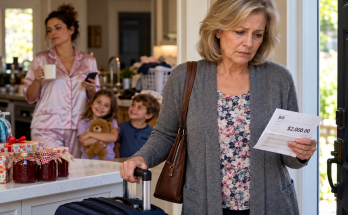
The suitcase stood beside me.
I had checked it twice.
My clothes were packed.
My belongings were together.
And the purse with Bianca's bill was ready to come home with me.
I wanted to leave.
I also knew I wasn't ready to pretend everything was settled.
That was the uncomfortable part.
For seven days, I had been looking forward to the moment when I could return to my own house.
I imagined sitting down.
Taking off my shoes.
Making something simple to eat.
Enjoying the quiet.
I had thought the end of the visit would feel like relief.
Instead, I was carrying a question that made me reluctant to go.
Why did Bianca believe I owed her two thousand dollars?
I had asked myself so many times that the words felt worn out.
But there was still no explanation I could honestly accept.
I had not agreed to the charge.
I had not known it was coming.
And I had not been given a reason that made it feel fair.
Those things mattered.
I looked toward the kitchen.
The house was no longer the same mess I had walked into.
I remembered the sink.
The crowded plates.
The laundry spread across the living room.
I remembered thinking that Bianca must have had a difficult few days.
I had felt sorry for her.
Then I had started working.
No ceremony.
No discussion.
I had simply begun doing what needed doing.
That was how I had always helped people.
I hadn't wanted to embarrass Bianca by pointing out the mess.
I hadn't wanted her to feel judged.
I had wanted her to know I understood.
And perhaps I had understood part of what she was experiencing.
Looking after children while a husband traveled for work could be tiring.
Keeping a house running could be difficult.
I wasn't denying any of that.
But I had spent the week taking responsibility for those difficulties.
Now I needed to recognize that responsibility had limits.
I wasn't the parent living in that house.
I wasn't the person who normally managed its routines.
I was a grandmother who had been invited to help for seven days.
I had fulfilled that invitation.
I didn't have to become responsible for anything Bianca decided to demand afterward.
That thought seemed almost too obvious to say.
But it had taken me a long night and many hours of reflection to reach it.
I thought about the way I had always spoken to my family.
“Don't worry about me.”
I said that often.
“It's no trouble.”
Another favorite.
“I can manage.”
That one had probably caused me the most difficulty.
I could manage many things.
That was true.
But being capable of doing something didn't mean I should always be expected to do it.
I had forgotten that.
Or perhaps I had never fully learned it.
I was good at noticing other people's needs.
I knew when children were hungry.
I knew when a kitchen needed attention.
I knew when someone sounded worried.
I responded almost automatically.
But I wasn't always good at noticing my own limits until I had passed them.
The week had shown me that.
I had become tired.
Then disappointed.
Then hurt.
And finally angry.
I hadn't recognized those feelings in time to speak about them calmly as they appeared.
I had pushed them aside.
One chore after another.
One day after another.
Until the bill made them impossible to ignore.
I didn't want to repeat that pattern.
Not with Bianca.
Not with Graham.
Not with anyone.
I thought about what the next invitation might sound like.
Perhaps Bianca would call again.
Perhaps Graham would ask me to visit.
Perhaps Maisie and Oliver would want Grandma to come for another week.
I hoped there would be more visits.
I wanted that very much.
But I knew I would answer differently.
I wouldn't immediately promise seven days.
I would ask what was needed.
I would explain what I could reasonably do.
I would talk about the practical details before packing my suitcase.
And if there were any expectation about money, I would insist on understanding it before agreeing.
Those questions wouldn't mean I loved the children less.
They would mean I had learned to respect my own time.
That was something I needed to believe.
I had spent years treating boundaries as though they were evidence of selfishness.
If I said no, someone might be disappointed.
If I asked a question, someone might think I didn't trust them.
If I admitted I was tired, someone might feel guilty.
So I avoided all three.
I said yes.
I stayed quiet.
I kept working.
And when I couldn't do any more, I blamed myself for feeling overwhelmed.
That was no way to live.
I understood it clearly now.
I thought again about the four jars of jam.
They had been sitting on my kitchen counter before the trip.
I could still picture the glass.
The bright strawberry color.
The careful wrapping.
I remembered feeling pleased because I was doing something special for the children.
I didn't want to lose that feeling.
I wanted to make jam for them again.
I wanted to bring small gifts.
I wanted to visit with an open heart.
But I also wanted those gifts to remain gifts.
I didn't want them becoming evidence that I could always be asked to give more.
There was a difference between generosity and obligation.
A difference between helping and being expected to carry everything.
A difference between being welcome and being useful.
Those distinctions had been difficult for me to make.
Now they seemed essential.
I picked up my purse.
The bill was still folded inside.
I could have left it behind.
I could have pushed it back across the table.
I could have torn it into pieces.
There were moments when I wanted to.
But I didn't.
I kept it because the issue wasn't something I could settle by destroying the paper.
The question would remain.
And so would the hurt.
I wanted a real explanation.
I wanted Bianca to understand what I had believed when she invited me.
I wanted Graham to know what happened while he was away.
And I wanted the adults to handle the disagreement without dragging Maisie and Oliver into it.
Those were my hopes.
I couldn't guarantee any of them.
But I could behave in a way that made them possible.
I thought about the children.
I wondered whether they understood how much I loved being their grandmother.
I hoped they did.
I had tried to show them in ordinary ways.
By coming when I could.
By listening.
By helping.
By bringing things I knew they enjoyed.
But I didn't want them growing up believing that love required someone to have no limits.
That wouldn't be a good lesson.
Not for them.
Not for anyone.
I wanted Maisie to know she could care for people and still respect herself.
I wanted Oliver to know that help was something to appreciate, not something to demand without thought.
Those were values I hoped they would carry into adulthood.
And I realized I couldn't teach them honestly if I refused to practice them myself.
That thought stayed with me.
I had been so worried about being a good grandmother that I hadn't asked what kind of example I was setting.
Always saying yes wasn't necessarily kindness.
Sometimes it was fear.
Fear of disappointing someone.
Fear of becoming less important.
Fear of not being invited again.
I didn't like admitting those things.
But they were real.
I had been afraid that if I became less useful, I might become less wanted.
That was the deepest hurt beneath the bill.
Not the money.
Not even the work.
The fear that my place in the family depended on what I was willing to do.
I sat with that thought for a while.
It made my eyes sting.
I didn't cry.
I simply let myself feel the sadness.
I had loved my family through years of ordinary responsibilities.
I had never expected them to be perfect.
I had never asked them to give me constant attention.
I wanted to belong.
That was all.
And belonging should not require a person to give up every boundary.
I knew that now.
I thought about Bianca.
I still didn't know why she had written or presented the bill.
I wasn't going to pretend I did.
Perhaps she had misunderstood something.
Perhaps she had expectations she never explained.
Perhaps there was a reason I hadn't considered.
Only a direct conversation could establish that.
I was prepared to hear it.
But being prepared to listen wasn't the same as agreeing to pay.
That distinction was important.
I could give someone a fair chance to explain without surrendering my right to disagree.
I could remain polite without becoming compliant.
I could continue loving the family without accepting every demand.
Those were the choices I had been trying to find since the previous evening.
I looked at the place where the bill had first been placed before me.
I could still remember my hand moving toward it.
I could still feel the paper folding.
I could still hear myself promising to settle everything the next morning.
I had been too stunned to say more.
That silence had protected me from reacting in anger.
But I wouldn't let it become a permanent agreement.
I had meant what I said.
I would settle the matter.
Not necessarily by paying.
Not by pretending.
By finding out what had happened and deciding what was fair.
I stood again.
The suitcase was ready.
The drive home was waiting.
I knew the road would be long.
I knew I would probably think about the week for most of it.
But I wanted to return to my own house with something more than exhaustion.
I wanted to bring home a decision about the way I would live afterward.
I would still help my family.
I would still answer when the children wanted to see me.
I would still cook, share food, and offer what I could.
But I would no longer use my love as a reason to ignore my own needs.
I would ask questions.
I would expect clear agreements.
I would speak when something hurt.
And I would stop confusing an uncomfortable conversation with a broken relationship.
I couldn't control whether Bianca accepted those changes.
I couldn't control how Graham reacted.
I couldn't control every future invitation.
But I could control whether I abandoned those boundaries the moment someone seemed disappointed.
That was where my responsibility began.
And where it ended.
I reached into my purse and touched the folded bill one last time.
I didn't take it out.
I already knew what it said.
Two thousand dollars.
The number still upset me.
But it no longer made me feel helpless.
I had not agreed to that debt.
I had not forgotten why I came.
And I had not lost the right to decide how I would respond.
I let the paper rest where it was.
There was still an explanation to hear.
There was still a conversation to finish.
And there was still the question of how Graham and Bianca would understand what I had given during those seven days.
I didn't know the answers.
I wouldn't invent them.
But I knew what I would no longer do.
I would not make myself smaller simply to keep someone else comfortable.
I would not turn my grandchildren's affection into a price I had to pay.
And I would not allow one painful visit to erase the good things I had given freely.
I was still Grandma.
I was still Graham's mother.
I was still the woman who had packed four jars of strawberry jam because she wanted to make two children smile.
Those things had not changed.
What had changed was my willingness to be silent when my own feelings mattered.
I picked up my suitcase.
I kept my purse close.
And I held to the decision I had finally made.
The bill required an honest answer.
But it did not require my surrender.
Click here to continue reading: PART 17: I Carried My Suitcase Toward the Door, Still Wondering How Seven Days of Helping My Family Had Become a Two-Thousand-Dollar Debt
I Thought My Grandchildren Needed Me for One Week, but I Had No Idea What Was Waiting Inside That House
Part 16 of 20