I had spent most of my life believing that every terrible event had a beginning.
Something happened.
Something went wrong.
And afterward, people tried to understand how it could have been prevented.
That was how I had thought about Julian's poisoning.
The poisoning had nearly killed him.
Patricia had announced his death.
And we had discovered a photograph of a body that might belong to Gabriel.
I had tried to arrange those facts in a simple order.
But the more I thought about them, the less comfortable that order became.
The problem was Gabriel.
Three years.
That number kept returning.
Three years since he vanished.
Three years of unanswered questions.
Three years during which the family had accepted the idea that he had run away because of gambling debts.
And now Julian recognized his tattoo on a dead body.
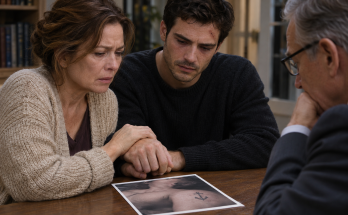
I looked at the photograph again.
I was tired of looking at it.
But I could not stop.
Every time I studied it, I returned to the same question.
Why would someone use Gabriel's body to represent Julian?
Mr. Morris sat across from us.
Julian was beside me.
The room felt quiet in a way that had become familiar.
Nobody was celebrating the fact that we had found a possible connection.
There was nothing to celebrate.
A missing family member might be dead.
A living family member had nearly been killed.
And someone had apparently attempted to make the world believe their identities belonged to the same corpse.
I tried to think carefully.
"We keep talking about the poisoning," I said.
Julian looked at me.
"Yes."
"But the body is a different problem."
He nodded slowly.
Mr. Morris turned toward the photograph.
I continued.
"If Patricia believed you were dead, she needed a reason to believe it."
I stopped.
That was not quite what I meant.
I corrected myself.
"Or she needed other people to believe it."
Julian watched me.
I could tell he understood the distinction.
Patricia's personal belief was one question.
The story she wanted others to accept was another.
We did not know every detail of what she knew.
But we knew what she had said to me.
She had declared Julian dead.
She had described money as though the matter had already been settled.
And she had spoken about his absence as though it solved a problem.
I thought about what the body contributed to that story.
Words could be challenged.
A photograph could appear convincing.
A corpse could make a false announcement seem real.
That was the frightening part.
The body did not need to belong to Julian for someone to use it to support the claim that he had died.
It only needed to be accepted as his.
I felt cold.
I looked toward my son.
"Someone wanted that body to be you."
He lowered his eyes.
The words were terrible.
I regretted saying them so plainly.
But I could not take them back.
And I did not think I should.
We had been avoiding the full meaning of the substitution because it was so difficult to accept.
A person had been reduced to a role.
A dead man had been made to stand in for a living one.
And that meant the truth about both men had been treated as something that could be rearranged.
I thought of Gabriel.
If the body was his, then even his death was being denied its proper name.
He was not being presented as Gabriel.
He was being presented as Julian.
That realization affected me more deeply than I expected.
I had spent so much time thinking about the danger to my son that I had nearly forgotten what the deception meant for the other person.
Gabriel might have disappeared without an explanation.
He might have died without his family knowing.
And now his body might be used to give another man a false death.
It was a cruel possibility.
I looked at Julian.
"Gabriel deserves to be identified."
He nodded.
"I know."
"And you deserve to be recognized as alive."
He looked at me.
I continued.
"Those are two different things."
For a moment, I could see him thinking about what I had said.
Then he nodded again.
It was a small agreement.
But it mattered.
The deception had tried to collapse two lives into one story.
We needed to separate them.
I turned toward Mr. Morris.
"If the corpse is Gabriel's, then we have to understand what happened before the poisoning."
He considered that.
"Yes."
I looked down.
The answer seemed obvious now.
But it had taken me a long time to reach it.
I had been treating the attempted poisoning as though it caused everything that followed.
Perhaps it had triggered the false announcement.
Perhaps it was connected to the use of the body.
But it could not, by itself, explain Gabriel's disappearance three years earlier.
That fact existed long before Julian nearly died.
I thought about the family search.
The police search.
The lack of answers.
The assumption that Gabriel had gone away voluntarily.
Those events did not become less important simply because a more recent crime had almost taken Julian's life.
If anything, they had become more important.
The past might hold the explanation for why the body was available.
And that meant we had to stop looking only at the moments surrounding Patricia's call.
I looked at the phone.
The screen was dark.
I remembered how suddenly Patricia's words had changed the atmosphere.
One moment, Julian and I were sitting together.
The next, his wife was announcing his death.
She sounded so composed in her grief.
So certain about money.
So relieved that he would no longer interfere.
I wondered whether her confidence came from knowing something had been arranged in advance.
That was possible.
But it was not proven.
I had to remind myself of that distinction.
I could not know precisely what Patricia believed about the body.
I could not know whether she recognized Gabriel.
I could not know how long she had been involved.
Yet the events we had witnessed raised questions that could not be dismissed.
Julian glanced at me.
"You're thinking about Patricia."
I nodded.
"I keep coming back to her."
He looked at the phone.
"So do I."
I wanted to ask him whether he had ever suspected something was wrong before the poisoning.
But I stopped.
The source of that question was my own fear.
I did not want to make him search his marriage for signs he had failed to notice.
He had survived.
That did not mean he had been responsible for recognizing every danger.
I remembered how easily people judge someone after the truth begins to emerge.
They say the warning signs were obvious.
They ask why nobody noticed.
They speak as though an outcome that has already happened should have been predictable.
I did not want to do that to Julian.
I did not want to do it to myself either.
Patricia had been part of the family.
She had smiled.
She had attended gatherings.
She had asked questions.
Those things had seemed normal at the time.
I could question them now.
But I could not pretend I had known what they meant.
I looked at the photograph.
Gabriel's tattoo remained the strongest connection we had between the missing man and the body.
That was where our attention belonged.
Not on imagined conversations.
Not on memories changed by suspicion.
On the mark Julian recognized.
On the identity that needed to be established.
On the timeline that could not be explained by the poisoning alone.
Mr. Morris seemed to be considering the same problem.
He looked concerned.
I knew he understood that the identity of the body could change the meaning of everything we had heard.
If the body belonged to Gabriel, then the disappearance was no longer only a missing-person mystery.
It became part of the circumstances surrounding Julian's false death.
But there were still things we did not know.
When Gabriel died.
How the body came to be used.
Who prepared it.
What Patricia knew.
Those were questions.
Not answers.
I repeated them silently.
I did not want to lose sight of the difference.
For a moment, I wondered whether we were making any progress at all.
We had gone over the same photograph repeatedly.
We had discussed Patricia's words more times than I could count.
We had remembered Gabriel's disappearance.
Yet nobody had explained exactly what happened.
I felt frustrated.
Then I remembered how little we had understood before Julian recognized the tattoo.
We had known there was a body.
We had known Patricia had announced his death.
We had known he had survived poisoning.
But we had not known why the corpse might be connected to our own family.
Now we had Gabriel's name.
That was not a complete answer.
But it was important.
I looked at my son.
"Before you recognized the tattoo, we didn't even know where to begin with Gabriel."
He nodded.
"Now we have a reason to question what happened."
"Yes."
I paused.
"That doesn't mean we know."
"No."
His answer was immediate.
I was grateful.
We were finally speaking about the same uncertainty without trying to escape it.
I thought about how long Gabriel had been missing.
If the photograph did show him, then the family had spent years believing the wrong story.
That possibility made me sad.
And angry.
Not with the people who searched for him.
Not with those who hoped he had run away.
But with the possibility that someone had allowed that explanation to stand while knowing something else.
I did not know whether that had happened.
But the thought was difficult to bear.
I looked at Mr. Morris.
"Gabriel's disappearance has to be part of the questions now."
He nodded.
I turned toward Julian.
"And Patricia's call doesn't explain it."
He looked at the photograph.
"No."
That was the reversal I had been struggling toward.
The call was not enough.
The poisoning was not enough.
Even the photograph was not enough on its own.
We needed to understand how the earlier disappearance and the later false death might be connected.
I felt the weight of that conclusion.
It meant we had no easy ending.
We could not simply confront the lie and declare everything understood.
Patricia might have believed the poisoning had succeeded.
She might have expected the body to support her announcement.
But the source of that body was still unexplained.
And if it was Gabriel's, then someone had more to answer for than the attempted death of Julian.
I looked at my son's face.
He was quiet.
But he seemed to be listening carefully.
I wondered what it felt like to realize your own survival might reveal a mystery involving someone else you loved.
Perhaps it was too much to understand all at once.
It was for me.
I reached for his hand again.
He let me take it.
I did not ask whether he was frightened.
I already knew he had reason to be.
Instead, I said something simple.
"We'll keep the questions separate."
He looked at me.
I continued.
"Who is the dead man?"
I touched the edge of the photograph.
"What happened to Gabriel?"
I looked toward the phone.
"And why did Patricia tell me you were dead?"
Julian nodded.
There were other questions.
About the poisoning.
About the preparation of the corpse.
About what Patricia knew and when she knew it.
But those three were enough to remind us what we still needed to understand.
I had spent so much time wanting one explanation to solve everything.
Now I understood that each part mattered on its own.
Gabriel's identity could not be reduced to a tool for exposing Patricia.
Julian's poisoning could not be treated as merely a step in a deception.
And Patricia's phone call could not be excused simply because we did not yet know every detail behind it.
I looked at the photograph once more.
The tattoo had forced us to see the body as belonging to a person with a history.
Not a convenient stranger.
Not a nameless corpse.
A possible member of our family.
I thought about the years we had spent wondering where Gabriel went.
I thought about the pain of believing he chose to stay away.
And I thought about how different that pain would become if we learned he never had a choice.
The realization settled heavily over me.
There was no comfort in it.
Only a reason to continue.
Mr. Morris did not offer a conclusion.
Julian did not make a dramatic promise.
Neither did I.
We had already learned the danger of reaching for an explanation before we had enough facts.
I wanted to know the truth.
But I wanted the real truth.
Not another story that would make the uncertainty easier to bear.
I looked at Julian.
He was alive.
That fact had not changed.
I looked at Gabriel's photograph.
The body's identity remained unconfirmed.
That fact had not changed either.
And I remembered Patricia's voice telling me that Julian was gone.
Her lie had not become less serious because we still lacked other answers.
The central conflict remained exactly where it had been.
A living man had been declared dead.
A missing man might have been used in his place.
And the preparation behind that deception might have begun years earlier.
I understood then that we could not judge the entire plan by the moment it nearly succeeded.
We had to understand what came before.
Julian looked at me.
I squeezed his hand.
"We need to know what happened to Gabriel."
He nodded.
That was no longer just a question about the past.
It was the question that could help us understand why someone had been ready to replace my son with a dead man.
And until we answered it, we could not honestly say we understood what had almost killed Julian.
Click here to continue reading: PART 9: I Had Been So Focused On Saving Julian That I Almost Missed What Gabriel’s Photograph Revealed About The Plan Against Him
My Daughter-in-Law Told Me My Son Was Dead, But She Had No Idea He Was Sitting Beside Me Hearing Everything
Part 8 of 10