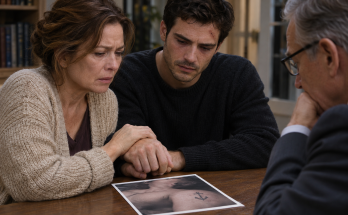
I had never considered listening to be something dangerous.
Listening was what caring people did.
They listened when someone was unhappy.
They listened when relatives told familiar stories.
They listened because being part of a family meant making room for other people's lives.
That was how I had understood Patricia.
Until the photograph.
Until Gabriel's tattoo.
Until the terrible possibility that she knew more about our family than any of us realized.
I remained beside Julian.
Mr. Morris was still with us.
The photograph was on the table.
I had looked at it so many times that I no longer wanted to see it.
But every time I looked away, I thought of Patricia.
That bothered me.
The photograph had not proved she knew Gabriel's fate.
It had not explained her involvement in the preparation of the body.
But my memory kept returning to her.
I wondered how I had allowed someone to become so familiar without ever questioning why she wanted to know certain things.
Then I caught myself.
That was unfair.
I was already assuming her questions had been deliberate.
I had no proof of that.
I needed to distinguish between what Patricia had actually done and what I now feared she might have done.
The telephone call was real.
I could still hear her voice.
The statement about money was real.
So was her remark that Julian would no longer be a problem.
But the family gatherings were memories.
And memories were much easier to distort.
I looked at Julian.
"Do you remember how Patricia behaved around the family?"
He turned toward me.
"What do you mean?"
"The way she listened."
He considered that.
I did not want to tell him what he was supposed to remember.
I wanted to know whether he had noticed the same thing.
"She liked asking questions," I said.
Julian looked down.
I continued before he answered.
"At least, I always thought she did."
That sounded weak.
Perhaps it was.
But weak words were better than false certainty.
I had been certain about Gabriel once.
Or I had pretended to be.
I had accepted that he ran away because of his gambling debts.
Now I was not prepared to make another assumption simply because the circumstances frightened me.
Julian looked toward the photograph.
"Mom, we don't know what she knew."
"I know."
I took a breath.
"I keep wondering."
He nodded.
"So do I."
That was the first time I understood we were struggling with the same thing.
Not just fear of Patricia.
Fear of everything we might have overlooked.
I thought about how many ordinary conversations happen during family gatherings.
People talk about the past.
They mention relatives.
They ask where someone is living or what someone is doing.
Most of it means nothing.
Most of it is forgotten before the day is over.
But I remembered Patricia's attention.
She seemed to hear people.
She did not always need to be speaking.
And now, with Gabriel's possible identity before us, I could not stop wondering whether she had learned something important from those conversations.
I pressed a finger against the table.
Julian watched me.
"You're thinking about Gabriel," he said.
"Yes."
I looked at the photograph.
"I don't know whether she asked about him."
That was difficult to admit.
I wanted to remember.
I wanted one particular conversation to come back clearly.
I wanted to hear Patricia asking a question that would explain why Gabriel had disappeared.
But there was no such memory.
Not one I could honestly describe.
I only remembered her listening.
I remembered her curiosity.
And I remembered that we had trusted her enough to speak openly.
Looking back, I think that uncertainty frightened me more than any particular recollection.
Because it made the boundaries of what she knew impossible to see.
She might have learned very little.
She might have learned far more.
We could not tell from her behavior alone.
Mr. Morris looked at us.
"Her knowledge and her actions are separate questions."
I turned toward him.
He was right.
I had been treating them as though they were the same.
If Patricia knew about Gabriel, that did not automatically establish what she had done.
If she had helped arrange the false death, that did not tell us exactly when she became involved.
And if she knew Julian had been poisoned, we still needed to understand how she knew and what part she played.
Every answer seemed to create another question.
I rubbed my hands together.
I was beginning to see why people sometimes accepted simple explanations.
They were easier to live with.
Gabriel ran away because of debts.
Julian died.
His widow received everything.
Those statements were neat.
They left little room for uncertainty.
They were also statements that might conceal something much worse.
Julian was alive.
That alone proved Patricia's announcement could not be accepted.
And Gabriel's tattoo suggested the body might not be who it was supposed to be.
The story that appeared simple from outside was coming apart.
I stared at my son.
"I keep thinking about what she said."
"Which part?"
"The part about you being out of the way."
His expression tightened.
I wished I had not reminded him.
But the words were important.
Patricia had not merely told me Julian died.
She had spoken as though his absence relieved her of a burden.
I could not forget that.
I wondered whether she had been thinking about money.
Or about something else.
Or about both.
We did not know.
But I remembered how naturally she moved from announcing his death to telling me I would receive nothing.
There had been no need for me to ask.
She raised the subject herself.
That made the conversation feel less like a grieving widow informing a mother and more like someone making sure an expected arrangement would not be questioned.
I could not prove that was her intention.
But it was how the call had sounded.
Julian remembered it too.
He lowered his eyes.
"She wanted you to believe it."
I nodded.
That was the center of it.
Patricia wanted me to accept that my son was gone.
And she expected that acceptance to carry consequences.
I thought about how close she had come to getting exactly what she wanted.
If Julian had not been sitting beside me, I might have believed her.
I would have heard the same voice.
The same pauses.
The same supposed grief.
The same certainty.
And I would not have had my son's breathing to contradict it.
That thought shook me.
I had judged Patricia's performance because I knew the truth.
What would I have thought if I did not?
I tried to imagine the call without Julian.
My phone ringing.
Patricia speaking.
The words telling me my child had died.
The statement that I would receive nothing.
I realized how difficult it might have been to question her while trying to understand the loss.
I might have become too frightened to notice the way she spoke.
I might have accepted the money statement as something that could be addressed later.
I might have believed she was suffering too.
That was what her voice seemed designed to suggest.
A grieving wife.
A terrible loss.
An unavoidable conversation.
And at the center, a death that had not occurred.
I looked at Julian.
"You saved me from believing her."
He shook his head.
"Mom."
"No, listen."
He went quiet.
"If you hadn't been beside me, I don't know what I would have believed."
I could feel my throat tightening.
"She sounded convincing."
He looked at the table.
"I heard."
I wanted to say I had never trusted Patricia.
That I had always sensed something was wrong.
But it would have been a lie.
I had trusted her.
I had accepted her presence in Julian's life.
I had treated her as family.
That was why the call hurt as much as it did.
A stranger might have lied to me about my son.
Patricia knew what his life meant to me.
She knew I would be devastated by the news.
And she delivered it anyway.
I looked at the photograph again.
If the body belonged to Gabriel, then Patricia might also have known that the supposed death would hurt more than one part of our family.
That possibility was almost unbearable.
Gabriel had already been missing for years.
Now his body might be used to make people believe another relative had died.
One family's unresolved loss becoming the evidence of another.
I could not imagine how anyone could justify that.
I did not try.
I had spent enough time making excuses.
For Patricia's manner.
For Gabriel's disappearance.
For my own failure to notice what was happening.
I needed to stop explaining away things I did not understand.
Mr. Morris remained quiet for a while.
Then he asked Julian another question.
"What made you certain about the tattoo?"
I watched my son.
He looked at the photograph again.
I knew the question was necessary.
I also knew it was painful.
Julian had recognized the mark.
That was the reason Gabriel's name had entered the conversation.
But recognition, however sincere, was not the same as confirmation.
I waited for him to speak.
"I remember it," he said.
There was no elaborate explanation.
He did not pretend to have more than that.
Mr. Morris nodded.
I was relieved nobody tried to force the answer into something stronger.
The truth would be difficult enough without exaggerating it.
I looked at the photograph.
The tattoo had already changed our understanding.
But the body still needed to be identified.
Patricia's knowledge still needed to be understood.
The connection to the poisoning still needed to be established.
I began to appreciate how far we were from knowing everything.
It frightened me.
But it also gave me a reason to be careful.
We could not afford another assumption.
Not about Gabriel.
Not about Patricia.
Not about Julian.
I looked at my son.
"What do you want to do about her?"
He seemed surprised by the question.
Perhaps because I had spent so much time telling him what frightened me.
Now I was asking him what he wanted.
He considered it.
"I want to understand what happened."
That answer mattered.
He did not say he wanted to frighten Patricia.
He did not say he wanted to make her suffer.
He wanted answers.
After hearing his own wife announce his death, he was still trying to understand the truth.
I felt proud of him.
And terribly sad.
He should never have needed that kind of restraint.
I reached for his hand.
"I want that too."
Mr. Morris glanced at us.
The photograph still lay in front of him.
For a moment, I thought about putting it away.
Then I stopped.
I did not want to remove the one thing that had made us question Gabriel's disappearance.
I wanted to face it.
Even if the truth was painful.
Especially then.
I returned to the memory of Patricia listening at family gatherings.
There was no single question I could point to.
No sentence I could repeat as proof.
Just a pattern I remembered differently now.
I understood that the pattern might mean nothing.
But I also understood why we could no longer ignore it.
Patricia had shown us that her words could not be trusted.
The tattoo had shown us that the body's identity needed to be questioned.
And the disappearance had shown us how easily an uncertain explanation could become accepted truth.
I sat back.
For the first time, I stopped trying to make every detail fit together immediately.
We needed to separate memories from facts.
Suspicion from proof.
What Patricia said from what she actually knew.
It was not the answer I wanted.
I wanted to know everything.
But it was the only way I could see to avoid making the same mistake we had made three years earlier.
We would not decide Gabriel's fate from an old rumor.
And we would not decide Patricia's entire role from the fact that she had once smiled and listened.
We would begin with what we knew.
The false announcement.
The attempted poisoning.
The body.
The tattoo.
And the name Julian had recognized.
That was the decision I could live with.
Whatever Patricia had been listening for, we would not answer her deception with another story built on guesses.
Click here to continue reading: PART 7: My Son Had Nearly Died, Yet What Hurt Him Most Was Hearing His Wife Speak About His Death As Something She Wanted
My Daughter-in-Law Told Me My Son Was Dead, But She Had No Idea He Was Sitting Beside Me Hearing Everything
Part 6 of 10