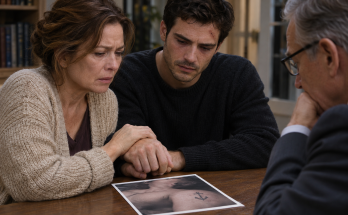
I used to think surviving danger meant the worst part was over.
I believed that once someone escaped death, relief would take the place of fear.
I was wrong.
Julian was alive.
I could touch his hand.
I could hear his voice.
I could look across the table and see him breathing.
And yet I could see that something in him had changed.
Patricia had announced his death.
She had spoken as though he would never hear what she said.
And he had listened to every word.
I had been so concerned with Gabriel's photograph that I had almost stopped thinking about what the phone call had done to Julian.
That realization made me ashamed.
My son had survived an attempt to poison him.
He had then been forced to hear his wife describe him as dead.
And I had been asking him questions about a tattoo.
Important questions.
Necessary questions.
But questions that kept him sitting inside the same terrible experience.
I looked at him.
His eyes were lowered.
He seemed older than he had before the call.
Not because of anything physical.
Because of the way he held himself.
He was quiet.
Careful.
As though speaking too quickly might make something inside him break.
I wanted to put my arms around him.
Instead, I asked something I should have asked earlier.
"How are you feeling?"
He looked surprised.
Then he looked away.
I waited.
He did not answer immediately.
I could understand that.
How could anyone explain what it felt like to hear a spouse announce their death?
How could Julian separate fear from betrayal?
How could he describe the knowledge that someone close to him had nearly succeeded in making his death real?
Finally, he spoke.
"I don't know."
I nodded.
It was an honest answer.
I had no better one myself.
I thought about the moment Patricia's name appeared on the phone.
Julian had looked at the screen.
He had not moved.
I had seen the strain in his face before I answered.
He knew the call mattered.
He knew we needed to hear what Patricia believed.
But I wondered whether either of us had understood what listening would cost him.
I remembered his hand beneath the table.
The way he held mine.
The pressure of his fingers when Patricia spoke.
He had not been comforting me alone.
I understood that now.
He had been holding on to something.
Something familiar.
Something he could trust.
And I had been so focused on keeping my voice steady that I had not fully understood how frightened he might have been.
I looked at him.
"You shouldn't have had to hear that."
He gave a small shake of his head.
"Neither should you."
His answer hurt.
Even now, he was thinking about me.
I wanted him to stop worrying about my feelings.
I wanted him to be selfish for once.
He had earned the right.
But I could not tell him how to feel.
I could only sit beside him.
Mr. Morris remained near us.
He did not interrupt.
I was grateful.
This was not a moment when we needed another theory.
We needed a little room to understand what had happened.
I looked at the phone.
It was no longer ringing.
Patricia's voice was gone.
But the memory of it filled the silence.
She had sounded like a grieving widow.
That was what I kept returning to.
She knew how a grieving widow was supposed to sound.
She knew when to pause.
She knew how to make the announcement seem difficult.
She knew how to speak as though the loss belonged to her.
But then she had begun talking about money.
I remembered my confusion.
I had not asked what I would inherit.
I had not suggested I expected anything.
I had been pretending to hear about my son's death for the first time.
And Patricia had made sure I understood there would be nothing for me.
Nothing.
The word had seemed so important to her.
I thought about what it must have felt like for Julian to hear that.
To discover that his supposed death had already become a question of who would receive money.
I turned toward him.
"Did that part surprise you?"
He knew what I meant.
"The money?"
"Yes."
He looked at the phone.
Then at the photograph.
"I didn't expect her to say it like that."
I felt a painful recognition.
Neither had I.
Patricia had made the announcement sound like a settled matter.
Julian was dead.
I would receive nothing.
And he would not be standing in the way anymore.
It was almost as though she believed the most difficult part was finished.
I could not know exactly what she was thinking.
But I knew what she had said.
And I knew how those words sounded to someone who loved Julian.
I reached for his hand.
"Whatever happens with the money, that isn't what matters to me."
He looked at me.
"I know."
I squeezed his fingers.
"I mean it."
His expression softened.
For a moment, he looked like the son I had known before this terrible situation began.
I wanted to keep him in that moment.
Away from the photograph.
Away from Patricia.
Away from the questions surrounding Gabriel.
But none of us could remain there.
The truth was still waiting.
I thought about how easy it would be to focus only on Patricia's greed.
She had brought up money.
She had said I would receive nothing.
That was clear.
But the money was only one part of the deception.
The deeper horror was that someone had tried to make Julian disappear from the world.
A corpse had apparently been prepared to replace him.
His wife had announced the replacement as though the matter were complete.
And my son had survived long enough to hear her say it.
I looked at Julian.
"You're still here."
He nodded.
I knew it sounded foolish.
Of course he was there.
He was sitting beside me.
But I needed to say it.
I needed him to hear someone acknowledge his life rather than his supposed death.
"You're here," I repeated.
His fingers tightened around mine.
I could feel the emotion building in my chest.
I did not want to cry in front of him.
I was afraid he would think he needed to comfort me.
So I looked away.
I focused on the edge of the table.
The same place I had held when he recognized Gabriel's tattoo.
The same hard surface beneath my fingers.
It had become something familiar in a situation where nothing else felt steady.
I remembered the first moment I saw Julian's face turn pale.
The tattoo.
The photograph.
The name Gabriel.
Each discovery had pulled us farther from the simple explanation Patricia wanted us to accept.
But it had also forced Julian to confront another possible loss.
His cousin.
Three years gone.
Perhaps dead.
Perhaps connected to the plan that had nearly killed him.
I wondered whether Julian felt guilty about Gabriel.
I wondered whether he blamed himself for not questioning the old explanation.
Then I stopped.
I had no right to place another burden on him by imagining what he felt.
I could ask.
Or I could give him time.
I chose to wait.
Mr. Morris looked at the photograph.
I could see he was still troubled.
There were questions he could ask.
Questions that might help us understand the body.
But for the moment, he let the silence remain.
I appreciated that more than I could say.
I thought about Patricia again.
The woman who had married my son.
The woman I had accepted into our family.
I remembered how ordinary she had once seemed.
Not perfect.
Not someone I had understood in every way.
But familiar.
A person whose name appeared on my phone without frightening me.
That was what had changed.
Now seeing her name was enough to make me tense.
Hearing her voice meant listening for lies.
Remembering her smile meant wondering what she knew.
I hated that.
I hated what suspicion did to ordinary memories.
It took moments that had once felt harmless and made them difficult to trust.
I did not want to spend the rest of my life wondering whether every kind gesture had been false.
But I also could not pretend Patricia had not made that call.
The truth was somewhere between those two feelings.
And I had to find a way to live with the uncertainty until we knew more.
I looked at Julian.
"Do you still hear her saying it?"
He met my eyes.
"Yes."
I swallowed.
"So do I."
We sat quietly.
I could hear my own breathing.
I could hear his.
I thought about the difference between those living sounds and the certainty in Patricia's voice.
She had spoken as though his life was over.
Yet here he was.
Breathing.
Listening.
Remembering.
The fact of his survival felt both wonderful and terrible.
Wonderful because he was alive.
Terrible because it allowed him to hear what someone believed they could say once he was gone.
I wondered how a marriage survived a moment like that.
Then I realized I was asking the wrong question.
I had spent years thinking about marriages as something people had to preserve.
Something that deserved effort.
Something that could be repaired if both people were willing.
But a marriage could not be discussed honestly while one person was pretending the other was dead.
That was not an ordinary disagreement.
It was not a hurtful argument.
It was a deception involving a life.
I felt ashamed that I had even tried to think of it in familiar terms.
Julian did not need me to defend marriage.
He needed me to take seriously what had happened.
I turned toward him.
"I believe what we heard."
He looked at me.
I continued carefully.
"I don't know everything Patricia did."
He nodded.
"But I know she told me you were dead."
His expression tightened.
"And I know she expected me to accept it."
I paused.
"I won't pretend that was normal."
He looked down at our hands.
For a moment, neither of us spoke.
Then he said something quietly.
"I know, Mom."
There was relief in his voice.
Small.
But real.
I had not realized how much he needed to hear me say it.
He did not need me to explain Patricia.
He did not need me to promise that everything would make sense.
He needed me to stop searching for excuses that might make the betrayal easier to accept.
I understood that now.
Mr. Morris looked toward us.
The photograph was still on the table.
We had not forgotten Gabriel.
We had not abandoned the questions.
But I was beginning to understand that finding the truth would not erase what Julian had heard.
Even if we learned exactly who prepared the body, he would still remember Patricia's voice.
Even if we discovered why Gabriel vanished, we would still have to live with the fact that the family had been misled.
Answers could explain events.
They could not make those events harmless.
I looked at my son.
I wished I could give him back the trust he had lost.
I wished the name Patricia could become ordinary again.
I wished Gabriel's photograph could be nothing more than a mistaken connection.
But wishing had not protected Julian.
And it would not help us understand the deception.
I took a breath.
"We need to keep going."
Julian nodded.
"But we don't have to pretend this doesn't hurt."
He looked at me.
For the first time since the call, I saw him allow the pain to show.
Not dramatically.
Not with anger.
Just a change in his eyes.
A little less effort to hide what he felt.
I squeezed his hand.
He squeezed mine back.
The same hand that had held me beneath the table while Patricia spoke.
The same hand I had feared losing.
I understood something then.
The terrible part was not only that someone had tried to make Julian dead.
It was that Patricia had spoken as though his life had already become an inconvenience she no longer needed to consider.
He had heard that.
And he would have to carry it.
I could not remove that pain.
But I could make sure he did not have to defend his right to feel it.
I looked at the photograph of the man who might be Gabriel.
Then at my living son.
Whatever we eventually learned about Patricia, I would not allow her false announcement to become the version of events we accepted.
Julian was alive.
Gabriel might have been lost.
And the difference between those two truths was something we needed to honor.
That became my next decision.
We would continue asking what happened.
But I would stop treating Julian's survival as though it meant he had escaped unharmed.
Click here to continue reading: PART 8: The Longer We Examined Gabriel’s Disappearance, The Clearer It Became That The Poisoning Was Not Enough To Explain The Dead Body
My Daughter-in-Law Told Me My Son Was Dead, But She Had No Idea He Was Sitting Beside Me Hearing Everything
Part 7 of 10