I had always believed that knowing the truth would bring me peace.
I was wrong about that too.
Sometimes the truth comes so late that there is no one left to speak to about it.
That was what hurt most.
Mr. Pickett had been dead for a week when I learned who paid off my mortgage.
Eleven years had passed since Conrad died.
Eleven years since that bank letter arrived.
Eleven winters since I first crossed the street with a shovel.
And only now did I understand what had been happening between our two houses.
I could finally name the person who had helped my family.
But I couldn't thank him.
Not in person.
Not anymore.
I kept thinking about that as I sat in Ms. Castellanos's office.
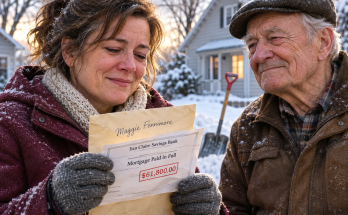
The mortgage document was still in front of me.
I had read the amount so many times that the numbers seemed fixed in my mind.
$61,800.
I remembered what that amount meant when Conrad died.
It wasn't just a balance owed to a bank.
It was the difference between a responsibility I could manage and one that frightened me every day.
I worked as a pharmacy cashier.
I knew exactly what I earned.
I knew what groceries cost.
I knew how quickly ordinary household bills could consume a paycheck.
And I knew there was no way I could cover everything as though Conrad were still alive.
He had been forty-one.
Our children had been eight and ten.
Neither child had any idea how frightened I was about the future.
At least, I tried not to show them.
I still remember how carefully I studied the bills that first winter.
I would look at one amount.
Then another.
Then the mortgage.
And I would realize the numbers didn't work.
No matter how I rearranged them, there wasn't enough money.
I couldn't make my paycheck larger by worrying about it.
I couldn't bring Conrad back.
And I couldn't explain to the children how uncertain everything had become.
I felt ashamed of how helpless I was.
Looking back, that shame was unnecessary.
But I felt it anyway.
Then January came.
And the bank sent the letter.
At first, I couldn't understand it.
The mortgage was completely paid off.
Not reduced.
Not postponed.
Paid.
I called because I thought someone had made a serious mistake.
The bank confirmed that the money had been received.
I called again because I didn't believe the first explanation.
Then I called a third time.
The answer didn't change.
Someone had paid the debt.
That person wanted to remain anonymous.
And the bank wouldn't identify them.
I remember sitting with that information and wondering how something so good could happen when everything else had gone so badly.
I wanted to believe Conrad had arranged it somehow.
Maybe there was insurance I hadn't known about.
Maybe someone had been looking after us without telling me.
I couldn't imagine another answer.
But after a while, I stopped asking.
Not because I wasn't grateful.
Because I was exhausted.
I had children to raise.
I had a job to keep.
And I had to learn how to live in a house where Conrad would never come home again.
The mortgage was gone.
That was what mattered at the time.
I could think about the next week.
Then the next month.
Eventually, the next year.
The fear never disappeared entirely.
But one enormous part of it had been taken away.
And I hadn't known who to thank.
Now I did.
Horace Pickett.
I looked down at his handwriting.
For years, I'd thought the man couldn't stand us.
He complained about our dog.
He complained about our trash cans.
He yelled when children crossed his lawn.
He seemed to find something wrong with almost everyone.
I never saw him as someone who might be looking after another family.
I saw an angry old man.
Nothing more.
That was the uncomfortable part.
I had judged him by the things he said.
And he had helped us through something I couldn't solve myself.
I still didn't know why he had done it.
His four-page letter began by admitting that he'd been unpleasant.
He knew people disliked him.
He knew he'd earned that reputation.
I respected that admission.
But it didn't answer every question.
I couldn't pretend to understand everything about his life.
I couldn't explain why a man who complained so freely had hidden such an extraordinary act.
I couldn't say why he was willing to give away that much money while remaining so distant from the family he helped.
Those answers belonged to him.
And he was no longer alive to give them.
All I knew was what the document proved.
He had paid.
And he had kept quiet.
I thought about my first winter without Conrad.
Two feet of snow had fallen.
I was standing outside before sunrise, trying to clear our driveway.
I had been crying.
Not because I hated shoveling.
Because Conrad used to do it.
His absence was everywhere.
Even in the snow.
I remembered stopping to catch my breath.
Then looking across the street.
Mr. Pickett was standing in his doorway.
He wore a bathrobe.
There was a shovel in his hands.
He looked at his buried driveway.
I could tell he was struggling.
Then he went inside.
At the time, I didn't think about what kind of man he was.
I didn't think about his complaints.
I didn't think about the police calls concerning my dog.
I just saw someone who needed help.
So I walked over.
I cleared his driveway.
Then I went home.
I hadn't planned to do it for eleven winters.
I hadn't made a promise.
I hadn't even spoken to him.
It was one morning.
One small decision.
And somehow it became a habit that lasted more than a decade.
I had believed no one noticed.
That was why his short note affected me so much.
He had known.
I thought about those words again.
For years, I had crossed the street while most of the neighborhood was asleep.
I had worked quietly.
I had returned home without knocking.
And I had believed that I was leaving no trace of myself behind.
But he had known.
I wondered when he first realized.
Was it during the first winter?
Had he figured it out years later?
Had he ever watched me through a window?
I couldn't answer those questions.
I didn't want to turn guesses into memories.
His note told me only that he'd known.
That was enough to change how I thought about the past.
I remembered every morning when I nearly stopped.
There had been plenty.
Sometimes the snow was heavy.
Sometimes I was tired from work.
Sometimes my own responsibilities felt impossible to manage.
And sometimes Mr. Pickett had said something so unpleasant that I wondered why I continued helping him.
I remember the neighborhood meeting.
He referred to me as the woman with the noisy dog.
I had sat there listening.
I knew how many mornings I'd spent clearing his driveway.
He didn't acknowledge any of them.
And I remember feeling foolish.
Not angry enough to confront him.
Just hurt.
I had wanted one kind word.
One sign that he understood.
I never received it directly.
Yet the mortgage document showed that he had been capable of far more than a kind word.
That didn't mean his complaints stopped hurting.
They had hurt.
I wasn't going to pretend otherwise.
But I could finally understand that one person's character might contain things I had never seen.
Mr. Pickett could be difficult.
He could also be generous.
The two truths existed together.
I didn't have to erase one to accept the other.
I looked across the lawyer's table.
Lyndon had been so certain about me.
He believed I'd wanted his uncle's property.
He had accused me of spending years trying to gain something.
He had even threatened legal action.
I knew how wrong he was.
But I also recognized something uncomfortable in his certainty.
For years, I had believed I understood his uncle.
I hadn't known everything either.
That didn't make Lyndon's accusation fair.
It didn't excuse the way he'd spoken to me.
But it reminded me how easily people build a complete story out of a few things they happen to see.
He saw an elderly man.
A neighbor who had helped him.
And an envelope in a lawyer's office.
Then he decided what it meant.
I had seen an elderly man who shouted at children and complained about dogs.
And I decided what that meant.
Neither of us had seen the bank payment being made.
Neither of us had known what Mr. Pickett kept to himself.
I didn't want to become the sort of person who mistook a small part of someone's life for the whole thing again.
I thought about the ice storm.
It was the other memory that kept returning.
His porch light had been on.
The door was open.
I found him near the bottom of his steps.
He was lying on the ice.
His lips were blue.
I remember calling for help.
I remember taking off my coat.
I remember lying beside him because I couldn't bear to leave him alone in that cold.
The ambulance came.
The doctors treated his broken hip and hypothermia.
And one of them told me he'd been dangerously close to dying.
Thirty more minutes.
That was what stayed with me.
Thirty minutes.
I had spent years thinking I was doing something useful by clearing his driveway.
But on that particular morning, being there had meant something much larger.
If I hadn't noticed the open door, I might never have found him in time.
I didn't like thinking about that possibility.
It frightened me even afterward.
At the hospital, he had looked at me for a long time.
There had been almost no conversation.
I hadn't demanded gratitude.
He hadn't offered an explanation.
We were still two neighbors who didn't know how to talk.
Now I wondered what that moment had meant to him.
I had been sitting beside the hospital bed, relieved that he was alive.
He had been looking at the woman whose driveway visits he already knew about.
And the woman he had once helped in secret.
I hadn't known either of those things.
That was the difference.
He had understood more about our history than I had.
I wished I could sit beside that hospital bed again.
Not to ask him about the money.
Not to make him uncomfortable.
Just to tell him that I appreciated having been able to help.
I wished I could have said something warmer than the few words we exchanged.
But I couldn't go back.
I had only the memory.
He recovered enough to return home after three weeks.
He used a walker.
I continued clearing his driveway.
And eventually the oranges began appearing on my porch.
I remembered looking at the bag.
I hadn't expected it.
Then came the bone for the dog.
That still made me smile a little.
The same man who had complained to the police about our dog had left something for it.
I hadn't known what to make of that.
Now I understood it as part of his awkward way of communicating.
I didn't know whether he intended the gifts as thanks.
I couldn't prove that.
But they had appeared after the accident.
And I knew they were unusual for him.
Maybe that was all I needed to know.
He didn't become a friendly neighbor.
He didn't start speaking openly.
And I didn't suddenly become his closest companion.
Our relationship remained quiet.
But it wasn't empty.
There were the oranges.
The dog bone.
The cleared driveway.
And the memory of the hospital.
Now there was the mortgage document too.
I thought about what those things had in common.
None required a long conversation.
None involved a promise.
None was done in front of an audience.
They were things we could do.
So we did them.
I couldn't say that was the best way to live.
In fact, I wished we'd spoken more.
I wished I'd known him beyond his anger.
I wished he'd allowed himself to be known.
But the years were over.
October had come.
And Mr. Pickett had died in his sleep.
He was ninety-two.
That fact hadn't changed.
The bank document couldn't bring him back.
The letter couldn't give us another winter.
It couldn't give me another chance to knock on his door.
But it could change how I remembered him.
That was something.
I looked at his name on the papers.
For eleven years, I'd believed I was helping someone who hadn't appreciated it.
Now I knew he'd been aware.
And for eleven years, I'd accepted help from a person I hadn't been able to identify.
Now I knew who he was.
I had thought our acts of kindness traveled in only one direction.
They hadn't.
I closed my eyes for a moment.
I pictured our two houses.
Across one street.
Close enough for me to see his doorway from my driveway.
Close enough that a few steps could take me from one property to the other.
And yet, for eleven years, we'd kept the most important things between us unspoken.
That was my regret.
Not the work.
Not the cold.
Not the mornings I spent shoveling.
I would make the same decision again.
My regret was that I had known Mr. Pickett for eleven winters without ever really knowing him.
And by the time I learned the truth, the man who could have explained it was gone.
Click here to continue reading: PART 10: Eleven Winters After I First Crossed the Street With a Shovel, I Finally Understood the Quiet Gift That Had Kept My Family Home
For Eleven Winters I Cleared the Driveway of a Man Who Hated My Family Without Ever Knowing Why I Kept Going Back
Part 9 of 10