I had wanted to know who paid the mortgage.
That was the question I carried for eleven years.
At first, I asked it constantly.
I called the bank three times.
I looked for an explanation.
I wondered whether Conrad had arranged something before he died.
I wondered whether the answer would eventually arrive in another letter.
It never did.
So I stopped asking.
Not because the question stopped mattering.
Because I had a family to raise.
I had work to do.
And I had to keep moving.
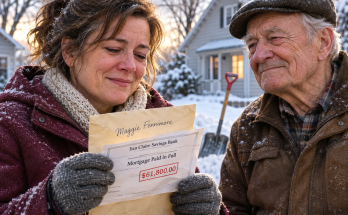
Then Ms. Castellanos placed the answer in front of me.
After eleven years, the mystery had a name.
Horace Pickett.
I thought about him standing across the street.
The first time I'd seen him with that shovel, he looked like an elderly man who couldn't manage the snow.
I hadn't known what he'd done for my family.
I hadn't known he was responsible for the bank letter that had allowed me to stop worrying about the mortgage.
I had seen a problem.
And I'd helped.
That was all.
If I had known about the money, I might have felt obligated to him.
I might have thought every driveway I cleared was some attempt to repay a debt.
But I hadn't known.
And that was what made our eleven winters so strange to remember.
I hadn't helped him because he paid our mortgage.
He hadn't told me what he'd done.
We had lived across from each other with separate secrets.
Mine involved a shovel.
His involved a bank.
I kept thinking about how much ordinary life had continued between those two things.
The children grew older.
I went to work.
The seasons changed.
Mr. Pickett complained.
The snow returned.
And every winter, I crossed the street.
I didn't expect gratitude.
I didn't expect money.
I didn't expect to be remembered.
Yet he remembered.
His short note settled that question.
He had known I was the one clearing his driveway.
I didn't know when he found out.
I didn't know how much he'd seen.
But he'd known.
And he'd chosen to keep that knowledge to himself until after his death.
I found that difficult to accept at first.
I wished he'd said something.
Even a short acknowledgment would have meant a lot.
It might have made those bitter mornings easier.
It might have helped me understand him.
But then I remembered the hospital.
He had looked at me for a long time.
He hadn't known how to begin a conversation.
Neither had I.
We had said almost nothing.
And somehow, that had been enough for the moment.
The same man had later left oranges on my porch.
He'd brought something for my dog.
He had chosen actions instead of explanations.
I couldn't pretend those gestures answered every question.
They didn't.
But I no longer dismissed them as unimportant.
They were part of what I knew about him.
And so was the mortgage payment.
I thought about the four-page letter.
I knew how it began.
Mr. Pickett had admitted that he'd been difficult.
He knew what people called him.
He knew he'd given them reasons.
I respected that admission more than I expected to.
He wasn't asking me to pretend he'd been a wonderful neighbor.
He wasn't denying his temper.
And I wasn't going to deny it either.
He had frightened my children with his shouting.
He had complained about my dog.
He had reported things that seemed small to me.
I remembered all of that.
I also remembered the man lying on the ice.
I remembered how vulnerable he'd looked.
And I remembered the bank document.
I could hold those memories together.
I didn't need to choose one version of him and throw away the rest.
He had been difficult.
He had been generous.
He had accepted help without speaking.
He had given help without announcing it.
All of those things were true.
I wondered whether he'd ever realized how much that payment meant.
Not just the money itself.
The relief.
The ability to think about my children's needs without the mortgage hanging over everything.
The chance to keep living in the house Conrad and I had shared.
I didn't have to guess whether the payment mattered.
I knew.
I'd lived through the years it affected.
And although Mr. Pickett hadn't been there to hear me say it, I finally understood whom I had to thank.
That was the hardest part of the discovery.
He was gone.
I couldn't walk across the street and knock on his door.
I couldn't ask why he'd kept quiet.
I couldn't tell him how many nights I'd worried about that mortgage before the bank letter came.
I couldn't explain how frightened I'd been after Conrad died.
I couldn't tell him that I'd spent years wondering who had helped us.
And I couldn't thank him for choosing to remain anonymous.
I could only sit with the knowledge.
I thought about Lyndon.
I remembered his threat to challenge whatever his uncle had left me.
He believed I had tried to take advantage of an elderly man.
I knew the truth about why I'd helped.
And I had the document showing what his uncle had done.
I didn't need to convince Lyndon that I was a good person.
I didn't need him to understand every winter morning.
I didn't need him to approve of me.
But I wouldn't accept his accusation as the truth.
I hadn't been waiting for Mr. Pickett's house.
I hadn't been trying to earn an inheritance.
I was a widow who saw an elderly neighbor struggling with snow.
And I had a shovel.
That was where my part of the story began.
The mortgage payment was something different.
Something Mr. Pickett had chosen to do without my knowledge.
Neither act canceled the other.
Neither created an obligation.
They were two separate decisions made by two people who barely knew how to speak to each other.
I found myself returning to that thought.
For years, I'd believed a good neighbor was someone friendly.
Someone who waved.
Someone who smiled when you passed.
Someone who said thank you.
Mr. Pickett had almost never done those things.
And for years, I believed that told me everything I needed to know.
But the most important thing he'd done for my family had happened quietly.
There had been no smile.
No handshake.
No visit to our front door.
Just a payment made to the bank.
And a request to remain unnamed.
I couldn't know all the reasons.
I couldn't claim to understand every part of Mr. Pickett's life.
But I knew what he'd done.
That was enough.
I thought about the first winter after Conrad died.
The driveway covered in snow.
The cold morning.
The exhaustion.
The feeling that I was responsible for everything and barely managing any of it.
I remembered looking across the street and seeing Mr. Pickett in his doorway.
He had stood there with a shovel.
Then he'd gone back inside.
I had watched the door close.
I could have turned away.
I could have reminded myself that he didn't like my family.
I could have left him to deal with his own driveway.
Instead, I crossed the street.
For eleven years, I believed that decision belonged to me alone.
Now I understood that there had been another act of kindness connected to our two houses.
One I hadn't seen.
One I hadn't requested.
One I hadn't been able to explain.
Conrad had been gone only six weeks when the bank received that payment.
I was still trying to understand how to live without him.
And someone across the street had quietly taken away the largest debt I feared losing our house over.
I didn't know that person was Mr. Pickett.
Not until his lawyer handed me the envelope.
I looked once more at the number.
$61,800.
It was the same amount that had confused me eleven years earlier.
But it no longer felt like an unexplained mistake.
It had a person behind it.
A person I knew imperfectly.
A person I had sometimes resented.
A person whose driveway I had cleared before sunrise for more than a decade.
And a person I could never thank face-to-face.
I couldn't change that.
I couldn't go back to January and learn the truth sooner.
I couldn't give Mr. Pickett a different personality.
I couldn't make our years as neighbors warmer than they had been.
But I could remember him more completely.
Not just as the man who shouted about my dog.
Not just as the man I found freezing at the bottom of his steps.
Not just as the elderly widower with a buried driveway.
He was also the person who had made an extraordinary payment when my family was struggling.
And he'd never asked me to know about it.
That was the truth I carried away from the envelope.
I had believed I was helping a man who never noticed.
He had noticed.
I had believed an unknown stranger saved our home.
The stranger lived across the street.
For eleven winters, neither of us told the other what we'd done.
I wished we had spoken.
I wished I'd understood him sooner.
But I was grateful for what we had managed to do, even without the words.
He had helped keep a roof over my children's heads.
I had helped keep his driveway clear.
And on one dangerous morning, I'd been there when he needed someone.
Those were the things that remained.
Not the complaints.
Not Lyndon's accusations.
Not the years of silence by themselves.
The actions.
The choices.
The help neither of us had demanded.
I had spent eleven winters believing kindness sometimes went unnoticed.
Mr. Pickett's final envelope showed me that mine hadn't.
And the bank document showed me that I hadn't noticed his.
Click here to continue reading: PART 9: After Eleven Years of Silence, I Finally Understood What Mr. Pickett Had Done, but Knowing the Truth Left Me With One Painful Regret
For Eleven Winters I Cleared the Driveway of a Man Who Hated My Family Without Ever Knowing Why I Kept Going Back
Part 8 of 10