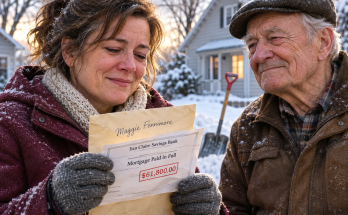
I couldn't stop looking at the number.
Sixty-one thousand eight hundred dollars.
For eleven years, that amount had been part of a mystery I couldn't explain.
Now I knew whose money it had been.
Horace Pickett's.
I sat in Ms. Castellanos's office with the old bank document in front of me.
Lyndon was still across the table.
The lawyer had given me the second letter, the one that ran four pages.
I had read only the beginning.
Mr. Pickett admitted that he had been a difficult man.
He knew the neighborhood disliked him.
He didn't pretend he'd been misunderstood.
I put my finger on the first page.
For years, I had accepted his unpleasant behavior as the whole truth about him.
Now I was being asked to look at something else.
Something I hadn't known existed.
I wanted to keep reading.
But the mortgage letter kept pulling my attention away.
I knew that date.
January.
Six weeks after Conrad died.
That was the month I had been trying to work out how to keep our house.
I could remember sitting with our bills and realizing my pharmacy paycheck wouldn't cover everything.
The mortgage was the largest problem.
I had two children to care for.
They were eight and ten when their father died.
Neither of them was old enough to understand how close I felt to losing the life we'd known.
I tried not to let them see how frightened I was.
But I was frightened.
Every day.
Then the letter from the bank arrived.
The mortgage had been settled.
I thought someone had made a mistake.
I called once.
Then again.
Then a third time.
Each time, I was told the same thing.
The payment was legitimate.
The person responsible hadn't wanted to be identified.
There was nothing further the bank could tell me.
Eventually, I stopped calling.
I still didn't understand.
I thought perhaps Conrad had arranged something without mentioning it.
I thought maybe there had been an insurance payment I didn't know about.
I couldn't imagine another explanation.
And I certainly didn't imagine Mr. Pickett.
I looked up from the document.
Lyndon had accused me of getting close to his uncle for money.
But I hadn't even known his uncle had helped me.
For eleven years, I'd been thanking no one because I didn't know whom to thank.
And for eleven years, Mr. Pickett had said nothing.
That bothered me almost as much as the amount.
Not because I was angry.
Because I couldn't understand how he had managed to keep such a large thing to himself.
He complained about small matters.
A dog barking.
A trash can left near the street.
Children stepping on his lawn.
He had never seemed able to let an irritation pass without making it known.
Yet he'd paid a neighbor's mortgage.
And kept quiet.
I looked back at the first page of his longer letter.
He had begun by acknowledging his own faults.
That much was clear.
I wasn't going to pretend I knew what the remaining pages meant before I read them.
But those first lines mattered.
Mr. Pickett had never seemed interested in admitting he was wrong.
Not to me.
Not to my children.
Not to anyone I had heard him speak with.
Now, after his death, I was looking at an admission written in his own hand.
It was difficult to take in.
I could still picture him in his bathrobe that first December morning.
He had been standing in his doorway.
His driveway was buried under two feet of snow.
He'd held a shovel that looked too heavy for him.
Then he went inside.
I didn't know what he was thinking.
I only knew what I'd seen.
An elderly man couldn't manage a job that needed doing.
So I crossed the street.
It had been that simple.
I hadn't told anyone.
I hadn't asked him to notice.
And when he continued treating me badly, I didn't use the snow shoveling against him.
I just returned whenever another storm came.
There were mornings when I resented him.
I could admit that now.
I didn't always feel generous.
Sometimes I was tired before I even started.
Sometimes I wondered why I bothered.
But I'd never believed he owed me a reward.
I didn't know he had already given my family more help than I could have afforded to repay.
I looked at Ms. Castellanos.
I wanted to ask questions.
How had Mr. Pickett arranged it?
Why had he chosen to remain anonymous?
Why hadn't he ever told me?
But I understood that the document answered only one question.
It established who had paid my mortgage.
It didn't explain every reason behind that decision.
And I didn't want to invent reasons for him simply because he was no longer there to answer.
Lyndon shifted in his chair.
I remembered what he'd said when I arrived.
He believed I had wanted the house.
The accusation had been so far from the truth that I hadn't known how to answer.
Now, sitting with the bank document, I could see how badly he'd misunderstood what had happened.
I hadn't spent eleven winters waiting for an inheritance.
I'd spent them trying to get to work on time and make sure a neighbor didn't have to struggle with heavy snow.
Mr. Pickett had never offered me anything for doing it.
I hadn't expected him to.
I thought about the ice storm.
The porch light.
The open front door.
The shape of his body near the steps.
His blue lips.
The cold beneath me when I lay down beside him.
I'd wrapped him in my coat until help arrived.
At the hospital, the doctor told me another thirty minutes outside might have killed him.
I'd gone there that morning because of a habit.
A habit that began with a shovel.
If I hadn't been checking on his driveway, I might not have seen him.
That was the part I couldn't stop thinking about.
I'd helped him through eleven winters.
But he'd helped me when my family was facing something I couldn't solve on my own.
Neither of us had known the whole story about the other.
At least, I hadn't.
His short note suggested he had understood more than I'd realized.
I returned my attention to the four-page letter.
I wanted to hear whatever he'd chosen to leave behind.
But before I read any further, I set the mortgage document down carefully.
I didn't want to crease it.
It had survived eleven years.
And I had only just learned what it meant.
For the first time since Conrad's death, I could name the person who had kept that mortgage from taking over my family's future.
Horace Pickett.
The man across the street.
The man I'd thought I understood.
I left the document on the table beside his handwritten letter.
They belonged together.
One showed what he'd done.
The other began to show that he had known exactly how people saw him.
I couldn't change the years we'd spent almost refusing to speak.
I couldn't go across the street and ask him why he'd kept his secret.
But I could stop pretending our story had been only about a woman clearing snow for an ungrateful neighbor.
It had never been that simple.
And I was finally beginning to understand how little I'd known.
Click here to continue reading: PART 6: The Four Page Letter Made Me Remember Every Winter Morning Differently, Especially the Ones When I Nearly Stopped Crossing the Street
For Eleven Winters I Cleared the Driveway of a Man Who Hated My Family Without Ever Knowing Why I Kept Going Back
Part 5 of 10