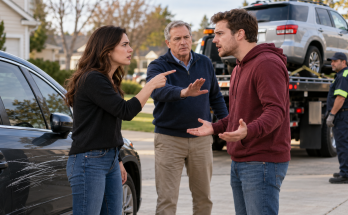
I wanted an apology.
That was what I had wanted from the beginning.
Not another argument.
Not another explanation about the camera.
Just an acknowledgment.
I wanted Mitch to admit he had damaged my SUV.
I wanted him to understand that refusing to give him money didn't justify what happened afterward.
And I wanted him to take responsibility without making me fight for every word.
I didn't get that.
What I got was denial.
He questioned what the video established.
He insisted the angle didn't show enough.
And when I asked him directly what he had been doing with the key, he couldn't answer.
That was how the confrontation stood.
No admission.
No apology.
No explanation I could accept.
I had to live with that.
For a long time, I had believed every serious family disagreement needed to end with someone admitting they were wrong.
I still thought honesty mattered.
I still believed responsibility mattered.
But I no longer believed I could force either one.
Mitch was responsible for what he said and did.
I was responsible for my own decisions.
And I had finally stopped confusing those responsibilities.
The car on the flatbed belonged to me.
Mitch had been driving it for two years.
I had allowed him to use it.
Now I was taking it back.
That was the outcome I could control.
I thought about the driver confirming that the vehicle was secure.
It was such a small exchange.
I asked a practical question.
He answered.
I thanked him.
But those words marked the moment when I stopped arguing and allowed my decision to stand.
Dad had told me to have the car unloaded.
I hadn't done it.
Mitch had refused to acknowledge what the recording showed.
I hadn't allowed that refusal to change my mind.
The vehicle remained secured.
The recovery was not reversed.
After two years of driving my car, Mitch was no longer going to have my permission to keep using it.
That wasn't the outcome I had once imagined for the arrangement.
When I first allowed him to drive the vehicle, I hadn't expected a confrontation over another car.
I hadn't expected fifteen thousand dollars to become the center of a dispute.
And I hadn't expected to watch a recording of my own brother holding a key against the paint of my SUV.
But those things had happened.
I couldn't undo them.
I could only decide what they meant for the help I continued to offer.
And I had decided that help was ending.
I didn't feel proud in the way people sometimes describe standing up for themselves.
I wasn't pleased that my brother was losing access to the car.
I wasn't happy that Dad had disagreed with me.
I wasn't satisfied that Mitch had remained silent when asked to explain the key.
Those weren't things worth celebrating.
I felt disappointed.
That was the simplest word for it.
Disappointed in what had happened.
Disappointed in the argument.
Disappointed that my brother seemed more interested in escaping responsibility than in addressing the damage.
I had hoped for something better.
That was the truth.
Even after seeing the recording, I had hoped he might surprise me.
Maybe he would admit it.
Maybe he would apologize.
Maybe we could deal with the scratches without another long argument.
Instead, he did exactly what I had feared he would do.
He challenged the evidence.
And when I asked for an explanation, he had none.
That left me with a choice.
I could keep searching for the right words.
Or I could accept that the conversation had gone as far as it was going to go.
I chose the second.
I thought about the SUV.
Forty thousand dollars.
A vehicle that belonged to me.
Paint that had been scratched after I refused Mitch's demand for money.
The damage remained part of the situation.
Taking back the other car didn't repair it.
I wasn't going to pretend otherwise.
I also wasn't going to pretend that reclaiming my car settled every question about responsibility.
Mitch hadn't confessed.
Dad hadn't withdrawn his instruction.
And I didn't know whether either of them would ever see the incident the way I did.
The source of the disagreement remained.
What changed was my willingness to keep providing something I owned.
I no longer believed the arrangement could continue as before.
I didn't trust Mitch with the same freedom I had allowed him for two years.
That was the cost I could name.
Trust.
It had changed.
I hadn't expected a disagreement over money to affect it so deeply.
But the scratches made it personal.
The denial made it worse.
I could have dealt with an angry brother.
I could have dealt with a brother who disliked being refused money.
What I struggled to accept was the combination of damage and denial.
He had been confronted with what I believed was clear evidence.
And his first instinct had been to reject it.
That told me something about what I could expect if another problem arose.
I wasn't willing to keep exposing my property to that possibility.
I thought about the two years he had driven my car.
That help had been genuine.
I didn't need to erase it from our history.
I didn't need to tell myself that helping him had been foolish from the beginning.
I had made a choice to help my brother.
At the time, I had been willing to make that choice.
Now circumstances had changed.
So had my decision.
I could accept both things without contradicting myself.
I had helped him.
And I had stopped.
One didn't cancel the other.
For a long time, that had been difficult for me to understand.
I thought withdrawing help meant admitting that giving it had been a mistake.
I thought saying no made me selfish.
I thought a family member's anger meant I had failed them.
But standing beside that flatbed forced me to reconsider.
I hadn't failed Mitch by refusing fifteen thousand dollars.
I hadn't wronged him by retaining control of a car that belonged to me.
And I hadn't become responsible for his behavior because my decision disappointed him.
He had choices.
So did I.
He had chosen how to respond when I refused the money.
He had chosen how to answer when I confronted him about the recording.
I had chosen not to continue the arrangement with my car.
Those choices belonged to the people who made them.
I couldn't take responsibility for all of them.
I thought about Dad once more.
He had wanted the confrontation stopped.
I understood why an argument between family members could make someone want an immediate end to it.
But I wished he had understood that unloading the car wouldn't solve the problem.
It would only reverse my decision.
The scratches would remain.
The recording would remain.
And Mitch's lack of an explanation would remain.
Nothing about that would have made me feel safe continuing the arrangement.
I hadn't wanted to defy Dad simply to prove a point.
I had wanted to keep control of my property.
There was a difference.
And I knew it, even if he disagreed.
I returned to the last exchange with the driver.
My question had been simple.
Was the car properly secured?
He confirmed that it was.
I thanked him.
And I didn't tell him to take it down.
Those were the final actions established in that confrontation.
I couldn't honestly claim that everything afterward was resolved.
I couldn't say Mitch eventually apologized.
I couldn't say Dad changed his mind.
I couldn't say the SUV had already been repaired or that every consequence had been settled.
None of that was part of what I knew.
What I knew was that I had taken back control of my car.
The vehicle Mitch had driven for two years was secured for recovery.
And I had refused to reverse that decision.
That was enough to mark a change.
Not because I had made Mitch admit anything.
I hadn't.
Not because the damage to my SUV no longer mattered.
It still did.
But because I had finally accepted that my brother's refusal to take responsibility didn't require me to keep providing him with the benefits of my trust.
I could be angry without retaliating.
I could be disappointed without surrendering.
And I could care about my brother without giving him my money or my car.
Those were things I wished I had understood sooner.
The scratches on the SUV would always remind me of what started the confrontation.
The ninety seconds on camera would remind me why I asked for an explanation.
Mitch's silence would remind me that not every question receives an answer.
And the secured car would remind me that I didn't need that answer to make a decision about my own property.
I had wanted the truth acknowledged.
I had wanted the family argument settled.
I had wanted to leave the confrontation feeling that something had been repaired.
Instead, I left the decision where it stood.
The car was not being unloaded at Dad's request.
Mitch was not being allowed to continue driving it.
And I was no longer waiting for his approval.
That was the outcome.
It cost me the comfortable belief that helping family would always be met with respect.
It left me disappointed in my brother and unsettled by Dad's response.
But it also left me with something I hadn't had during all those years of trying to keep everyone satisfied.
A limit I was willing to enforce.
I hadn't fixed everything.
I hadn't received an apology.
I hadn't erased the damage.
I had simply stopped allowing the argument to decide what happened to something that belonged to me.
For once, I didn't need Mitch to agree.
I didn't need him to admit defeat.
I didn't even need him to understand.
The car was mine.
I had taken it back.
And I was not changing my mind.
The End
Read more original stories on Feel Every Story.
I Thought Catching My Brother on Camera Would Finally Make Him Admit What He Had Done to My SUV
Part 16 of 16