
Two years.
I kept returning to that number.
It was a long time.
Long enough for something borrowed to begin feeling ordinary.
Long enough for the person using it to forget that somebody else had the final say.
I couldn't tell exactly when Mitch began thinking of the car as something he should always have.
I didn't know whether he thought that at all.
What I knew was simpler.
He had been driving my car for two years.
And I had decided that arrangement was over.
For a long time, I had seen helping him as a reasonable thing to do.
He was my brother.
I had a car he could use.
So I let him drive it.
There didn't need to be a grand reason.
Family helped family.
I believed that.
I still did.
What I hadn't thought enough about was what happened when help became expected.
What happened when a person who had already received something began demanding something more.
Fifteen thousand dollars.
That was what Mitch wanted.
I had refused to give it to him.
I didn't need to explain every reason behind that refusal.
The money was mine.
And no was an answer.
I had a hard time allowing myself to leave it there.
I kept thinking that perhaps I should have said it differently.
Perhaps I could have been more patient.
Perhaps Mitch wouldn't have become so angry if I had found a way to make the refusal easier to hear.
Then I remembered my SUV.
The scratches.
The key.
The ninety seconds.
And I realized how much responsibility I was trying to take for somebody else's behavior.
I had refused a request.
That was all.
Mitch was responsible for what he did afterward.
I couldn't put those two decisions on the same level.
I wasn't going to pretend that refusing to give him money justified damaging my vehicle.
It didn't.
The thought should have been obvious.
But with Mitch, I had grown accustomed to examining my own behavior every time he reacted badly.
Had I been too harsh?
Had I misunderstood?
Had I made things worse?
I asked myself those questions almost automatically.
Standing by the flatbed, I recognized the habit.
And I didn't like what it said about me.
I had become so concerned with avoiding conflict that I sometimes treated Mitch's anger as evidence that I had done something wrong.
His anger was not proof.
Neither was his disappointment.
He could be upset without being right.
That realization was uncomfortable.
Because it meant I couldn't keep blaming misunderstandings for a problem that had become clear.
I was allowed to help him.
I was also allowed to stop.
I thought about the car one more time.
Two years of use.
Two years during which it remained my property.
I hadn't stopped owning it because he drove it.
I hadn't given up the right to take it back because the arrangement had continued.
Those facts hadn't changed.
Only my willingness to act on them had.
I wondered why that felt so difficult.
Maybe because taking back the car was a visible decision.
A refusal of money could remain a conversation.
A car on a flatbed was harder to ignore.
It showed that something had changed.
It showed that I wasn't going to settle the matter by making another concession.
And it gave Dad something immediate to object to.
I understood why the flatbed drew his attention.
It was right there.
The driver was there.
The car was secured.
Dad could point at it and tell me to reverse the decision.
The scratches on my SUV weren't so easily undone.
Neither was Mitch's refusal to explain them.
I kept thinking about the difference.
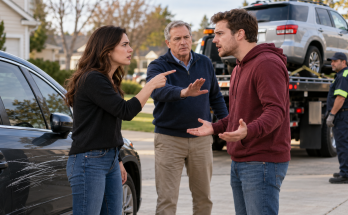
Dad had told us the argument needed to stop.
Then he had directed me to have the car unloaded.
But ending an argument and reversing a decision were not the same thing.
I could stop arguing.
I could refuse to say another word about the recording.
I could let Mitch keep his opinion of what the camera proved.
None of that required me to return the car.
That was the distinction I wanted to hold on to.
I didn't need to win the conversation.
I needed to stop surrendering the decision.
The car belonged to me.
The decision belonged to me.
And the responsibility for scratching my SUV belonged to the person who had done it.
Those things were separate.
I was beginning to see how often I had allowed them to become tangled.
Mitch wanted me to defend the evidence.
Dad wanted the confrontation stopped.
I wanted the arrangement with the car ended.
Only one of those things was completely within my control.
So I focused on that.
I didn't try to make the driver part of the family disagreement.
He had a job to do.
I had asked whether everything was secure.
He had confirmed it.
I thanked him.
That was the entire conversation I needed to have with him.
I wasn't going to ask him to reverse what had already been prepared.
The car stayed on the flatbed.
And I allowed myself to accept something I should have understood much earlier.
Helping my brother for two years did not mean I owed him a third.
Click here to continue reading: PART 8: I Had Wanted My Brother to Admit the Truth, but Taking Back My Car Required Something He Never Had to Give Me
I Thought Catching My Brother on Camera Would Finally Make Him Admit What He Had Done to My SUV
Part 7 of 16

One Comment on “PART 7 – For Two Years I Had Let My Brother Drive My Car, and Only Now Did I Understand What I Had Given Away”