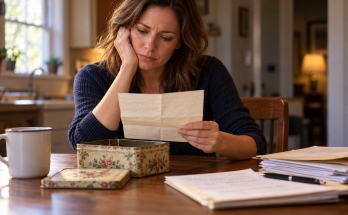
I remained seated long after Rosella's friend stopped turning the pages.
My name was still there.
Elnora Ruthanne Whitsett.
I had written it on employment forms, bank papers, and countless documents over the years.
Seeing it in that old book should not have felt unfamiliar.
But it did.
The name seemed to belong to a woman I had never met.
A woman who had somehow become connected to a property that was never supposed to be hers.
I ran my finger along the edge of the page without touching the ink.
"Could this be a mistake?"
Rosella's friend did not answer immediately.
She studied the entry again.
Then she looked at me.
"That is what we need to understand."
I wanted a clearer answer.
I wanted her to tell me that there was an obvious explanation and that I could go home without carrying another worry.
Instead, she kept her eyes on the book.
I looked at the clerk.
He had returned to his desk and was sorting papers.
The courthouse continued around us as though nothing important had happened.
A telephone rang.
Someone asked a question at another counter.
A door opened and shut.
Ordinary sounds.
I could not understand how the world had continued to behave normally.
Rosella's friend closed the book carefully.
She did not say that the property belonged to me.
She did not say that the record gave me any particular right.
She only said that the entry mattered and that we needed to be certain we understood it.
That distinction was important.
I had seen my name.
I had not yet learned what it meant.
We spent more time examining the record.
The description matched the property I knew, down to the old pike and the fields near the creek.
There was no reasonable way to pretend it referred to some unrelated place.
I asked when the entry had been made.
Rosella's friend looked over the page again, trying to make sense of the information available to us.
I could not tell what she was thinking.
I only knew she had expected to find something.
That troubled me more than the record itself.
She had not brought me to the courthouse by accident.
She had known there was a reason for looking.
I asked whether Rosella had told her about the property.
She paused.
"Rosella believed some things needed to be understood before anyone made a decision."
It was not the answer I wanted.
"What things?"
She looked at me with a sadness that made me stop asking.
"I cannot tell you what I do not know."
I believed her.
At least, I wanted to.
We left the courthouse with no simple explanation.
Outside, the air felt warmer than it had when we arrived.
I stood on the steps and looked toward the street.
I thought of the farmhouse.
I thought of Rosella's sons.
And I thought of the way Rosella had held those papers in her lap shortly before she died.
There are things I should have explained a long time ago.
Perhaps she had been trying to explain something.
Perhaps she had run out of time.
I hated myself for not asking more questions when I had the chance.
For years, I had told myself that staying out of family matters was a sign of respect.
Now I wondered whether it had simply been easier to remain ignorant.
Rosella's friend drove me home.
I thanked her before getting out of the car.
She asked me not to make any decisions based on what we had seen.
I told her I would not.
Then I went inside and sat at my kitchen table.
I tried to remember every conversation I had ever heard about the farmhouse.
Rosella's sons had always discussed the property as though it were their future inheritance.
They spoke about the fields, the house, and the cost of maintaining the land.
I had assumed their interest was ordinary.
Most children eventually think about what their parents will leave behind.
But if the property record had some meaning beyond an ordinary family document, I could no longer ignore the possibility that they might not know everything.
Or perhaps they knew far more than I did.
I could not decide which thought frightened me more.
That evening, I barely ate.
I sat by the window until the light faded, remembering the years I had spent in Rosella's kitchen.
I remembered her correcting the placement of a chair.
I remembered her asking me to stay for tea.
I remembered the way she had asked whether I had ever found a place that felt permanent.
At the time, I had thought she was making conversation.
Now I was no longer certain.
The following morning, I returned to the farmhouse.
I had no clear reason to go.
My work there was finished, and I had no intention of entering the house without permission.
But I wanted to look at it one more time.
I wanted to see the place with my own eyes and remind myself that the record in the courthouse was not some strange dream.
The gravel drive was quiet.
The pecan grove stood beyond the tenant house.
The fields stretched toward the creek.
Nothing looked different.
I remained outside for several minutes before turning back toward my car.
Then I saw one of Rosella's sons near the entrance.
He was speaking to someone on the telephone.
When he noticed me, he ended the call.
"What are you doing here?"
His tone was not openly hostile.
Still, I felt as though I had been caught doing something wrong.
"I wanted to see the house."
He looked past me toward the road.
"There's nothing here for you now."
The words stung more than I expected.
I had known I was an employee.
I had never believed that twenty-six years of work made the property mine.
But I had thought those years meant something to the people who lived there.
"I understand," I said.
He studied me for a moment.
Then he asked whether anyone had contacted me about Rosella's affairs.
I hesitated.
"Someone spoke to me."
His expression changed.
"Who?"
"Rosella's friend."
He looked away.
For a few seconds, he said nothing.
Then he told me that the family was handling everything and that I should not involve myself.
I wanted to ask what he was afraid I might discover.
Instead, I nodded and walked back to my car.
I drove away with my hands tight on the steering wheel.
That was the first time I seriously wondered whether the record was something his family did not want me to see.
I did not know what it meant.
I did not know whether it changed anything about my life.
But I knew that Rosella's son had reacted differently when I mentioned her friend.
And I knew that he had asked whether anyone had spoken to me before telling me to stay away.
I had spent years cleaning around conversations that stopped when I entered a room.
Now I was beginning to understand how much those silences had concealed from me.
Click here to continue reading: PART 4: I Returned to the Courthouse With More Questions Than Answers, and Every Familiar Detail of the Farmhouse Began to Feel Different
I Spent Twenty-Six Years Cleaning a Wealthy Woman’s Home Without Knowing Why She Never Let Me Leave It Behind
Part 3 of 20