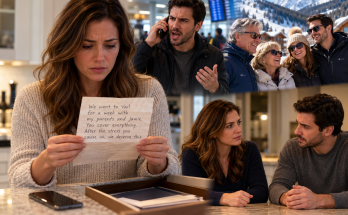
Several weeks passed before I stopped thinking about the vacation every day.
At first, I noticed its absence.
I would walk into the kitchen and remember the note.
I would hear my phone ring and remember Mauro shouting from the airport.
I would open the household drawer and remember how frightened I had been that refusing to reactivate the card would cost me my marriage.
Then the memories began to settle.
They did not disappear.
They simply stopped controlling the way I experienced every ordinary moment.
Mauro and I were learning to talk before making decisions.
Sometimes he asked me what I thought before agreeing to a family plan.
Sometimes I reminded him that we needed more information before committing to an expense.
There were still awkward conversations.
There were still moments when he became defensive.
There were moments when I wanted to give in just to make the tension disappear.
But I was learning to recognize those moments for what they were.
A difficult conversation was not necessarily a failed marriage.
Someone's disappointment was not proof that I had done something wrong.
And refusing a request was not the same as refusing to love the person who made it.
One Saturday morning, Mauro and I sat at the kitchen table with our calendars open.
We were discussing plans for the coming weeks.
He mentioned a family event and asked whether I wanted to attend.
I checked my schedule.
Then we discussed the details together.
It took only a few minutes.
No one became angry.
No one assumed the other person would pay for something without asking.
When we finished, Mauro closed the calendar.
“Anything else we need to discuss?”
I smiled.
“Not right now.”
He reached for his coffee.
I watched him for a moment.
The scene was so ordinary that someone else might not have noticed its significance.
But I did.
This was what I had wanted all along.
Not to control Mauro.
Not to prevent him from helping his family.
Not to make him ask permission for every small decision.
I wanted us to treat each other as partners.
I wanted a chance to speak before a decision became an obligation.
I wanted to know that my answer mattered, even when it was no.
After breakfast, I cleaned the kitchen.
I washed the mugs and wiped the counter.
Then I opened the drawer to put away a receipt.
The folder was still there.
I took it out and sat at the table.
For a long time, I had wondered whether keeping the note meant I was refusing to forgive Mauro.
I no longer believed that.
Forgiveness did not require me to erase the past.
It required me to stop using the past as the only way to understand the present.
I could acknowledge that Mauro had hurt me.
I could accept his apology.
I could recognize the effort he was making to change.
And I could still keep the paper that reminded me why I had finally spoken up.
I unfolded it.
The message was brief.
The words had been written casually, without any sign that Mauro expected them to matter beyond the moment.
He had left them on the counter and gone to Colorado.
At the time, I had read the note as a demand.
Now I saw something else in it.
I saw the assumption that had existed beneath many of our disagreements.
He had assumed I would pay.
I had assumed that refusing would make me a bad wife.
Both assumptions had kept us trapped in a pattern neither of us had properly examined.
But the responsibility for his decision had belonged to him.
And the responsibility for my future choices belonged to me.
That was the distinction I needed to remember.
I folded the paper along its creases and placed it back in the folder.
Then I returned the folder to the drawer.
I did not need to destroy the note.
I did not need to display it.
I simply needed to stop living according to the expectation it represented.
Later that afternoon, Mauro found me in the living room.
“Do you want to go for a walk?”
I looked up from my book.
“Sure.”
We left the house together.
The weather was mild, and the neighborhood was quiet.
We walked without discussing the vacation.
We talked about ordinary things.
At one point, Mauro asked whether I thought we were doing better.
I considered the question.
“Yes,” I said. “I think we are.”
He nodded.
“I'm glad.”
I looked at him.
“So am I.”
There was more I could have said.
I could have told him that I still worried about old habits returning.
I could have reminded him that an apology was only meaningful if our behavior continued to change.
But I didn't need to turn that walk into another difficult conversation.
We had already spoken honestly about what happened.
Now we needed to live differently.
That would take time.
When we returned home, Mauro went into the kitchen to get water.
I followed him.
He filled two glasses and handed one to me.
We stood beside the counter, drinking in silence.
The kitchen looked the same as it had on the day I found the note.
The same counter.
The same drawer.
The same table where I had sat through so many difficult conversations.
But the room no longer felt like the place where I had lost control of my marriage.
It felt like the place where I had finally begun to take responsibility for my own choices.
I had not forced Mauro to change.
I had not made Patricia agree with me.
I had not convinced every member of his family that my decision was reasonable.
I had done something smaller.
I had stopped pretending that my silence meant agreement.
That choice had frightened me.
It had also made an honest conversation possible.
Mauro set his glass in the sink.
“Are you all right?”
I looked at him.
“Yes.”
This time, the answer did not mean that I was hiding something.
It meant I was learning to trust myself.
I knew we would have disagreements again.
I knew Mauro would sometimes disappoint me.
I knew I would sometimes disappoint him.
No marriage could promise otherwise.
What mattered was whether we could speak honestly when those moments came.
Whether we could listen without immediately defending ourselves.
Whether we could admit when we had made a mistake.
Whether we could remember that love did not give either person the right to make decisions for the other.
I could not guarantee that we would always succeed.
But I could promise myself that I would no longer disappear simply to keep the peace.
That evening, we made dinner together.
Mauro asked what I wanted to eat.
I told him.
He suggested something else.
We discussed it and settled on a meal we both liked.
It was a small exchange.
A question.
An answer.
A decision made together.
I smiled as I reached for a plate.
For years, I had thought being a good wife meant making sure everyone else had what they needed.
I had measured my love by how much I could carry without complaining.
I had believed that if I were patient enough, generous enough, and careful enough, I could prevent the people I loved from becoming unhappy with me.
I know better now.
I can be generous without giving up my judgment.
I can be patient without remaining silent.
I can love my husband without accepting every decision he makes.
And I can forgive someone without pretending that what happened did not matter.
The platinum card had been the immediate problem.
The vacation had exposed the deeper one.
I had spent years believing that keeping the peace was my responsibility, even when the peace depended on me accepting things I had never agreed to.
When I finally refused, I was terrified of what I might lose.
I thought I might lose Mauro.
I thought I might lose his family's approval.
I thought one decision could undo everything we had built.
Instead, it forced us to face something we had avoided for too long.
We had to learn that marriage meant more than sharing expenses and living under the same roof.
It meant allowing both people to have a voice.
The note remained in the drawer.
I kept it because I wanted to remember the lesson, not because I wanted to keep the argument alive.
I wanted to remember the woman who had stood alone in the kitchen, holding a phone to her ear, listening to her husband demand that she make everything right.
I wanted to remember how frightened she had been when she said no.
And I wanted to remember that she had said it anyway.
I had once believed that love meant never making the people around me uncomfortable.
Now I understood that honest love sometimes required a difficult answer.
Not every disagreement could be avoided.
Not every person would understand.
Not every apology would repair everything immediately.
But I no longer believed that my worth depended on how much I was willing to sacrifice without being asked.
I was Rebecca.
I was Mauro's wife.
I was a person whose feelings and decisions mattered.
And I did not need to prove my love by giving up the right to choose.
That was what the missing platinum card had taught me.
Not how to win an argument.
Not how to punish someone who had hurt me.
How to stop confusing being needed with being respected.
I turned off the kitchen light that night and followed Mauro down the hallway.
The drawer stayed closed.
The note stayed inside.
And for the first time in a long while, I went to bed without wondering what I would have to give up to make the next morning peaceful.
The End
Read more original stories on Feel Every Story.
The Morning My Husband Demanded Money From Me, I Finally Understood How Little My Permission Had Ever Mattered
Part 20 of 20