The conversation happened on an ordinary Tuesday evening.
Mauro and I had finished dinner.
I was wiping the kitchen counter while he stacked the plates beside the sink.
He looked at me for a moment.
“Can I ask you something?”
“Of course.”
He hesitated.
“Do you think things are different between us now?”
I put the cloth down.
I had thought about that question many times.
I had wondered whether he would ever ask it.
I had also wondered whether I would be brave enough to answer honestly.
“Yes,” I said.
He looked concerned.
“Different how?”
I sat at the table.
He pulled out the chair opposite me.
I took a breath.
“I think I understand our marriage differently now.”
He waited.
“I used to believe that if I could keep things peaceful, that meant we were doing well. If you were upset, I tried to fix it. If your family needed something, I tried to help. If I disagreed with a decision, I often kept quiet because I didn't want an argument.”
Mauro looked down at the table.
I continued.
“I thought I was being supportive. Sometimes I was. Other times, I was afraid to say what I really thought.”
He rubbed his hands together.
“I didn't know you felt that way.”
“I know.”
I meant it.
I had not always told him.
I had hidden my frustration behind practical solutions and quiet compromises.
But the fact that he hadn't known did not mean the pattern had been harmless.
“I need to be more honest with you,” I said. “And I need you to listen when I am.”
He nodded slowly.
I looked toward the kitchen drawer.
“The vacation made me realize how much I had accepted without being asked.”
Mauro was quiet.
“I thought you would understand why I wanted to take my family away,” he said.
“I did understand that. I still do.”
“Then why did it become so serious?”
I looked at him.
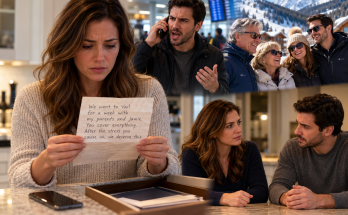
“Because you didn't ask me. You left a note telling me to pay for everything. When I questioned the card, you threatened to cut me out of your life.”
He closed his eyes briefly.
“I shouldn't have said that.”
“No, you shouldn't have.”
He nodded.
For once, he did not explain that he had been angry.
He did not tell me I had pushed him too far.
He simply sat with the words.
That mattered.
I continued.
“I don't want to keep bringing up the vacation forever. But I need to know that the next time you want to make a decision like that, you'll talk to me first.”
“I will.”
I watched him carefully.
He seemed sincere.
But I had learned not to treat a promise as proof that a habit had changed.
“I'm not asking you to stop helping your family,” I said. “I'm not asking you to stop making plans. I'm asking you to include me when those plans affect us.”
He nodded again.
“I understand.”
I wanted to ask whether he truly did.
Instead, I gave him room to speak.
He looked toward the window.
“I think I've been taking your help for granted.”
I remained still.
He continued slowly.
“You've always handled things. If something went wrong, you usually found a way to fix it. I got used to that.”
I felt a knot tighten in my throat.
It was the first time he had described the pattern in his own words.
“I thought you didn't mind,” he added.
“Sometimes I didn't.”
I paused.
“Sometimes I minded very much, but I didn't say so.”
He looked at me.
“Why didn't you?”
I could have given him a long answer.
I could have described the arguments, the guilt, and the fear that saying no would make me seem selfish.
Instead, I chose the simplest truth.
“I wanted everyone to be happy with me.”
He was quiet.
“And I thought if I made things easy enough, we wouldn't have to fight.”
He lowered his eyes.
“I didn't realize that was what you were doing.”
“I didn't fully realize it either.”
We sat in silence.
I could hear the refrigerator running.
A car passed outside.
The ordinary sounds of the house seemed unusually clear.
Mauro finally spoke.
“I'm sorry I left without asking you.”
The words were quiet.
I looked at him.
“I appreciate that.”
“I'm also sorry I spoke to you the way I did when the card stopped working.”
I felt my eyes sting.
I had wanted to hear those words from the beginning.
Not because an apology could undo the week.
Because it meant he was willing to acknowledge the part of the situation that belonged to him.
“Thank you,” I said.
He reached across the table and took my hand.
I let him hold it.
For a moment, neither of us spoke.
Then he said, “I don't want us to go back to fighting like that.”
“Neither do I.”
He squeezed my hand.
“I can't promise we'll never disagree.”
“I wouldn't expect that.”
“But I can try to talk to you before making decisions.”
“That would mean a lot to me.”
We remained at the table for several minutes.
I felt relieved.
I also felt cautious.
I had lived with our old pattern for too long to believe one conversation could change everything.
Still, the apology mattered.
It was not the end of the work.
It was a beginning.
Later that evening, I took the folder from the drawer.
I opened it and looked at the note.
The handwriting was still the same.
The words were still the same.
But I no longer felt that I needed the paper to prove that my experience had been real.
Mauro had acknowledged what he had done.
He had apologized.
I could keep the note as a reminder without needing it to defend me.
I folded it and placed it back in the folder.
Then I returned the folder to the drawer.
I stood in the kitchen for a moment.
The counter was clean.
The chairs were pushed beneath the table.
The room looked exactly as it had on the morning I found the note.
But I was not the same person who had stood there reading it.
I had learned that love did not require me to accept every demand.
I had learned that a boundary could make someone unhappy without making it wrong.
And I had learned that a marriage could not become more honest if one person did all the work of avoiding conflict.
Mauro and I still had things to learn.
We would still disagree.
There would still be days when one of us misunderstood the other.
But we had finally spoken about the problem without turning it into a contest over who had suffered more.
That night, I went to bed feeling hopeful.
Not certain.
Hopeful.
For the first time since the airport call, I believed we might be able to build something better than the arrangement we had before.
Click here to continue reading: PART 20: I Kept the Note After We Made Peace, Because the Most Important Thing I Learned Was Not About a Platinum Card but About My Own Voice
The Morning My Husband Demanded Money From Me, I Finally Understood How Little My Permission Had Ever Mattered
Part 19 of 20