I used to believe that keeping a family together meant knowing when to give in.
That morning, I learned how expensive that belief could become.
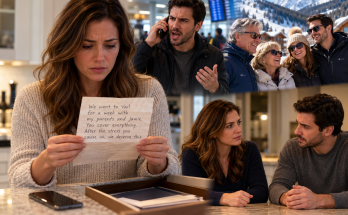
My phone rang while I was standing in the kitchen, staring at a piece of paper Mauro had left behind.
His voice came through before I could even say hello.
“Rebecca, you need to fix this immediately. If you leave me stranded over a stupid card, don't expect me to forgive you.”
He sounded furious.
There was an echo behind his words, the kind that came from a large public building. I could hear people talking, an announcement crackling overhead, and someone calling out a name in the distance.
An airport.
Mauro was somewhere in Colorado, and he was calling me as though I had deliberately arranged his humiliation.
I looked down at the paper on the counter.
He had written the message in a hurry, using the same black pen he kept beside the telephone at home.
We had gone through arguments before. We had endured unpleasant dinners, tense holidays, and conversations that ended with one of us walking away.
But this was different.
Mauro had taken his family to Vail without asking me.
Then he had expected me to pay for everything.
I had discovered the note two evenings earlier, after coming home and finding the house unusually quiet.
At first, I thought he had gone out to buy something.
Then I saw the empty space beside the coat rack where his suitcase usually stood.
His shoes were gone.
So were the small bags Patricia kept in the hall closet for weekend trips.
I had called him twice.
He hadn't answered either call.
When I found the paper on the kitchen counter, I finally understood why.
He had made the decision without me and left the explanation behind as though I were an employee who needed instructions.
I had read his message several times.
Each time, the words seemed more insulting.
He had not asked whether I could afford the trip.
He had not asked whether I wanted to join them.
He had not even bothered to tell me where they were going until he was already gone.
And now he was shouting because the platinum card he had been using was no longer available.
“Are you going to answer me?” he demanded.
“I already answered you.”
“No, you haven't done anything.”
“I contacted the card company.”
There was a pause.
Then his voice dropped into the tone he used whenever he wanted me to feel foolish.
“Why would you do that?”
“Because I saw charges I couldn't account for.”
“You know perfectly well those charges were mine.”
“That doesn't mean I agreed to them.”
He exhaled sharply.
I could picture him standing near an airport counter, one hand gripping his phone, the other moving impatiently through the air.
Mauro hated being told no.
He hated it even more when someone told him no in front of other people.
For years, I had tried to protect him from that feeling.
I had paid bills quietly, corrected mistakes without mentioning them, and pretended not to notice when his promises became obligations that somehow landed on my shoulders.
I told myself marriage required patience.
I told myself everyone had weaknesses.
Sometimes, I even told myself that his behavior was my fault because I was better at handling money than he was.
That was the lie I had lived with longest.
“Reactivate it,” he said. “We'll discuss the rest when I get home.”
I stared at the paper.
The word everything seemed to stand out more than the others.
Everything.
As if I had agreed to become responsible for every person he had chosen to bring along.
“No,” I said.
The silence on the other end was immediate.
“What did you say?”
“I said I'm not turning it back on.”
“You cannot be serious.”
“I am.”
“You're embarrassing me.”
I almost laughed.
Not because anything was funny, but because of how familiar the accusation sounded.
He had left me out of his plans, spent money without asking, and disappeared with his relatives.
Yet somehow, I was the one embarrassing him.
“I didn't know you were going to Colorado,” I said.
“You knew we were planning a vacation.”
“I knew you had mentioned taking a trip. I didn't know you had decided I would pay for it.”
“We're married, Rebecca.”
“I know.”
“Then stop acting like we're strangers.”
That sentence stayed with me.
For a long time, I had treated our marriage as a shared responsibility.
Mauro seemed to treat it as a standing arrangement in which I provided the resources and he decided how they would be used.
I had not understood the difference until he was hundreds of miles away, demanding access to money I had never agreed to spend.
Before I could answer, another voice joined the conversation.
Patricia.
His mother had a way of entering a disagreement as if she had been appointed to settle it.
She never needed an invitation.
She simply assumed that whatever happened between Mauro and me was also her business.
“Rebecca, what is wrong with you?”
I closed my eyes briefly.
There she was.
“We are trying to enjoy ourselves, and you're making this into a disaster.”
“I didn't know you were all going.”
“Oh, please. Don't start that.”
“I found Mauro's note after he left.”
“And what does that prove?”
I looked at the paper again.
It proved more than I could explain in a single sentence.
“It proves nobody asked me.”
Patricia made a sound of disgust.
“You should be grateful that Mauro wants to include his family.”
I wondered which family she meant.
The one he had taken to Colorado?
Or the one he had left behind to handle the consequences?
“I'm his wife,” I said.
“Exactly. You should act like it.”
That hurt more than I expected.
Not because Patricia had said something new, but because I had spent years trying to earn her approval.
I had learned which foods she liked, which subjects upset her, and which small inconveniences could ruin her mood.
I had remembered birthdays and purchased gifts.
I had made room for her opinions in decisions that should have belonged to Mauro and me.
I had done all of that because I believed kindness might eventually become mutual.
Looking back, I am embarrassed by how long I waited.
“Patricia, I didn't cancel the card to punish anyone,” I said. “I reported it because I didn't recognize the spending.”
“Your husband was using it.”
“That doesn't answer my question.”
“What question?”
“Why was I expected to pay for a trip I never agreed to?”
For a moment, neither of them spoke.
I heard the airport announcement again.
Then Mauro returned to the conversation.
“Enough. You're making this ridiculous.”
“I didn't make the reservation.”
“You're the one causing the problem now.”
“I haven't done anything except report the card.”
“And now we're stuck here.”
I pressed my fingertips against the counter.
The stone felt cool beneath my hands.
I needed something solid to focus on because the conversation was beginning to feel unreal.
“Where are you right now?” I asked.
“At the airport.”
“Then talk to the card company there.”
“Why would I do that when you can fix this in thirty seconds?”
“Because I don't know what happened to the card.”
He went quiet again.
I had not meant to say anything dramatic.
It was simply the truth.
I did not know where the card was.
I did not know who had used it most recently.
I did not know why the transactions had appeared the way they had.
And I was no longer willing to pretend those questions did not matter just because Mauro disliked answering them.
His voice became colder.
“If you don't sort this out right now, don't bother expecting me to treat you like my wife when I come back.”
I looked at the empty chair across the kitchen table.
It was the chair he usually occupied while scrolling through his phone and telling me about his day.
For years, I had imagined that one day we would sit there and discuss our finances honestly.
I had pictured us planning together, saving together, and making decisions without either person feeling cornered.
Instead, I was standing alone in our kitchen while my husband threatened to withdraw his affection unless I restored his access to money.
“I'm sorry you're having trouble,” I said.
I was surprised by how calm I sounded.
“But I'm not reactivating the card.”
Mauro began speaking over me.
I couldn't make out every word.
Then Patricia said something sharp enough that I pulled the phone away from my ear.
I ended the call.
For several seconds, I simply stood there.
My heart was beating hard.
My hands were trembling.
I had expected to feel triumphant after finally refusing him.
Instead, I felt afraid.
Not of Mauro's anger itself, but of what would happen if I stopped making that anger go away.
I had built so much of my life around preventing the next argument that I had forgotten what it felt like to make a decision without calculating everyone else's reaction.
The phone rang again.
I watched Mauro's name appear on the screen.
I let it ring.
It stopped.
Then it started again.
I turned the phone facedown beside his note.
The kitchen fell quiet.
I looked at the paper one last time before folding it in half.
I didn't throw it away.
I put it in the drawer where I kept household documents.
I wasn't sure why.
Maybe I wanted proof of what he had written.
Maybe I wanted to remember how the whole thing had started.
Or maybe some part of me already understood that I would need to stop relying on my memory whenever Mauro insisted that things had happened differently.
That evening, I ate dinner alone.
I heated something simple and sat at the table without turning on the television.
The empty chair across from me bothered me more than I expected.
Not because I missed Mauro's company that night.
I missed the husband I had spent years believing he might become.
I missed the version of our marriage in which a decision about money would begin with a conversation instead of an ultimatum.
I finished eating and carried my plate to the sink.
Then I checked my phone.
There were three missed calls from Mauro and two messages from Patricia.
I didn't open them.
For once, I allowed other people to be angry without rushing to repair the situation.
It was a small decision.
It changed the way I saw everything that followed.
Click here to continue reading: PART 2: His Family Called My Refusal Cruel, but the Note on My Counter Revealed What They Had Assumed About My Place in Their Lives
The Morning My Husband Demanded Money From Me, I Finally Understood How Little My Permission Had Ever Mattered
Part 1 of 20