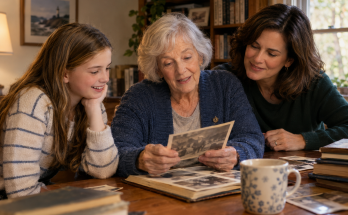
Daniel was fourteen when he found the photograph.
Not the wedding photograph.
Not the nursery images.
The one of Anna Mercer standing outside Saint Matthew with her hospital badge clipped to her sweatshirt.
Emily had kept it in a box in the top of her closet.
Daniel was looking for old school pictures for a family project.
Instead he found the past.
He called Emily into his room holding the photograph.
“Who’s this?”
Emily answered easily.
“My mom.”
“Grandma Anna?”
“Yes.”
“What hospital?”
She recognized the background immediately.
Her expression changed.
Daniel noticed.
“What?”
“Nothing.”
“That was definitely something.”
Emily sat on the edge of his bed.
“What are you doing with the box?”
“Family history project.”
Of course.
Every parent’s nightmare eventually arrived as homework.
“What do you have to do?”
“Make a timeline.”
Emily called me that evening.
“Help.”
I laughed.
“What happened?”
“Middle school.”
“That bad?”
“He found Saint Matthew Anna.”
I stopped laughing.
“What did you tell him?”
“That it was Grandma Anna.”
“And?”
“That there’s more to the story.”
“Good.”
“He wants the more.”
Of course he did.
Daniel had grown up around us.
He knew Sophie had survived leukemia.
He knew Emily donated marrow before learning they were related.
He knew Anna Mercer had raised Emily.
He knew Marianne Hayes was his biological grandmother.
What he did not know was why Emily had been hidden.
The attempted abduction.
The falsified hospital identity.
Vale-Carter.
Robert.
The clinic.
All the parts we agreed were adult information until he became old enough to understand them.
“He’s fourteen,” Emily said.
“I know.”
“Is that old enough?”
“For which part?”
“That’s exactly the problem.”
We gathered at Emily’s house the following Saturday.
Not everyone.
Too many adults would turn explanation into tribunal.
Emily.
Marcus.
Me.
Sophie.
Ruby joined by video because Daniel specifically asked for her.
“Why Ruby?” Sophie complained.
“Because she’s a lawyer.”
“I had cancer. That’s more interesting.”
“This is not a contest.”
“It could be.”
Daniel looked at all of us.
“You’re making this seem worse.”
Fair.
Emily sat beside him.
“The short version is that when I was a baby, some people tried to take me from a hospital.”
Daniel stared.
“What?”
“Your grandmother Marianne was hiding from people connected to a medical clinic. Grandma Anna and her uncle Daniel helped keep me safe.”
“Why didn’t you tell me?”
“Because when you were six, this would have been horrifying and useless information.”
“I’m fourteen.”
“That’s why we’re telling you now.”
He looked at me.
“Were you there?”
“My daughters were newborns in the same hospital.”
“Anna’s mom?”
Sophie raised one hand.
“Eventually.”
Daniel stared.
“You were a baby too?”
“Yes.”
“And somebody tried to take Mom?”
“Almost.”
“Did they take you instead?”
“No.”
He looked relieved.
Then confused.
“Why is this family so weird?”
Ruby’s face appeared larger on the tablet as she leaned toward her camera.
“That is the most legally accurate question so far.”
Emily continued.
She explained Marianne.
The clinic.
The false name.
Daniel Mercer’s decision to hide the infant after the attempted abduction.
Anna agreeing to raise Emily.
She did not describe every crime.
She did not need to.
Daniel interrupted often.
“Was Grandma Anna my actual great-grandmother?”
“Not biologically.”
“But basically?”
“Yes.”
“Did she know who Mom’s real mother was?”
“Yes.”
“Did Mom know?”
“No.”
“Isn’t that lying?”
Emily took a breath.
“Yes.”
Daniel looked shocked by the answer.
“You’re saying Grandma Anna lied?”
“Yes.”
“But she was good.”
Sophie spoke quietly.
“Good people can lie.”
Daniel frowned.
“Then how do you know who’s good?”
Nobody rushed to answer.
Finally Marcus said, “You look at patterns.”
“What does that mean?”
“Do they take responsibility? Do they care when they hurt someone? Do they change when they understand better?”
Daniel looked at Emily.
“Did Grandma?”
Emily’s eyes filled.
“She tried.”
“Did you forgive her?”
“She died before I knew everything.”
“That’s not what I asked.”
Apparently directness was also hereditary.
Emily smiled sadly.
“I love her. I’m angry with her. Both are true.”
Daniel considered that.
Then turned to me.
“What did Graham do?”
The room grew quiet.
He had heard enough pieces over the years to know Graham belonged somewhere in the story.
I looked at Sophie.
She nodded.
Ruby did too.
So I told him.
Not every detail.
Enough.
Graham discovered parts of the Saint Matthew secret years later and concealed them.
During our divorce, he used false evidence to remove me from Sophie and Ruby’s lives.
Daniel stared at Sophie.
“Your dad?”
“Yes.”
“And you still see him?”
“Yes.”
“Why?”
Sophie smiled slightly.
“Because relationships aren’t math.”
“That doesn’t answer it.”
“No.”
She thought.
“I see him because I want to.”
“Did you forgive him?”
“Some things.”
“Why not all?”
“Because forgiveness isn’t a bill you eventually have to pay.”
Daniel looked toward Ruby on the screen.
“What about you?”
“I see him more than Sophie does.”
“Why?”
“Because I want to.”
He groaned.
“You all give the same answer.”
“That’s the point,” Ruby said.
Daniel folded his arms.
“So nobody tells anybody what they’re supposed to feel.”
All of us went quiet.
Emily said, “That’s what we’re trying to do.”
The family history project became more ambitious than the teacher expected.
Daniel created a timeline beginning with Marianne at the reproductive clinic.
Emily refused to let him include identifiable details about unrelated patients.
Ruby reviewed the language for privacy.
Sophie insisted he include the marrow donation.
I insisted he not use the phrase “insane hospital conspiracy” in the title.
He argued that it was accurate.
Marcus supported him until Emily threatened to assign him his own family-history project.
The final presentation was called:
HOW SECRETS CHANGE FAMILIES ACROSS GENERATIONS.
His teacher wrote Excellent research, unusually complex.
That was diplomatic.
Then Daniel did something none of us anticipated.
He asked Graham for an interview.
Emily called me first.
“Should I allow this?”
“What does Daniel want to ask?”
“Why Graham lied.”
I considered it.
“Does Graham know?”
“Yes.”
“And?”
“He said Daniel can ask anything.”
“That sounds like Graham.”
“Current Graham.”
“Yes.”
Emily worried the conversation would burden Daniel.
Ruby pointed out he was asking voluntarily.
Sophie wanted to be present.
Daniel refused.
“I’m interviewing him, not holding a family meeting.”
They met at a café.
Marcus sat at another table.
Daniel recorded the interview with permission.
Later he allowed us to hear part of it.
“Why did you lie?”
Graham answered, “Because the truth threatened the life I wanted.”
“What life?”
“One where I was respected. Where my father’s reputation stayed intact. Where your cousins loved me without asking difficult questions.”
“Did lying work?”
“For a while.”
“Was it worth it?”
“No.”
“Did you know it wasn’t worth it when you were doing it?”
Graham paused.
“Sometimes.”
“Then why keep doing it?”
“Because admitting the first lie would expose the next one.”
Daniel was quiet.
Then:
“So secrets stack.”
“Yes.”
That phrase became the centerpiece of his project.
Secrets stack.
Simple enough for a fourteen-year-old.
Accurate enough for all of us.
Afterward, Graham called me.
“He reminds me of Ruby.”
“Poor boy.”
“He didn’t let me escape anything.”
“Good.”
“I’m glad he asked.”
“Why?”
“Because I’m tired of being afraid somebody will discover what I did.”
I understood.
Shame depended partly on concealment.
Once a story was known, it could still hurt.
But it lost the power of discovery.
“You don’t get to control how he sees you.”
“I know.”
“How did he seem?”
“Thoughtful.”
“That’s ominous.”
Graham laughed.
At the end of the school term, Daniel received an award for the project.
The school invited families to an exhibition.
His timeline covered an entire display board.
There were no graphic details.
No accusatory photographs.
Only dates.
Connections.
Choices.
Consequences.
At the bottom he included five sentences.
My family survived because some people told the truth.
My family was hurt because other people hid it.
Sometimes the same person did both.
Love does not make every choice right.
Knowing the past gives us more choices about what we repeat.
I read the last sentence twice.
Emily came beside me.
“He wrote that himself.”
“I know.”
“How?”
I looked across the room.
Daniel was explaining the timeline to Anna, who was seven and mostly interested in the photograph of Sophie with no hair.
“He listened.”
Later, Anna asked Sophie why she had been bald.
“I had cancer.”
“Did it hurt?”
“Sometimes.”
“Did you die?”
“No.”
Anna considered this.
“Good.”
“Yes.”
“Did Grandma save you?”
Sophie looked at me.
Anna meant me.
“Partly.”
“Who else?”
Sophie pointed across the room.
“Emily.”
Anna looked confused.
“But she’s not a doctor.”
“No.”
“How?”
Sophie crouched.
“She gave me something her body made that mine needed.”
“Like blood?”
“Sort of.”
Anna thought.
“Did she want it back?”
Sophie laughed.
“No.”
“Good.”
That was enough for seven.
There would be more later.
Not because children deserved every truth immediately.
Because they deserved truths matched to their ability to carry them, not truths manipulated to protect adult comfort.
That difference took our family generations to learn.
Click here to continue reading: PART 20: On the Anniversary of the Call That Changed Us, We Returned to the Place Where Fear First Lost Its Power
The Blood Test That Brought Me Back to the Daughters I Had Been Forced to Leave Behind
Part 19 of 35