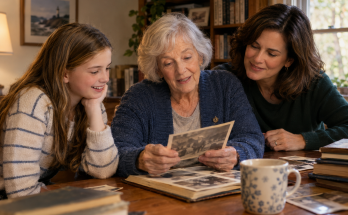
My mother’s memory began failing in small, almost polite ways.
She misplaced keys.
Repeated stories.
Forgot whether she had called me the previous evening.
For months we treated each incident as ordinary aging.
Then she called Sophie by Marianne’s name.
Nobody laughed.
We were having dinner at Emily’s house.
Daniel was building a tower from plastic blocks beneath the table.
My mother looked across at Sophie and said, “Marianne, pass the salt.”
Sophie froze.
My mother corrected herself immediately.
“Sorry. Isabelle.”
That was wrong too.
I reached across the table.
“Mom.”
She looked at me.
For several seconds, fear moved across her face.
Then recognition returned.
“Isabelle.”
“Yes.”
She smiled weakly.
“I’m tired.”
Her doctor referred her for cognitive testing.
The diagnosis was early-stage Alzheimer’s disease.
I sat beside her while the neurologist explained progression, medications, legal planning, driving, safety, and support.
My mother listened calmly.
In the parking lot she cried.
“I spent half my life trying not to remember things.”
I held her hand.
“And now?”
“Now I’m afraid I won’t.”
The cruelty of that was difficult to name.
My mother had once chosen forgetting as a form of protection.
Now forgetting was happening without her permission.
We made practical arrangements.
Power of attorney.
Medical directives.
Financial access.
This time every document was discussed openly.
No one signed anything they did not understand.
Ruby reviewed the legal paperwork and made us all redo one section because the language was vague.
My mother complained.
“You sound like your father.”
Ruby stared at her.
“Which father?”
My mother blinked.
Then realized what she had said.
“Graham.”
“That’s my actual father.”
“I know.”
The room relaxed.
Even memory loss could collide strangely with our family history.
Sophie began recording conversations with my mother—with permission.
Not investigations.
Stories.
What food Marianne hated.
Where my mother met my father.
The first apartment she rented.
The summer I broke my wrist.
Ordinary things.
One afternoon Sophie asked, “Do you remember when Mom married Dad?”
My mother looked toward me.
“Yes.”
I stiffened.
“Do you remember Robert?”
Her expression changed.
“Yes.”
“Do you want to talk about him?”
My mother shook her head.
“No.”
Sophie stopped the recording.
That impressed me.
She did not push.
Later I asked why.
“Because she said no.”
Simple.
We had finally made consent ordinary.
As the disease progressed, my mother occasionally returned to old fears.
Once she called at midnight.
“They found Clara.”
I sat up.
“Who?”
“The men.”
“Mom, Emily is safe.”
“No. Clara.”
She was somewhere between decades.
I drove to her apartment.
She was standing beside the window wearing her coat.
“We have to move her.”
I took her hands.
“Anna already did.”
She stared at me.
“Anna?”
“Yes.”
“She took the baby?”
“She kept her safe.”
“Daniel helped?”
“Yes.”
My mother’s shoulders relaxed.
“Good.”
Then she looked at me.
“Does Isabelle know?”
I swallowed.
“I’m Isabelle.”
She studied my face.
“No.”
The word hurt more than I expected.
“You’re older.”
I almost laughed.
“Yes.”
“Isabelle is thirty.”
“In your memory.”
She frowned.
Then touched my cheek.
“My daughter.”
“Yes.”
Recognition returned.
“I’m sorry.”
“You don’t need to apologize.”
That became harder as the months passed.
She apologized constantly.
For forgetting.
For repeating.
For losing things.
For Marianne.
For Robert.
For my wedding.
Sometimes the apology belonged to the present.
Sometimes it belonged to thirty years earlier.
I stopped deciding which.
“I hear you,” I would say.
That was enough.
Graham visited her once.
He asked me first.
I asked her.
She agreed.
For twenty minutes she recognized him.
Then she called him Robert.
Graham went completely still.
My mother’s face hardened.
“You leave Isabelle alone.”
He swallowed.
“I will.”
“You hear me?”
“Yes.”
“She doesn’t belong to you.”
“No.”
My mother pointed toward the door.
“Go.”
Graham looked at me.
I nodded.
He left.
Afterward my mother asked why Robert had become old.
I did not correct her.
That evening Graham called.
“I know she didn’t mean me.”
“She meant what she said.”
“I know.”
He was quiet.
“Maybe somebody should have said it to my father more often.”
Perhaps.
But the dead did not need more trials.
The living needed boundaries.
My mother eventually moved into memory care.
We chose a place near me with a garden and staff who learned quickly that our family history could not be summarized on an intake form.
One nurse tried.
She gave up after Emily explained how she was related.
“You know what?” the nurse said. “I’ll write cousin.”
“Excellent,” Emily replied.
Daniel visited every Sunday.
My mother often forgot his name but remembered he liked crackers.
She kept packets in her drawer.
He called her Grandma even though technically she was something more complicated.
No one corrected him.
One afternoon, my mother asked me to bring the shoebox of Marianne’s letters.
I did.
She held each page carefully.
“Did I give these to you?”
“Yes.”
“Good.”
She found the letter describing Emily’s birth.
Her eyes moved slowly across the handwriting.
“Marianne was frightened.”
“Yes.”
“So was I.”
“I know.”
She looked at me.
“Did I hurt you?”
The question was clear.
Present.
I could have lied.
She might have forgotten the answer within an hour.
“Yes.”
Her eyes filled.
“I’m sorry.”
“I know.”
“Did you forgive me?”
That was harder.
I had never found a clean answer.
So I gave her the true one.
“I love you.”
“That isn’t what I asked.”
Even with Alzheimer’s, my mother remained herself.
“No.”
She waited.
“I forgave some things.”
“And the rest?”
“I learned to live without needing to finish them.”
She considered that.
Then nodded.
“That sounds fair.”
We sat together in silence.
Eventually she said, “I don’t remember what we were talking about.”
“That’s okay.”
“Was it important?”
“Yes.”
“Did we finish?”
I looked at her.
“Yes.”
That time, I allowed the word.
We finished.
Not because every hurt vanished.
Because nothing more needed to be demanded from either of us.
My mother died two years later.
Peacefully.
Sophie was beside her.
So was Ruby.
Emily arrived twenty minutes too late and cried in the hallway until Marcus found her.
Graham sent flowers.
I kept them.
At the funeral, Ruby spoke.
She did not mention secrets.
She talked about her grandmother teaching her to make soup and cheating at card games.
Sophie read a short passage from one of Marianne’s letters about family being the people who keep choosing to come back.
Emily cried through most of it.
I said nothing publicly.
My memories were mine.
After everyone left, I stood beside the grave.
For years I thought forgiveness was a door.
Open or closed.
Eventually I understood it could be a house with rooms you entered differently.
Some wounds I had forgiven.
Some I had simply stopped feeding.
Some remained painful without controlling me.
That was enough.
At home, Sophie placed Marianne’s shoebox on the shelf beside my old letters.
“Family archive,” she said.
Ruby looked at the overloaded shelf.
“We need a bigger one.”
“Probably.”
“Are we keeping everything?”
I thought about Robert burning VC-19.
Hospital administrators destroying files.
Graham hiding letters.
Daniel concealing records.
Our family had spent generations deciding information was dangerous.
“No,” I said.
Ruby looked surprised.
“What do we throw away?”
“Anything nobody needs.”
Sophie smiled.
“That sounds normal.”
It was.
We kept Marianne’s letters.
My custody letters.
Anna’s note.
A copy of the Saint Matthew incident report.
The family rules.
We destroyed duplicate legal filings.
Old bills.
Medical paperwork whose retention period had passed.
Not every piece of paper deserved immortality simply because secrecy had once hurt us.
Sometimes throwing something away was not concealment.
It was making room.
Click here to continue reading: PART 16: At Sophie’s Wedding, the Family We Rebuilt Finally Faced the Future Without Needing Another Secret to Explain the Past
The Blood Test That Brought Me Back to the Daughters I Had Been Forced to Leave Behind
Part 15 of 35