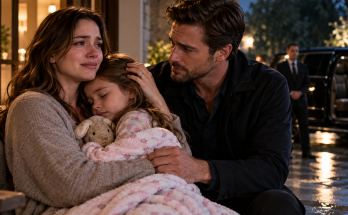
The prosecutor never asked Emily to testify automatically.
That mattered to Mary Davis more than almost anything else about the trial.
For months, adults had built cases from documents, recordings, DNA, ledgers, witnesses, recovered remains, financial trails, medical evidence, and Thomas’s own actions.
They did not need an eight-year-old child to carry the entire prosecution.
Emily knew this.
Still, when the trial date approached, she asked:
“Do I have to talk?”
Mary sat beside her at Rebecca’s kitchen table.
“No.”
“Would it help?”
“That’s something the prosecutor can explain.”
“Would Daddy see me?”
“Possibly, if you testified in court. There are protections, but you would know he was there.”
Emily rubbed June’s bent ear.
“What if I don't?”
“The case still continues.”
“Will he get out?”
“No one can promise the verdict.”
Emily frowned.
“Adult answer.”
“Yes.”
Rebecca brought hot chocolate and sat across from her.
“You can choose not to testify.”
Emily looked at her.
“Rachel tried to tell.”
Rebecca’s face tightened.
“She did.”
“Lily told.”
“Yes.”
“I told Claire.”
“Yes.”
Emily stared into the cup.
“Maybe I’m done telling.”
Mary felt relief but did not show it too strongly.
“That is allowed.”
Two days later Emily changed her mind.
Not because anyone pressured her.
Because Sophie sent a letter.
The seventeen-year-old survivor had written:
You already saved me once without knowing it. You do not owe the courtroom anything. If you speak, speak because you want your words to belong to you.
Emily read it twice.
Then said:
“I want them to hear one thing.”
The prosecutor met with her under child-witness protocol.
“What thing?”
Emily answered:
“That I called because Lily was crying.”
“Anything else?”
“That Daddy told me nobody would believe me.”
The prosecutor nodded.
“We can work with that. You do not have to describe everything.”
Emily looked surprised.
“I don't?”
“No.”
The trial began without spectacle.
Rachel’s sealed court petition came first.
Then Claire’s emergency-call testimony.
Claire described the whispering child.
The silence when footsteps approached.
The final sentence.
Please find the other girl.
The 911 recording played.
Thomas sat still.
Emily did not attend that day.
She spent it at school.
Rebecca picked her up afterward.
No one told her whether Thomas reacted.
That detail belonged to the courtroom, not to her healing.
Next came Daniel and Mary’s initial response.
The locked basement.
Emily’s fear.
The dusty bunny.
Thomas running toward the door.
The reinforced room.
Lily.
The evidence did not depend on dramatic interpretation.
Photographs were enough.
The steel door.
The hidden room.
The child-height scratches.
Lily’s bed.
Medical testimony followed.
Malnutrition.
Long-term confinement.
Old injuries.
The prosecutor avoided unnecessary graphic detail.
Then came Rachel’s death.
The damaged recorder.
The basement video.
Thomas’s voice.
Rachel fighting.
Hale.
Grant.
Patrick.
The wrapped body.
The jury watched in silence.
Thomas’s attorney challenged chain of custody.
Authenticity.
Interpretation.
Appropriate.
Trials required testing evidence.
But the digital signatures, recovered hardware, corroborating witness accounts, and Rachel’s own contemporaneous recordings supported the footage.
Richard Hale testified under cooperation agreement.
He did not ask for sympathy.
When asked about Thomas, he said:
“He liked having someone weaker nearby.”
Thomas’s attorney attacked Hale’s motives.
“You are blaming my client to reduce your own sentence.”
“I’m telling you what happened because my sentence is already going to be terrible.”
“Mr. Hale, you kept children chained in rooms.”
“Yes.”
“You buried bodies.”
“Yes.”
“You participated in Rachel Miller’s death.”
“Yes.”
“You expect this jury to trust you?”
“No.”
That answer quieted the courtroom.
Hale continued:
“They don’t have to trust me alone. There are recordings.”
The prosecution rested many facts on corroboration rather than character.
That made the case stronger.
Evelyn’s trial would come later.
Grant’s separately.
Patrick’s.
Dean’s.
Thomas’s case focused on what Thomas had personally done.
Emily testified on the eighth day.
The courtroom was modified.
She entered through a protected route.
A child advocate remained nearby.
The judge explained that she could ask for breaks.
Thomas was ordered not to make gestures or attempts at contact.
Emily sat.
She looked smaller than the witness chair.
The prosecutor began with simple questions.
Name.
Age.
School.
June did not come into the courtroom.
Emily had left the rabbit with Rebecca.
“I don’t want Daddy looking at her.”
The prosecutor asked:
“Why did you call emergency services that night?”
Emily swallowed.
“Because Lily was crying downstairs.”
“Did you know Lily was downstairs?”
“I heard her.”
“Were you allowed to go there?”
“No.”
“Why not?”
“Daddy said bad children asked about downstairs.”
The prosecutor paused.
“Were you afraid?”
“Yes.”
“Then why call?”
Emily looked toward the jury.
“Because she was more scared.”
Mary, sitting near the back, lowered her eyes.
The prosecutor did not stretch the moment.
“What did your father tell you about police?”
“That they wouldn’t believe me.”
“Did you believe him?”
“Yes.”
“What changed?”
“Claire believed me.”
Claire sat outside the courtroom.
She would hear later.
“Did the police find Lily?”
“Yes.”
“No further questions.”
Thomas’s attorney approached carefully.
He was not cruel.
He knew attacking a child witness would damage his client more than help.
“Emily, you were very frightened that night?”
“Yes.”
“Sometimes when we are frightened, memories can get mixed up. Has that happened to you?”
“Yes.”
“Did you sometimes call different children by different names?”
“Yes.”
“Did you remember some events out of order?”
“Yes.”
“Could some things you believed about your father have been wrong?”
Emily thought.
“Yes.”
The attorney seemed encouraged.
“Such as?”
Emily answered:
“I thought he loved me.”
Silence.
The judge immediately watched the prosecutor.
No objection.
The answer remained.
Thomas looked down.
Emily asked for a break.
She did not testify again.
She had said what she came to say.
Outside the courtroom, she shook.
Rebecca held her.
“I don’t want to go back.”
“You don’t have to.”
“Ever?”
“Not for this testimony.”
Emily breathed.
Mary joined them.
“You did enough.”
Emily looked at her.
“I said the wrong thing.”
“What?”
“That I thought he loved me.”
Mary crouched.
“That was your answer.”
“It sounded mean.”
“It sounded true to what you feel.”
Emily nodded slowly.
“I’m tired.”
They left.
No press.
No hallway questions.
No celebration.
Testifying was not a victory performance.
It was work a child had chosen to do.
The defense presented Thomas as a man manipulated by Evelyn and Hale.
There was evidence he had been manipulated.
Evelyn had introduced him to Rachel.
She knew his childhood history.
She used his knowledge of Richard.
She placed false identities within his reach.
But manipulation did not erase Thomas’s independent conduct.
He had locked children downstairs.
He had threatened Emily.
He had struck David.
He had participated in Rachel’s death.
He had concealed evidence.
He had lied repeatedly after police arrived.
The jury had to decide specific charges.
Carter refused to speculate publicly.
While Thomas’s trial continued, Grant’s cooperation produced new records.
Not because Grant suddenly developed remorse.
Because prosecutors showed him how much evidence existed without him.
He handed over offshore-account access.
The money revealed more private placements.
Most historic.
Some recent.
One transfer date occurred after Hale’s farm had already been searched.
Carter stared.
“That’s impossible.”
Marcus checked.
Payment initiated three days after the first arrests.
Recipient:
Safe Passage International.
A foreign charity.
No direct link previously known.
Grant claimed it was automatic.
“Who authorized?”
“I didn’t.”
“Evelyn?”
“No.”
“Aaron?”
“No.”
“Then who?”
Grant looked frightened.
“Someone still has account authority.”
The network’s financial infrastructure had continued moving after arrests.
“Name.”
“I don't know.”
“That’s not useful.”
Grant insisted authority credentials had been shared years earlier among four people.
Grant.
Evelyn.
Howard Lane.
And Caleb Voss.
Howard dead.
Caleb dead.
Unless credentials had been copied.
Aaron had copied Voss.
But Aaron was in custody by the transfer date.
Another possibility.
“Victor?”
“No.”
“Doyle?”
“No.”
“Foster?”
“No.”
Carter looked through user logs.
Authorization tag:
HB.
No known operator.
“Who is HB?”
Grant stared.
Then his face changed.
“Oh.”
“Who?”
“Helen.”
“Helen Ward?”
Sophie’s rescuer.
Carter felt the floor shift.
Helen had received Sophie from Victor.
Helped hide her.
Claimed fear of Dean.
Could she also hold financial credentials?
Grant nodded slowly.
“Helen Ward worked accounts for us before she became a caseworker.”
Carter had not known.
“Why didn’t you tell us?”
“You never asked.”
That answer nearly made her lose patience.
“What was her role?”
“Early bookkeeping.”
“Orchard?”
“No. New Horizons.”
“Did she know transfers were illegal?”
“Eventually.”
“Did she profit?”
“Some.”
Carter immediately secured Sophie’s safety.
Helen was contacted.
She did not answer.
Her Vermont home was empty.
No signs of struggle.
Closet partly cleared.
Car gone.
Sophie was elsewhere under independent protective placement and had not been with Helen.
That was crucial.
Helen had not taken her.
But why run?
Carter searched Grant’s payment.
Safe Passage International received twenty-five thousand dollars.
Reference:
H.W. / one minor.
One child.
Recently moved.
“Who?”
Grant claimed he did not know.
Then a missing report emerged.
A fourteen-year-old boy disappeared from a residential placement two days after the arrests.
Name:
Caleb Moreno.
One of Victor’s remaining attic targets.
Carter went cold.
Victor had been watching Caleb.
Helen had financial access.
Caleb vanished.
Payment moved.
“What was Victor planning for Caleb?”
He answered from custody:
“Get him out before Grant found him.”
“Why would Grant care about Caleb?”
“His mother had something.”
“What?”
“Records.”
Caleb’s mother had stayed at Safe Harbor.
Diane Mercer had helped her years earlier.
Maybe she preserved documents.
Carter asked Diane.
She remembered.
Caleb’s mother, Sofia Moreno, had worked cleaning offices at Grant Holdings.
She copied files after suspecting financial crime.
Then entered hiding after threats.
She died of illness two years later.
Caleb entered foster care.
“Where are the copies?”
Diane shook her head.
“I thought Victor had them.”
Victor did not.
Helen might.
The account payment to Safe Passage could represent an attempt to move Caleb beyond investigators.
Not necessarily harm.
But unilateral disappearance was still dangerous.
“Find Helen.”
Border alerts showed no foreign travel.
Her car was found at a bus station.
Security footage:
Helen.
Caleb beside her.
No struggle.
They boarded a bus south.
Destination:
Baltimore.
Then train.
Final ticket:
Washington, D.C.
Carter frowned.
Why take a child toward the capital?
Safe Passage International maintained one office there.
But no actual overseas facilities.
Its name was misleading.
It was a legal-aid nonprofit.
Carter contacted federal partners.
Helen entered the office voluntarily that morning.
With Caleb.
She had not fled the country.
She had gone to seek federal whistleblower protection.
When Carter finally spoke to her, Helen sounded angry.
“I didn’t trust your task force.”
“Why?”
“Grant still had people.”
“Who?”
“I don't know.”
“You moved a fourteen-year-old across state lines.”
“With his consent.”
“He is a minor.”
“His placement was compromised.”
“Why not contact federal authorities directly?”
“I did.”
“After taking him.”
“Yes.”
Carter exhaled.
Again.
Good intention.
Bad process.
“Why the twenty-five-thousand-dollar transfer?”
“To trigger the account.”
“What?”
Helen explained she still possessed legacy authorization.
She initiated a transfer from Grant’s offshore fund to Safe Passage knowing investigators would detect it.
A beacon.
Not payment for Caleb.
She wanted someone to follow.
“Why not send a message?”
“Because I didn’t know who was clean.”
Dean’s corruption had infected everyone’s assumptions.
“What does Caleb have?”
“His mother’s files.”
“Where?”
Helen looked toward the camera.
“Not with him.”
“Then why move him?”
“Because somebody searched his foster room.”
“Who?”
“Unknown man.”
“Description?”
Helen gave one.
Carter knew the face.
Not from the main board.
From Rachel’s manuscript file.
A photograph in the background of one scan.
Judge Malcolm Reeves’s son.
Peter Reeves.
The same son whose theft Grant once concealed.
Carter stared.
Grant had not merely used Peter’s past to pressure Judge Reeves.
He had recruited him.
“What does Peter do now?”
Financial compliance consultant.
For charities.
Including Safe Passage.
Carter felt the network’s residue moving through another generation.
Peter Reeves was located that afternoon.
In his car.
Dead.
Gunshot wound.
Apparent suicide.
A note on the passenger seat.
But Carter had learned not to accept convenient endings.
The note read:
I only wanted the files. Grant said the boy had them.
No mention of suicide.
No apology.
No explanation.
And the gun lay in Peter’s left hand.
Records showed he was right-handed.
Carter looked at Brooks.
“This isn’t over.”
The medical examiner later agreed.
Trajectory inconsistent with self-infliction.
Peter Reeves had been murdered.
Whoever killed him knew he had been searching for Caleb.
And perhaps believed the files had died with him.
Helen said:
“They haven’t.”
“What files?”
“His mother copied Grant’s client list.”
Carter went still.
“Names?”
“Buyers.”
The recent private-placement families.
Possibly older clients.
Possibly people untouched by every arrest so far.
Caleb’s mother had preserved the names.
The files existed.
And someone had just killed Peter Reeves trying to recover them.
Click here to continue reading: PART 31: A Murder Staged as Suicide Exposed the Last Active Buyer List, and One Name Connected Directly to the Night Emily Called for Help
The Dispatcher Heard a Child Whisper About a Snake, Then Realized the Call Was Not About an Animal
Part 30 of 35