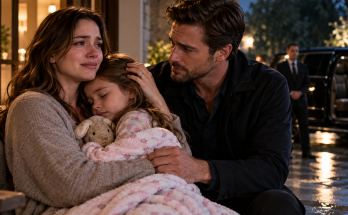
The first thing Mary Davis did the next morning was sit beside Lily without telling her anything.
The child was eating toast slowly, breaking each piece into tiny squares before bringing it to her mouth. Hospital staff had learned not to place too much food in front of her at once. Large portions made her anxious.
Mary waited until Lily looked up.
“Can I ask you about names again?”
Lily shrugged.
“Do you remember anyone ever calling you Lillian?”
The toast stopped halfway to her mouth.
Mary noticed immediately.
“Maybe.”
“Who?”
Lily frowned.
“A lady.”
“What lady?”
“I don’t know.”
“Can you remember her face?”
Lily’s eyes filled.
“Yellow coat.”
Mary leaned closer.
“The lady wore a yellow coat?”
“Yes.”
“Where?”
“Cars.”
“A parking lot?”
Lily nodded.
“Did she call you Lillian?”
“Yes.”
“What else did she say?”
Lily put down the toast.
“She said, ‘Come back to Mommy.’”
Mary felt her throat tighten.
“Was she your mother?”
“I don’t know.”
“Did Thomas tell you?”
Lily’s face closed.
“He said she was stealing me.”
Mary froze.
It was the same lie Thomas had told Emily about Rachel.
Your mother is trying to steal you.
A child too young to understand custody, parenthood, or abduction could be taught to believe rescue was danger.
“What happened to the lady in the yellow coat?”
Lily whispered, “Mr. Gray came.”
Mary let several seconds pass.
“And then?”
“Thomas took me in the car.”
“Did you see the lady again?”
“No.”
“Do you remember another woman named Evelyn?”
Lily’s breathing changed.
Mary stopped immediately.
“You don’t have to answer.”
Lily looked toward the door.
“Is she here?”
“No.”
“Promise?”
“I promise.”
The girl pulled her knees beneath the blanket.
“Miss Evelyn said Mommy was sick.”
“Did she say that about the yellow-coat lady?”
“Yes.”
“Did you believe her?”
“I was little.”
Mary heard Katherine’s answer echoed in Lily’s words.
I was six.
I was little.
Children had been taken at ages when adults controlled the meaning of everything around them.
Who was mother.
Who was stranger.
Who was safe.
Who was dangerous.
Thomas and Evelyn had not needed to erase memories completely.
They only needed to reinterpret them until the children doubted themselves.
Across town, Susan Carter spent the morning reconstructing Rachel Miller’s final months.
Rachel had been murdered three years earlier, but the evidence now suggested she had not discovered Thomas’s secret basement by accident.
She had been investigating him.
Technicians restored portions of her damaged digital recorder recovered from the hidden wall cavity.
The first playable file contained only household noise.
The second captured Thomas speaking on the phone.
His voice was clear enough.
“No. Emily stays here.”
A distant response was inaudible.
Thomas again:
“I don’t care what Richard promised.”
Another pause.
“She’s mine.”
Carter listened twice.
Then a woman’s voice appeared faintly near the recorder.
Rachel.
“What are you talking about?”
The recording ended.
Carter looked at Brooks.
“She heard him discussing Emily.”
“That may have started it.”
The next file was recorded days later.
Rachel spoke alone.
Her voice shook, but she was trying to remain quiet.
“If anyone finds this, Thomas has children downstairs. I saw two. Maybe three. He told me they were relatives before. They’re not.”
Carter closed her eyes for a moment.
Rachel had documented the truth.
The recording continued.
“One girl said her name was Katie. Thomas says her name is Sophie. I searched missing children and found Katherine Price. I think it’s her.”
Rachel had identified Katherine years before police did.
“I found Melissa Reed too. Thomas dated her before me. Melissa and her daughter disappeared.”
The file crackled.
“Thomas said they moved. He says everyone moves.”
Rachel laughed once, bitterly.
“I believed him.”
The next recording contained another discovery.
Rachel had searched Thomas’s office while he was away.
She found receipts from Hale’s farm.
Payments from Grant’s consulting business.
A business card belonging to Evelyn Marsh.
Rachel read the names aloud.
Richard Hale.
Gregory Grant.
Evelyn Marsh.
Carter stared at Brooks.
“She had the core group.”
“Three years ago.”
“And nobody knew.”
Brooks looked toward the recorder.
“She knew.”
Carter nodded.
Rachel had died trying to make sure somebody else eventually would too.
The final intact recording was the most difficult.
Rachel sounded hurried.
“I’m taking Emily tonight.”
Keys jingled in the background.
“I called a detective. I left a message. I don’t know if he believes me.”
Carter stopped playback.
“What detective?”
Analysts searched call logs from Rachel’s recovered phone.
One outgoing call had been made to the county sheriff’s office.
Duration: three minutes.
The number routed through a public line.
Records showed who had been assigned callback duty that night.
Deputy Martin Lewis.
Carter stared at the name.
Lewis.
David’s note:
Doctor comes Tuesdays.
Katherine:
Dr. Lewis.
Not necessarily connected.
But the surname was enough to demand scrutiny.
Martin Lewis was not a doctor.
Carter resumed the recording.
Rachel again:
“If I can’t leave, look for Detective Lewis.”
She had called him detective incorrectly.
Maybe she meant someone else.
Then:
“I think his brother is involved.”
Carter stopped the file again.
Brooks stared.
“Brother.”
They searched Martin Lewis’s family.
One sibling.
Dr. Patrick Lewis.
Pediatrician.
Former volunteer physician for New Horizons Family Outreach.
Carter felt the pieces align.
Dr. Lewis.
Glasses, according to Katherine.
Doctor comes Tuesdays, according to David.
Patrick Lewis’s photograph showed thin metal-frame glasses.
The connection was no longer speculative.
Carter requested immediate surveillance and warrant preparation.
Patrick Lewis still practiced medicine.
His clinic served children.
The thought made everyone move faster.
But before arresting him, Carter wanted the rest of Rachel’s recording.
Technicians cleaned the final section.
Rachel’s voice returned.
“I called Deputy Lewis because someone told me he had asked questions about New Horizons years ago. He said not to go to local police until he checked something.”
A pause.
“I don’t know if I trust him.”
Then noise.
A door.
Rachel whispered:
“Thomas is home.”
The recording ended.
Carter sat back.
Martin Lewis may have been trying to investigate his brother.
Or protect him.
Rachel’s uncertainty was preserved exactly.
Carter refused to decide without evidence.
They found Martin retired in another state.
He answered his phone after three calls.
When Carter identified herself, silence followed.
Then he said, “Is this about Rachel Miller?”
Carter exchanged a glance with Brooks.
“Yes.”
“I wondered when somebody would call.”
“Why?”
“Because I failed her.”
Carter did not soften the question.
“How?”
Martin told them Rachel had left a voicemail requesting urgent help. She mentioned children, New Horizons, and Thomas Miller.
Martin recognized Thomas’s name.
Years earlier, he had seen Thomas with his brother Patrick at Hale charity events.
Martin had long suspected Patrick’s relationship with New Horizons was improper, though he had no proof of crimes involving children.
“What did you do after Rachel called?”
“I tried to call her back.”
“She didn’t answer?”
“No.”
“Then?”
“I called Patrick.”
Carter’s jaw tightened.
“You told him Rachel was asking about New Horizons?”
“Yes.”
“Why?”
“I thought he could explain what she’d seen.”
“You alerted the person she may have been investigating.”
Martin’s voice broke.
“I know.”
“What happened next?”
“Patrick told me Rachel was unstable. Said Thomas’s marriage was collapsing.”
“Did you believe him?”
“For a day.”
“What changed?”
“Rachel disappeared.”
Carter remained silent.
“I drove to Thomas’s house.”
“When?”
“Two days later.”
“Did you speak with him?”
“Yes.”
“What did he say?”
“That Rachel left.”
“Did you search?”
“I had no warrant.”
“Did you report your concerns?”
“Yes.”
Carter checked records.
There was a supplemental note.
One paragraph.
Wife reportedly left voluntarily. Husband cooperative. No evidence of foul play.
Signed by another deputy.
Not Martin.
“Who wrote this?” Carter asked.
Martin exhaled.
“My supervisor.”
“Name?”
“Captain Robert Dean.”
Another name.
Carter added it to the board.
“Why didn’t you push?”
“I did. He told me to drop it.”
“Why?”
“He said Rachel had contacted the department before over marital issues.”
“Had she?”
“No.”
Carter stopped.
“Did you verify?”
“Later.”
“And?”
“There were no prior calls.”
“Then Dean lied.”
“Yes.”
“Did you report that?”
“I went to internal affairs.”
“What happened?”
“Nothing.”
Martin’s voice became bitter.
“Dean retired six months later.”
Carter looked up.
A possible law-enforcement connection had now emerged.
Not necessarily part of the trafficking network.
Possibly corruption.
Possibly negligence.
Possibly something else.
They needed records.
“Did your brother Patrick ever talk about Richard Hale?”
Martin hesitated.
“All the time.”
“In what context?”
“Money.”
“What kind?”
“Patrick owed him.”
“For what?”
“I never knew.”
“Did Patrick ever bring children to your attention?”
“No.”
“Did you ever see him with Thomas?”
“Yes.”
“Where?”
“Hale’s farm.”
Carter felt cold.
“When?”
“About twelve years ago.”
“What were you doing there?”
“Patrick invited me to a charity fundraiser.”
“Did you see anything unusual?”
Martin remained quiet.
“Mr. Lewis.”
“There was a girl.”
Carter’s grip tightened on the phone.
“What girl?”
“Blond. Very small.”
“Name?”
“I didn’t know.”
“Could it have been Lily?”
“I don’t know.”
“What happened?”
“She was crying near the barn.”
“Who was with her?”
“Evelyn Marsh.”
Carter closed her eyes.
Lily may have been visible at public events even after her abduction.
Hidden not by physical walls alone, but by adults telling convincing stories.
“What did Evelyn say?”
“That the girl was a foster placement overwhelmed by crowds.”
“Did you believe her?”
“Yes.”
Again.
Belief had protected the network.
Respectable titles.
Charity language.
Explanations that sounded ordinary enough to stop questions.
Carter thanked Martin but told him investigators would need a formal interview.
Then she turned to Brooks.
“Patrick Lewis first.”
A coordinated team arrived at the pediatrician’s clinic that afternoon.
Patrick Lewis was finishing with a patient when officers entered.
Carter waited until the child and parent had been safely escorted out.
Patrick emerged wearing a white coat.
He was sixty-one now.
The glasses remained.
When he saw Carter, his expression held neither surprise nor confusion.
“You found Richard.”
It was not a question.
Carter said, “Dr. Lewis, we have a warrant for your office, home, vehicles, and electronic devices.”
Patrick removed his glasses.
“Is Richard talking?”
Carter did not answer.
That question told her plenty.
Patrick requested counsel.
Investigators searched his private office.
Inside a locked drawer they found controlled medication records inconsistent with clinic inventory.
Sedatives.
The same type found in Grant’s motel room.
More important, they found an old photograph.
Patrick.
Richard Hale.
Gregory Grant.
Evelyn Marsh.
Thomas Miller.
All standing together beside the red barn.
On the back:
New Horizons Board Retreat.
Twelve years earlier.
The group existed.
The relationships were documented.
Then Cole called from Patrick’s home search.
They had found VHS tapes.
Dozens.
Labels contained dates and initials.
Some matched the ledger.
K.P.
H.R.
D.J.
L.T.
M.C.
Carter’s stomach turned.
“No one watches anything casually,” she ordered. “Digital forensics handles it under child-evidence protocol.”
The tapes could document crimes.
They could also contain deeply sensitive material involving victims.
Everything would be handled under strict protection.
One label drew immediate attention.
R.M.
Rachel Miller.
Dated the night she disappeared.
Carter stared at it through the evidence bag.
“How would Patrick have a recording from that night?”
Brooks asked.
Carter had no answer.
Another search team found old appointment logs.
Patrick had treated children under names that did not correspond to legitimate patient records.
One appointment:
Anna Miller.
Age seven.
Thomas listed as father.
Date eleven years earlier.
If Anna was Lily, Thomas had called her seven even then.
The fabricated age had persisted for more than a decade.
Another:
David Miller.
Another:
Sophie Miller.
Thomas had presented abducted children as relatives using false names.
Patrick had given the arrangement medical legitimacy.
The final discovery came from Patrick’s desk.
A sealed envelope addressed to Richard Hale.
Never mailed.
Inside was a handwritten note.
Rachel recorded us. Thomas says he destroyed everything, but I don’t believe him. If she left copies, Grant says Dean can contain police.
Carter stared at the last sentence.
Dean can contain police.
Captain Robert Dean’s role had just become far more serious.
Rachel had not simply failed to reach help.
Someone inside law enforcement may have been actively preventing help from reaching her.
Click here to continue reading: PART 12: Rachel’s Last Recording Exposed a Police Cover-Up, but One Surviving Witness Remembered Where the Missing Mothers Had Been Taken
The Dispatcher Heard a Child Whisper About a Snake, Then Realized the Call Was Not About an Animal
Part 11 of 35