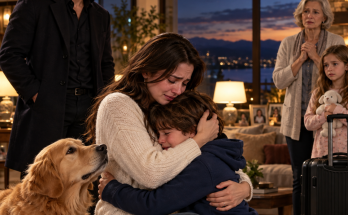
Alyssa arrived in Chicago just before noon.
She brought coffee.
Good coffee.
I considered that proof of growth.
The video file remained unopened on my laptop.
All morning, I had avoided looking directly at the icon.
Not because I thought it contained another financial disaster.
Bennett had been clear.
Every contested claim had been resolved before the recording was released.
No hidden creditor.
No forgotten property.
No legal ambush.
Dad had recorded this six months before he died.
That made it more frightening.
This was not evidence.
It was him.
Alyssa set her bag beside the couch.
“You watched it.”
“No.”
“You look like you watched it.”
“I look like I slept badly.”
“Same face.”
I pointed toward the kitchen.
“Get glasses.”
“For what?”
“Wine.”
“It’s noon.”
“Then water.”
She laughed and got two glasses.
We sat on the couch.
My laptop rested on the coffee table.
For a few seconds neither of us moved.
Then Alyssa said, “Do you want to press it?”
“No.”
“Me neither.”
“We’re doing well.”
“Excellent emotional courage.”
Dad would have appreciated the irony.
I reached forward.
The file opened.
Black screen.
Then Dad appeared.
For one second, everything inside me stopped.
He sat in his study.
The same chair.
Same bookcase.
He wore the navy sweater I remembered from Christmas cards.
He looked thinner.
Sick, but not yet fragile.
Alive.
That was the unbearable part.
Not his words.
His movement.
He adjusted his glasses.
Cleared his throat.
Looked away from the camera.
Then back.
“Candace. Alyssa.”
Alyssa grabbed my hand.
I let her.
Dad gave a tired smile.
“If Richard followed instructions, the two of you are watching this after every major estate dispute has been resolved.”
He paused.
“If that sentence made either of you roll your eyes, I deserve it.”
Alyssa laughed through tears.
I did too.
Dad continued.
“I waited until the end because I did not want this recording influencing legal decisions.”
Of course.
Even dying, he separated paperwork from emotion.
But this time, appropriately.
He said he did not know exactly what we would learn.
He knew some documents might surface that he had forgotten.
Some people might tell stories differently.
Some choices he had made would look worse once everyone compared records.
“I am not recording this to correct them.”
That surprised me.
“Believe documents where documents deserve belief. Believe people where their account is supported. If I contradicted evidence while I was alive, do not let my death make me more credible.”
I stared at the screen.
Alyssa whispered, “Wow.”
Dad had spent years avoiding truth.
Now he was telling us not to privilege his version merely because he was gone.
That mattered.
He spoke first about the estate.
“If there is money left after everyone finishes arguing about it, I hope you use it without making it a moral test.”
I almost smiled.
Mom had said something similar.
Dad continued.
“Money is useful. It is not proof of love, repentance, legitimacy, or virtue.”
He leaned back.
“I wish I had learned that much earlier.”
He talked about Harper Development.
How proud he had been.
How often he used the company as justification.
Late dinners.
Missed weekends.
Bad financial decisions.
Keeping Edward’s conduct quiet.
Protecting company reputation when people deserved honesty.
“I built something valuable and then started treating its survival as more valuable than people.”
His face tightened.
“That is not what I intended. Intent did not change the result.”
Alyssa squeezed my hand.
Dad then addressed her.
“Alyssa, Thomas is your biological father.”
She exhaled shakily.
“I knew that when I made this recording.”
He said it plainly.
No suspense.
No dramatic revelation.
“I am your father too.”
Alyssa started crying immediately.
Dad looked into the camera.
“I do not need you to choose language that makes me comfortable. If you want to call Thomas your father someday, do it. If you call him Thomas forever, do that. If you call us both Dad, I won’t be here to be jealous.”
Alyssa laughed through tears.
Dad smiled slightly.
“Though if there is an afterlife, I reserve the right to complain privately.”
She covered her mouth.
I laughed.
For a moment, Dad sounded like the man from Sunday pancakes.
Then he became serious.
“I spent years afraid that biology could take you from me.”
He shook his head.
“That fear was insulting to you.”
Alyssa stared.
“You stayed because of relationship. Not genetics. I should have trusted that.”
He apologized for hiding Thomas.
For letting Vivian make the decision.
For telling himself secrecy protected Alyssa.
“I made your identity a thing adults managed instead of something you had the right to know.”
Alyssa whispered, “Yes.”
Dad could not hear.
Still, she answered him.
Then he looked down.
“Candace.”
Just my name.
I braced myself.
“I have already left you letters.”
A tiny smile.
“Too many, probably.”
“Yes,” I said.
Alyssa laughed.
Dad continued.
“I know words after death are cheap.”
That hurt.
“They cost the speaker nothing.”
I felt my throat tighten.
“So I do not want you to use this video to imagine I finally did enough.”
I looked down.
He had understood.
Maybe completely.
Far too late.
“I did not.”
No defense.
“I failed to confront Vivian when you needed me to.”
“I know.”
“I failed to challenge the paternity rumor publicly.”
“I know.”
“I failed to protect your education funds.”
“I know.”
“I failed to return to Chicago after I suspected Marianne had lied.”
My eyes filled.
“I know.”
“I failed to pick up the telephone after writing myself reminders to do exactly that.”
I laughed bitterly.
“Yes.”
Dad took off his glasses.
For a moment, he looked directly into the camera without the layer of glass between us.
“If you never forgive that, you are still my daughter.”
My breath caught.
“If you do forgive it, do not let anyone use that forgiveness to rewrite what happened.”
Alyssa was crying openly.
I was too.
Dad continued.
“You left because home became unsafe emotionally. I understand that now.”
He swallowed.
“I should have understood while you were standing in the driveway.”
The image returned.
My hand on the car door.
Dad behind me.
Are you asking me to stay?
That pause.
That horrible pause.
Dad said, “I was asking myself whether I could handle the consequences of asking you to stay.”
I closed my eyes.
That was it.
“I should have been asking what you needed.”
Silence on the video.
He took a drink of water.
Then he said something unexpected.
“I want to tell you one good thing about myself.”
Alyssa and I looked at each other.
Dad smiled.
“That sounded terrible.”
We laughed.
“I have spent years documenting failures. Therapy apparently suggests people are allowed to remember things they did well.”
His humor was dry.
Familiar.
He talked about loving us.
Not perfectly.
Not equally at every moment.
Not always wisely.
But genuinely.
He taught us to ride bikes.
Attended school plays.
Tried to cook.
Failed repeatedly.
Taught Alyssa to drive.
Taught me how to change a tire.
Helped with homework badly.
Built bookshelves crookedly.
Was proud of my writing.
Was proud of Alyssa’s work.
He said those memories were also true.
“I do not want guilt to become another lie.”
That sentence stayed with me.
If I reduced Dad to failure, I would be simplifying him too.
He had earned anger.
He had also earned some affection.
Both.
Dad leaned closer.
“Now the part I am afraid you will hate.”
Alyssa groaned.
“Here we go.”
I almost laughed.
Dad said he had one request.
Not legal.
Not binding.
Not attached to inheritance.
“You can ignore it.”
Good.
“I want the two of you to choose what sister means.”
Alyssa’s hand tightened.
Dad continued.
“Not what Vivian taught you.”
He paused.
“Not what I taught you.”
Another pause.
“Not biology.”
He looked into the camera.
“You spent years being assigned roles.”
Candace, the difficult one.
Alyssa, the easy one.
Candace, the outsider.
Alyssa, the chosen one.
Candace, the biological daughter.
Alyssa, the daughter by choice.
All of those labels had been used as weapons.
“I want you to throw them away if they are useless.”
I looked at Alyssa.
She stared at the screen.
Dad continued.
“You do not owe each other closeness.”
That surprised me.
“You do not owe each other holidays, secrets, phone calls, or friendship.”
Alyssa whispered, “Okay.”
“But if you choose any of those things, choose them because you want them.”
That felt different.
Dad was not asking us to reconcile.
He was refusing to turn reconciliation into another family obligation.
“If you decide you are sisters, let that be your decision.”
He smiled.
“If you decide you are two women who survived the same household and occasionally exchange sarcastic messages, that is also acceptable.”
Alyssa laughed.
“That might be us.”
“Maybe.”
Dad turned serious again.
“Family without choice becomes a trap.”
Vivian had believed family required control.
Dad had believed family required silence.
Mom had believed family required protection through withheld information.
Everyone had confused obligation with love.
Dad seemed to have finally understood.
He spoke about Vivian last.
“I loved her.”
The sentence caused both of us to tense.
Dad nodded as if anticipating that.
“That is also true.”
He said Vivian had lied.
Manipulated.
Taken money improperly.
Used fear to control.
Done harm.
He had no intention of erasing any of that.
“I also stayed after I knew enough to leave.”
There it was.
Responsibility.
He said some of the marriage had been real.
Some happiness genuine.
Some years peaceful.
Some care mutual.
The fact that later truth exposed harm did not turn every earlier smile into fraud.
I thought of Mom’s photograph.
We were happy once. That mattered even though it did not last.
Same lesson.
Dad continued.
“If Vivian changes, you do not owe her access.”
I breathed out.
“If she does not change, you do not owe her punishment either.”
Alyssa looked down.
“You owe yourselves honest boundaries.”
Dad looked tired now.
The recording was nearly forty minutes long.
His energy seemed to be fading.
He spoke about Grandma.
Asked us not to turn her into family mediator.
“Your grandmother has done enough unpaid emotional labor for several generations.”
That made us laugh.
He asked that Marianne be judged by her own future behavior, not by whether she could produce enough apologies.
He said Edward’s wrongdoing should be handled financially and legally, not emotionally.
By the time we watched the recording, that had happened.
Dad would never know.
I wished he could.
Then he looked toward something off camera.
Maybe notes.
Maybe a clock.
When he looked back, his face had changed.
“This is the last time I intend to record anything for you.”
Alyssa whispered, “Thank God.”
I laughed through tears.
Dad smiled faintly as if he had heard.
“I spent too much time preparing messages for after death.”
Yes.
He knew.
“The better version of me would have said these things alive.”
Yes.
“I am sorry you got this version.”
My throat tightened.
Then he addressed us together.
“If either of you becomes a parent someday, please teach your children something I learned embarrassingly late.”
We both listened.
“Love does not become fair by pretending conflict does not exist.”
I thought of that dining room.
Dad telling everyone to calm down.
Never solving anything.
“Sometimes fairness means taking a side against harmful behavior.”
Yes.
“Sometimes love means letting someone be angry with you.”
Yes.
“Sometimes protection means giving a person painful information and trusting them to survive knowing it.”
Yes.
“And sometimes family means leaving.”
I stopped breathing.
Dad looked directly into the camera.
“Candace leaving was not the failure.”
My eyes filled.
“What made her need to leave was.”
I cried then.
Not quietly.
Alyssa wrapped both arms around me.
Dad continued through my tears.
“I wish I had understood that before I watched her drive away.”
He sat silently for a few seconds.
Then:
“I love you both.”
No elaborate speech.
“I loved you badly sometimes.”
Alyssa laughed and sobbed at once.
“But I loved you.”
My chest hurt.
“I hope whatever comes next for you is less complicated than what came before.”
Impossible.
Still kind.
Then Dad smiled.
“Although given this family, that seems optimistic.”
We laughed.
His final words were simple.
“Choose well.”
The screen went black.
For several minutes, Alyssa and I stayed exactly where we were.
My laptop fan hummed.
Traffic moved outside.
The world continued with offensive normality.
Alyssa finally whispered, “Well.”
“Yeah.”
“He really saved emotional competence for the end.”
“Apparently terminal illness helped.”
“That’s terrible.”
“I know.”
She leaned her head against my shoulder.
“Do you forgive him?”
I looked at the black screen.
“Still don’t know.”
“Okay.”
“But I understand him better.”
“Same.”
“That’s not the same thing.”
“No.”
We sat.
Eventually Alyssa asked, “What does sister mean?”
I smiled.
“Dad told us to decide.”
“I’m asking.”
I thought carefully.
“A person I want in my life.”
She became very still.
I continued.
“Not because Dad wanted it.”
“Okay.”
“Not because we survived the same house.”
“Okay.”
“Not because you apologized.”
Her eyes filled.
“Then why?”
“Because I like who you are becoming.”
She covered her face.
“That is disgustingly sincere.”
“I hate it too.”
She laughed through tears.
I nudged her.
“What about you?”
She lowered her hands.
“My sister is the person I can tell something ugly about myself to and trust she won’t make it prettier.”
That hurt in the good way.
“Very poetic.”
“I’ve been around publishing.”
“Three days.”
“Transformative.”
We laughed.
Then she said, “Also someone who drinks terrible coffee without complaining enough.”
“That was one time.”
“Still family.”
We closed the laptop.
No replay.
Not yet.
The next morning, Bennett called.
“Did you watch?”
“Yes.”
“How are you?”
“That sounds outside your billing category.”
He laughed.
“There’s one final administrative question.”
I groaned.
“Richard.”
“Administrative.”
“Fine.”
“The estate can close once the remaining tax reserve is resolved.”
“How long?”
“Likely several months.”
“That’s fine.”
“No action required.”
“Best phrase I’ve heard all year.”
Then he said, “William left no more sealed statements.”
I laughed.
“Can I get that notarized?”
“I can arrange it.”
After the call, Alyssa and I went for breakfast.
No estate discussion.
No DNA.
No death.
We argued about pancakes.
She liked blueberries.
I considered fruit inside pancakes a structural failure.
We disagreed.
Nothing collapsed.
That was new too.
At the end of breakfast, Alyssa looked at me.
“I’m going home tomorrow.”
“I know.”
“Are you going to miss me?”
“No.”
“Liar.”
“Probably.”
She smiled.
“I’ll call.”
“You don’t have to every morning.”
She understood the reference.
Dad.
Daily calls.
Dependence.
She nodded.
“Weekly?”
“Maybe.”
“No contract?”
“Absolutely not.”
“Good.”
We walked back to my apartment.
At the corner, she stopped.
“Candace.”
“What?”
“I’m glad the test happened.”
I stared at her.
She immediately raised her hands.
“Not because I demanded it.”
“Explain quickly.”
“Because the lie was already there.”
I waited.
“If we had never tested, it might have stayed.”
She was right.
The DNA test had not created the truth.
It had forced buried structures into daylight.
Still, I said, “I wish you hadn’t tried to use it against me.”
“I know.”
“I’m glad the truth came out.”
“Same.”
That was another pair of truths.
Alyssa linked her arm through mine.
Not dramatically.
Not like a movie ending.
Just because the light changed and we crossed the street.
I let her.
Click here to continue reading: PART 30: The Estate Finally Became Ordinary Numbers, and I Learned the Hardest Inheritance to Accept Was the Life Dad Could Not Give Back
Eighteen Years After Leaving Home, My Father’s Funeral Forced Me Back Into the Family That Had Erased Me
Part 29 of 35