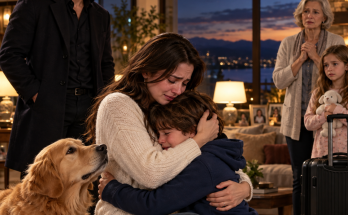
Grandma was asleep when we returned.
The house was quiet.
Alyssa made tea.
I sat at the kitchen table with Mom’s envelope in front of me.
For Candace, when the money is finally hers.
No legal language.
No warning.
No “if I fail.”
Mom had assumed something would eventually work.
That alone felt different from Dad.
Alyssa placed a mug beside me.
“You want privacy?”
I looked at her.
“No.”
She sat across from me.
I opened the envelope.
Mom’s letter was six pages.
Her handwriting became shakier near the end.
She must have written it during treatment.
The first line almost made me laugh.
Candace,
If you are reading this, apparently at least one adult eventually completed something properly.
I covered my mouth.
“That sounds like her,” I said.
Alyssa smiled.
Mom explained that the trust in her name had not been her idea originally.
Dad created the first version.
Mom changed it.
She insisted the assets be placed with an independent trustee and made legally unreachable by Dad, Vivian, Edward, or anyone else in the family.
Smart.
She wrote that too many Harper decisions depended on which person currently controlled the paperwork.
I laughed.
“She definitely knew us.”
Mom described meeting Dad at the diner.
She told him the truth about Edward forging his signature.
She told him she had allowed herself to be blamed temporarily because she feared the company collapse would destroy the value needed to restore my trust.
Then she admitted it had been a terrible decision.
I believed I was protecting your future by allowing another lie about your past.
My throat tightened.
At least she saw it.
Mom wrote that when Dad finally learned everything, he wanted to confront Edward publicly.
She stopped him.
Not because Edward deserved protection.
Because Harper Development was in another fragile financing period.
Again, she had chosen financial recovery over immediate truth.
She wrote:
You may think this was practical. You may think it was cowardly. Both are fair.
Alyssa murmured, “She sounds like you.”
“No.”
“Yes.”
I kept reading.
Mom said she had one condition.
Dad must rebuild the trust completely and contact me directly.
No intermediaries.
No gifts.
No messages through Grandma.
Directly.
Dad agreed.
Then failed at the second part.
Mom apparently knew he drove to Chicago.
Grandma told her afterward.
She learned Marianne had said I refused contact.
Mom did not believe it.
Of course she didn’t.
She knew me.
She called Dad.
They argued.
Mom told him to return.
Dad refused.
Not because he believed Marianne completely.
Because he was afraid.
Mom wrote:
That was the day I understood I could not make your father brave.
I stopped.
Alyssa looked down.
The sentence was brutal because it contained no hatred.
Only recognition.
Mom continued.
She then faced a decision.
Should she tell me everything herself?
The stolen money.
The trust.
Dad’s investigation.
Vivian’s role.
Thomas.
Not all of Thomas, perhaps.
Enough to destroy any remaining family structure.
She almost did.
She wrote three different letters.
Destroyed two.
Kept one.
The one I found in her box.
But she never sent it.
Why?
The answer angered me even before I finished.
Because I seemed happy.
I closed my eyes.
Alyssa noticed.
“Oh no.”
“Yes.”
The same excuse.
Dad saw me laughing outside work.
Marianne saw me building a life.
Mom saw me finishing school and starting my career.
Everyone decided visible functioning meant truth would be an interruption.
Mom acknowledged how wrong that was.
I made the mistake wounded parents often make. I treated your independence as proof you no longer needed information that still belonged to you.
I breathed slowly.
She knew.
She had understood before death.
Maybe that mattered.
Maybe not enough.
She wrote that cancer complicated everything.
Once diagnosed, she did not want our final months consumed by decades of financial betrayal.
That sounded understandable.
It was still a choice made for me.
Mom knew.
She said exactly that.
I chose the kind of goodbye I wanted instead of asking what kind of truth you needed.
My eyes filled.
That sentence was different.
No defense.
No request to reinterpret it kindly.
She wrote that she was sorry.
Then she explained the trust.
She and Dad had calculated what the original five-percent stake might have become.
They disagreed.
Dad wanted to overfund.
Mom told him money could not compensate for abandonment.
Dad said he knew.
She apparently replied, “Then stop trying to make arithmetic do the work of character.”
Alyssa laughed softly.
“I wish I’d known her.”
“You would have been terrified.”
“Probably.”
Mom insisted that any restored assets remain mine regardless of my relationship with Dad.
If I never spoke to him again, the money was still mine.
If I reconciled, still mine.
If I hated him, still mine.
No condition.
No emotional exchange.
That was why the trust sat outside the estate.
Then Mom addressed me directly.
Do not turn the money into a test of whether you are good.
I stared.
She knew me too well.
She anticipated I might want to reject it.
Or give it away immediately.
Or prove I had never needed anyone.
She wrote:
You already proved you can survive without it. Survival is not a moral argument for refusing what belongs to you.
I looked toward Alyssa.
She raised her eyebrows.
“Your mom wins.”
“Quiet.”
I kept reading.
Mom told me to use the money if I wanted.
Save it.
Invest it.
Give some away.
Buy ridiculous shoes.
Take a year off.
Do nothing.
The point was choice.
That word again.
Choice.
She wrote that nearly every adult around me had made choices on my behalf because they feared my reaction.
Some loved me.
Some used me.
Some did both at different times.
But the consequence was the same.
My choices arrived last.
Her final instruction was simple.
Put yours first now.
My throat tightened.
Not above everyone forever.
Not selfishness.
Just first now.
After years of being last in decisions about my own life.
Then Mom wrote about Dad.
I braced myself.
She did not ask me to forgive him.
She did not defend him.
She said he loved me deeply.
She also said love had allowed him to believe good intentions mattered more than completed action.
She had loved him once.
Later, she had been furious with him.
Near the end, she had cared about him in a quieter way.
None of those states cancelled the others.
Again.
Two truths.
Multiple truths.
No courtroom verdict required.
Mom wrote:
Your father’s worst habit was waiting until he understood himself perfectly before acting. People can spend whole lives that way.
I swallowed.
Then:
Do not inherit that habit.
That sentence landed harder than anything else.
I had spent the previous weeks saying I needed time.
Sometimes correctly.
But there was danger in turning time into Dad’s “later.”
Thoughtfulness could become avoidance if stretched long enough.
Mom seemed to know.
She told me not to rush forgiveness.
Not to rush reconciliation.
But when I knew what I wanted, act.
Say it.
Choose it.
Do not make other people guess.
I read the final page slowly.
There is one more thing you should know.
I stopped.
Alyssa groaned.
“Your family cannot help itself.”
I almost laughed.
Mom continued.
When she became ill, she had updated her will.
Nothing dramatic.
She had left me everything she owned.
I knew that.
But she had also left a sealed instruction with the trustee.
If the Harper trust ever transferred to me, I was to receive one additional item.
Not money.
I looked toward the envelope.
Another smaller packet remained inside.
I removed it.
A key.
I stared.
Alyssa laughed.
“You people love keys.”
“I hate this family.”
“No, you don’t.”
“Currently undecided.”
Attached was an address.
A storage facility in Chicago.
My stomach tightened.
Mom had maintained a storage unit too.
Of course.
The letter explained.
Inside were personal records she did not want destroyed after her death.
I had assumed I received everything.
Apparently not.
But Mom’s description calmed me.
Photographs.
Journals.
Early Harper Development records.
Letters between her and Dad from before the divorce.
Nothing she described as a bomb.
Then one sentence:
There is also a box labeled CANDACE—GIVE HER WHEN SHE ASKS WHO I WAS BEFORE I BECAME HER MOTHER.
I stopped.
Alyssa watched me.
“That sounds different.”
“Yes.”
For the first time, a hidden box did not seem to exist because of fraud.
It existed because my mother had once been a person before I knew her.
That realization moved me unexpectedly.
I knew Mom as nurse.
Divorced woman.
Cancer patient.
My mother.
Not Elaine at twenty.
Not the young woman who worked nights while Dad built a company.
Not the person who loved him before resentment.
Not the woman who struggled after giving birth.
Maybe she had preserved that self because she could not explain it while alive.
Or maybe she simply wanted me to ask.
The letter ended:
You may open it immediately.
You may wait ten years.
You may throw away the key.
That is the point.
Your choice.
Love,
Mom
I set the letter down.
Alyssa said nothing.
Smart.
I cried.
Quietly at first.
Then harder.
Not because of one revelation.
Because there was finally no new demand attached to the truth.
No deadline.
No legal condition.
No person waiting for the correct emotional response.
A key.
A choice.
Mine.
Alyssa moved around the table.
“Can I hug you?”
The question almost broke me again.
Everyone in our family had spent decades touching decisions without asking permission.
She asked.
“Yes.”
She hugged me.
I held her.
For a while, we were just sisters.
Not repaired.
Not magically close.
Not absolved of history.
But present.
When I stopped crying, we sat again.
“Are you going to open the storage unit?” she asked.
“Yes.”
“When?”
I thought about Mom’s warning.
When you know, act.
“Tomorrow.”
Alyssa smiled.
“Want company?”
“Yes.”
“Okay.”
That was easy.
The next morning we flew to Chicago.
The storage facility was twenty minutes from my apartment.
Mom’s unit had remained prepaid through a long-term trust arrangement I never knew existed.
The manager verified the documents Bennett had forwarded.
Then he led us down a narrow corridor.
Unit 318.
The key turned.
Inside were twelve boxes.
No furniture.
No dramatic safe.
Just boxes labeled in Mom’s handwriting.
ELAINE—SCHOOL.
WILLIAM—EARLY YEARS.
PHOTOS.
NURSING.
CANDACE—BABY.
CANDACE—SCHOOL.
HARPER DEVELOPMENT.
I stood in the doorway.
Alyssa waited.
“You okay?”
“Yes.”
It was almost true.
We started with photographs.
Mom at seventeen.
Laughing beside a car.
Dad at twenty-two with hair long enough to embarrass his later self.
Their wedding.
Cheap apartment.
Mom in scrubs.
Dad holding blueprints.
A life before I became aware of it.
Then the baby box.
Photos from those eleven weeks with Grandma.
Mom’s hospital bracelet.
A handwritten journal from postpartum treatment.
I did not read it.
Not yet.
Choice.
The Harper Development box contained early ledgers and contracts.
Useful for Bennett.
Nothing immediately explosive.
Then I found the box Mom mentioned.
CANDACE—GIVE HER WHEN SHE ASKS WHO I WAS BEFORE I BECAME HER MOTHER.
I opened it.
Letters.
College notebooks.
Photographs.
A cassette tape.
A ridiculous pair of sunglasses.
Concert tickets.
A life.
At the bottom was a photograph of Mom and Dad sitting on the hood of an old car.
Young.
Laughing.
On the back, Mom had written:
Before we knew how badly adults can complicate simple love.
I smiled.
Then another line.
We were happy once. That mattered even though it did not last.
I understood why she had kept it.
Not to rewrite their marriage.
To preserve complexity.
Good memories did not become lies because later years went wrong.
That applied to Dad too.
Maybe even, eventually, to parts of Vivian.
Alyssa held up a photograph.
“Is that Mom?”
I looked.
Vivian.
Young.
Standing at a Harper Development picnic.
Mom beside her.
Both smiling.
I stared.
“They knew each other before the divorce?”
Alyssa’s eyes widened.
Apparently.
The photo was dated one year before my parents separated.
My stomach tightened.
“Here we go.”
Alyssa sighed.
“Of course.”
But beneath the photograph was a note from Mom.
Met Vivian today. William says she’s helping Edward with office work. She seems ambitious. Candace likes her because she brought cupcakes.
I stared.
I had met Vivian before Dad divorced Mom.
I had no memory of it.
Another photograph showed all four adults.
Mom.
Dad.
Edward.
Vivian.
No Thomas.
The date was months later.
Mom’s journal note:
Something about Vivian makes William nervous. Probably business. I’m too tired to investigate every tension in that office.
My pulse quickened.
Had Vivian and Dad known each other more closely before the divorce?
That possibility would change timelines again.
Alyssa looked worried.
“You think they were together?”
“I don’t know.”
We had learned enough not to fill blanks with worst-case assumptions.
We searched.
Nothing proving an affair between Vivian and Dad before the divorce.
Only workplace proximity.
Then I found a letter from Vivian to Mom.
Elaine,
Thank you for being kind to me during a difficult week. I know we barely know each other.
I stared.
Vivian had written to my mother.
Alyssa read over my shoulder.
The letter thanked Mom for helping Vivian after a car accident.
Nothing suspicious.
Human.
Kind.
That almost felt more destabilizing.
Vivian had once received kindness from the woman she later threatened and undermined.
People did not begin as villains.
They became capable of choices.
That was worse and more hopeful at the same time.
The final box contained one envelope addressed jointly.
Candace and Alyssa.
We stared.
Mom had written both names?
The date was eighteen years earlier.
Before I left.
Before Alyssa knew Thomas.
Before Mom died.
I opened it.
Girls,
You probably will not read this together. I hope I am wrong.
Alyssa sat beside me on the floor.
Mom wrote that she had watched us grow into competitors.
She blamed the adults.
Including herself.
She had sometimes encouraged my contempt for Vivian without considering that Alyssa might hear it as contempt for her.
I had forgotten that.
Weekend conversations.
Mom rolling her eyes when I complained about “Vivian and Alyssa.”
Maybe Alyssa had felt that from across households.
Mom admitted it.
She wrote:
Children should not be asked to carry the moral verdict on their parents.
Alyssa wiped her eyes.
Mom said she hoped someday we could meet without defending anyone.
Not Dad.
Not her.
Not Vivian.
Not ourselves.
Just meet.
She did not predict friendship.
She did not demand sisterhood.
She wrote:
If all you ever manage is honesty without cruelty, that will be more than we gave you.
I stared at that sentence.
Honesty without cruelty.
Maybe that was the actual inheritance worth keeping.
The letter ended with no revelation.
Only:
Neither of you needs the other to lose in order to belong.
Alyssa leaned against the box.
“That’s it.”
“Yes.”
“That’s the whole thing.”
“Yes.”
For decades, everything had been built around the opposite idea.
One daughter’s legitimacy threatening the other.
One child’s comfort requiring another’s silence.
One person’s security financed by another’s loss.
Mom had seen it before most of us.
She had not stopped it.
But she had named it.
Alyssa looked at me.
“Do you believe that now?”
“What?”
“That neither of us needs the other to lose.”
I thought about the DNA test.
The estate.
The house.
The money.
Dad.
Vivian.
Thomas.
All the ways we had been trained to measure ourselves against each other.
“Yes.”
She nodded.
“Me too.”
We packed the important files for Bennett.
The personal boxes came home with me.
Before leaving the storage unit, I looked back.
For weeks, every locked drawer and sealed envelope had represented someone withholding my life from me.
This room felt different.
Mom had left the key.
And permission.
I closed the door.
Outside, Chicago traffic moved under a bright afternoon sky.
Alyssa stood beside me.
“What now?”
I thought of Dad’s thirty-five-part life reduced to papers and consequences.
We were nowhere near finished.
Vivian still had six months in the house.
The insurance investigation remained open.
The education initiative existed only as notes.
Thomas and Alyssa had just begun figuring out what biological connection could become.
Marianne had years of repayment ahead.
I still had anger.
Grief.
Money I had not emotionally accepted.
A family home waiting to be sold.
But for the first time, none of those things felt like unanswered questions someone else controlled.
They were decisions.
Mine.
Ours where appropriate.
Separate where necessary.
“Now,” I said, “we go home.”
Alyssa smiled.
“Which one?”
I looked toward the city.
“Mine.”
She nodded.
And followed me there.
Click here to continue reading: PART 25: The First Morning Alyssa Stayed in My Chicago Apartment, We Discovered Sisterhood Was Harder to Build Than a Shared Enemy
Eighteen Years After Leaving Home, My Father’s Funeral Forced Me Back Into the Family That Had Erased Me
Part 24 of 35