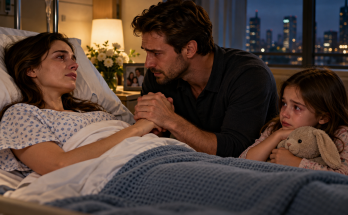
Four years after Carol died, I woke before dawn on a Sunday and realized I had forgotten the exact date of her funeral.
The realization startled me.
For a long time, grief had made dates feel sacred.
Diagnosis.
Hospital admission.
Last conversation.
Death.
Funeral.
Anna’s phone call.
The bank.
The cassette.
Every day had once seemed carved into stone.
Now I had to think.
October second?
Third?
I lay in bed staring at the ceiling.
Then I laughed.
Carol would have hated the importance I had given the date.
She remembered birthdays.
Anniversaries.
Appointments.
But funerals?
“Remember the person, not the catering,” she once said after my uncle’s burial.
So I got up.
Made coffee.
Opened the curtains.
The maple tree was red again.
Nearly half its leaves had turned.
I looked for the first branch Carol used to watch.
Could not identify it anymore.
That felt right.
Life had grown beyond the marker.
The house was still mine.
I had painted the kitchen.
Finally replaced the cabinet door Rebecca complained about.
Carol’s chair remained beside the lamp, though I sometimes sat in it now.
Anna did too when she visited.
The first time that happened, she froze halfway down as though she had violated some law.
I told her furniture was not sacred.
She remained uncomfortable for ten minutes.
Then complained the chair was too soft.
Carol would have agreed.
Rebecca arrived around nine with Mark and the children.
Except they were not really children anymore.
Her son was tall enough to borrow my jackets.
Her daughter had become obsessed with family history but had been warned that if she ever created another ancestry spreadsheet during dinner, she would lose dessert.
Daniel arrived before noon.
Anna came with him.
Family gatherings had become large and confusing.
Exactly the way Rebecca wanted.
The occasion was not an anniversary.
Not a memorial.
Just Sunday lunch.
Rebecca brought chicken.
Daniel brought wine.
Anna brought pie.
I made potatoes.
Mark brought common sense.
The grandchildren brought noise.
At some point, Rebecca’s daughter asked:
“Grandpa, how did you meet Grandma Carol?”
Everyone became quiet.
Not because the question was forbidden.
Because we understood how enormous the full answer could become.
I smiled.
“At church.”
“That’s boring.”
“It was a very boring church.”
Rebecca laughed.
The girl asked, “Did you love her right away?”
“No.”
“When?”
I thought.
“Slowly.”
That was true.
“Did she love you right away?”
Rebecca looked toward me.
Anna too.
The old story contained that question.
Now it no longer carried danger.
“Earlier than I loved her, apparently.”
The girl frowned.
“How do you know?”
“She told me.”
That was also true.
Eventually.
“Was Grandma Carol a good person?”
The table became still again.
Children ask brutal questions with casual voices.
Rebecca opened her mouth.
I raised a hand.
“I’ll answer.”
I looked at my granddaughter.
“She was kind.”
“Yes.”
“She was funny.”
“Yes.”
“She could be bossy.”
Rebecca said, “Extremely.”
I continued.
“She loved your mother.”
“Grandma Anna does too.”
“Yes.”
“Were they friends?”
The adults exchanged looks.
Anna almost choked on water.
“Complicated,” Rebecca said.
The girl rolled her eyes.
“Adults say complicated when they don’t want to explain.”
Daniel laughed.
“She has you there.”
I thought about the question.
Were Carol and Anna friends?
Not exactly.
Rivals?
Sometimes.
Co-conspirators?
In moments.
Witnesses to each other’s grief?
Certainly.
Women connected by me?
At first.
By Rebecca?
Forever.
“They cared about each other,” I said.
Anna looked at me.
That was true enough.
The girl accepted it.
Then asked, “Did Grandma Carol do bad things?”
Rebecca put down her fork.
I answered.
“Yes.”
The child looked surprised.
“So she was bad?”
“No.”
“Why not?”
I smiled.
“Because people are more complicated than one thing they did.”
“There’s that word again.”
Everyone laughed.
I continued.
“She made choices that hurt people.”
“Did she say sorry?”
“Yes.”
“Did everyone forgive her?”
“No.”
The child frowned.
“Did you?”
“Yes.”
Anna looked at me.
So did Rebecca.
No hesitation now.
“Yes.”
The girl considered this.
“Then it’s okay?”
“No.”
That confused her.
“If you forgave her, doesn’t that mean it’s okay?”
“No.”
I leaned closer.
“Forgiveness means I stopped needing what happened to be different before I could keep loving her.”
She thought.
“That sounds hard.”
“It was.”
Then she returned to her potatoes.
Children do not need every philosophical argument completed.
Lunch continued.
Later, Rebecca and I washed dishes.
Everyone else moved to the living room.
The house filled with conversation.
I could hear Anna arguing with Daniel.
Mark explaining something to the children.
A television nobody was watching.
Rebecca dried a plate.
“You handled that well.”
“I have practice.”
“Do you wish we told them less?”
“No.”
“More?”
“No.”
She smiled.
“Look at you choosing moderation.”
“Old age.”
“You were old four years ago.”
“Respect your biological father.”
She laughed.
Then grew quiet.
“Do you ever wish Mom hadn’t asked you to find Anna?”
I stopped washing.
There was the final version of the question.
Not whether I wished the truth different.
Whether I wished I had remained ignorant.
“No.”
Immediate.
“Never?”
“No.”
“Even during the worst part?”
“Especially then.”
“Why?”
I turned off the tap.
“Because pain is not evidence that truth was a mistake.”
Rebecca looked at me.
“That sounds like something the fund should print.”
“Do not steal my intellectual property.”
She laughed.
I continued.
“If Carol had died without telling me anything, I would have remembered her differently.”
“Better?”
“Easier.”
“That’s not the same.”
“No.”
I looked toward the living room.
Anna was helping my granddaughter with something on the phone.
Daniel sat in Carol’s chair.
Apparently he had no furniture shame.
Rebecca followed my eyes.
“You’d never know Anna.”
“No.”
“I’d never know her.”
“No.”
“Or Daniel.”
“No.”
“The kids wouldn’t have Grandma Anna.”
“No.”
“The Choice Fund wouldn’t exist.”
“Probably not.”
Rebecca smiled sadly.
“So Mom’s final wish did some good.”
“Yes.”
“But that doesn’t make the lie worth it.”
“No.”
Good outcomes did not justify harm.
That was another lesson we kept relearning.
Rebecca dried another plate.
“I used to think Mom asked you to find Anna because she wanted you two together.”
“So did I.”
“Now that seems almost ridiculous.”
“Yes.”
Carol’s final wish had sounded romantic when spoken in a hospital room.
Find your first love.
Like some sentimental blessing.
A dying wife sending her husband back toward an old romance.
That was never the truth.
Carol did not send me to Anna because she wanted to arrange my next love story.
She sent me because Anna was the living person who held the beginning.
The person whose existence could contradict Carol’s version.
The person capable of restoring the choices Carol could no longer return.
That had been the real final wish.
Not reunion.
Truth.
Rebecca put the towel down.
“Did you ever ask Anna whether Mom told her to take care of you?”
I smiled.
“Yes.”
“What did she say?”
“She said Carol would have known better.”
Rebecca laughed.
“Accurate.”
Years earlier, I might have imagined a dramatic scene.
Carol secretly asking Anna to love me after she died.
That would have been simpler.
More romantic.
Less human.
Instead Carol had done something harder.
She stopped directing the outcome.
Find Anna.
Then she let whatever came after belong to us.
That was her final act of love.
Not pure.
Not enough to repair everything.
Still love.
Rebecca left after lunch.
Daniel and Anna stayed another hour.
Before leaving, Anna walked with me into the backyard.
The maple tree cast red leaves across the grass.
“You look old,” she said.
“Four years of knowing you.”
“Cruel.”
“True.”
She smiled.
Then looked toward the house.
“Happy?”
I considered.
“Yes.”
“Really?”
“Most days.”
“Good.”
“You?”
“Yes.”
“Really?”
“Most days.”
Fair.
We stood quietly.
There was no unfinished romance between us.
No temptation.
No alternate life pressing at the edges.
Just gratitude.
“You know,” Anna said, “when Carol told me you were going to find me, I almost refused.”
“She told you?”
“Not directly.”
“What do you mean?”
“The last message she sent me.”
I looked at her.
“What message?”
Anna smiled at my expression.
“Relax. Nothing important.”
“That phrase has history.”
“She emailed me before going into the hospital.”
“You never mentioned that.”
“It was one sentence.”
“What did it say?”
Anna recited from memory.
If Walter calls, please answer.
I stared.
“That’s all?”
“That’s all.”
“What did you reply?”
Nothing.
I raised an eyebrow.
Anna shrugged.
“I was angry.”
“Fair.”
“Then you called.”
“And you answered.”
“Yes.”
“Why?”
She looked toward the tree.
“Because after forty years, I was tired of letting fear answer for me.”
That sentence could have belonged to any of us.
I smiled.
“I’m glad you picked up.”
“So am I.”
She hugged me.
No ache for youth.
No fantasy.
Family.
When she and Daniel drove away, I stayed outside.
Leaves moved in the wind.
A red one landed near my shoe.
I picked it up.
Carol would have declared victory over summer.
I carried it inside.
Placed it beside her photograph.
Not as evidence.
Not as a memorial ritual.
Just because she would have liked it.
That evening, I opened the album containing the photographs Carol had hidden in the safe-deposit box.
Anna and me at twenty.
College lawn.
Bad hair.
Cheap clothes.
Terrible certainty.
I turned the page.
Carol and me years later.
Rebecca in between.
Then more.
Birthdays.
Vacation.
Wedding.
Grandchildren.
A life.
Not the only possible life.
The one we actually had.
For decades, I believed Anna had left because she stopped loving me.
Then I learned she had been pressured away.
For decades, I believed Rebecca came into my life by chance.
Then I learned she was my biological daughter.
For decades, I believed Carol and I built our marriage from an ordinary beginning.
Then I learned fear, jealousy, coercion, silence, and love had all been present before the vows.
None of those discoveries erased the life itself.
They changed its meaning.
Meaning could change without reality disappearing.
That took me years to understand.
I closed the album and looked at Carol’s photograph.
The question that had followed me since her hospital room no longer needed asking.
Why did you send me to Anna?
I knew.
Because Anna was where the truth began.
Because Rebecca deserved her own history.
Because I deserved to know the decision had been taken from me.
Because Carol finally understood that love without truth had become another kind of possession.
Because when she could no longer repair what she had done, she could at least stop controlling what happened next.
I touched the frame.
“You were late.”
That made me smile.
Carol hated being late.
“You were very late.”
My throat tightened.
“But you got there.”
Not soon enough.
Never soon enough.
Still.
She got there.
I sat in her chair.
The house was quiet.
Not empty.
Quiet.
There was a difference.
My phone buzzed.
Family group chat.
THE PEOPLE WHO SHOULD HAVE TALKED SOONER.
Daniel had posted a photograph of Anna asleep in the passenger seat.
Rebecca responded:
DELETE THAT BEFORE MOM WAKES UP.
Daniel:
WHICH MOM?
Rebecca:
YOUR MOM.
Then another message.
Rebecca:
MY MOM TOO, APPARENTLY.
Anna responded thirty seconds later.
I AM AWAKE AND I HATE ALL OF YOU.
I laughed so hard I had to remove my glasses.
Then Rebecca sent:
Love you too, Mom.
No correction.
No hesitation.
Anna replied with a heart.
I looked at Carol’s photograph.
For a moment, grief moved through me.
Not the sharp grief from the hospital.
Not betrayal.
Just absence.
I wished she could see this.
Rebecca with two mothers without needing to choose between them.
Daniel with a sister.
Grandchildren with a larger family.
Ruth’s money funding other people’s freedom.
Anna alive and loved.
Me still here.
Maybe Carol had imagined some of it.
Maybe not.
It no longer mattered.
The outcome was ours.
That was the gift inside her final wish.
Not a restored romance.
Not a perfect explanation.
Not permission to replace her.
Choice.
At twenty-two, others had chosen for me.
At twenty, others had chosen for Anna.
As a child, others had chosen what Rebecca was allowed to know.
Carol spent decades choosing what truth the family could survive.
Then, at the very end, she finally let go.
Find Anna.
Three words.
The first honest door she opened without deciding what had to stand on the other side.
I picked up my phone.
Typed into the family chat.
WALTER:
YOUR MOTHER IS SLEEPING. LEAVE HER ALONE.
Rebecca replied:
WHICH MOTHER?
I stared at the screen.
Then smiled.
WALTER:
EXACTLY.
The responses came immediately.
Laughing faces.
Arguments.
Daniel objecting.
Anna threatening everyone.
Rebecca sending hearts.
Family noise arriving through a phone in a quiet house.
I leaned back in Carol’s chair.
Outside, red leaves crossed the window.
For the first time, the past no longer felt like a locked room I was trying to escape.
It was simply behind me.
I knew what happened.
I knew what had been taken.
I knew what remained.
And I knew something none of us understood forty years earlier:
Truth does not guarantee the life you wanted.
Love does not excuse the choices you stole from someone else.
Forgiveness does not make harm disappear.
And family is not made honest by pretending its history is simple.
Family becomes honest when everyone is finally allowed to know enough to choose where they stand.
Carol learned that too late.
But not too late for us.
I looked once more at the photograph beside the red leaf.
“Good night, Carol.”
Then I turned off the lamp.
The room went dark.
My phone continued buzzing with messages from the people she had finally allowed me to find.
The End
Read more original stories on Feel Every Story.
On the Last Night Carol Could Speak Clearly, She Asked Me to Find the Woman I Had Spent Forty Years Forgetting
Part 35 of 35