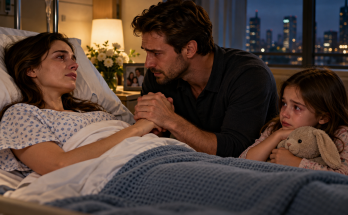
The first time my wife asked whether I would forgive her, I assumed she was frightened of dying. I had no idea she was asking forgiveness for something that had already shaped nearly every year of my adult life.
Carol lay propped against two hospital pillows, so diminished beneath the blankets that I kept noticing the empty space around her. An oxygen tube curved beneath her nose. The monitor beside the bed marked each heartbeat with a soft electronic pulse, and a pump clicked whenever another measured dose of medication entered the line in her arm.
Outside the window, rain had begun gathering against the glass. I watched two drops join and slide downward because looking at the weather was easier than looking at the woman I had loved for thirty-six years and admitting that the doctors had run out of things to try.
Carol noticed anyway. She always noticed when I was hiding inside some ordinary detail. “Walter.”
I turned immediately. “Right here.”
“You’ve been staring at that window for ten minutes.”
“Five, maybe.”
“Ten.” Her voice was thin, but the old certainty was still there. “You were never any good at pretending not to worry.”
“That makes two of us.”
One corner of her mouth lifted. Even that small movement cost her something. She closed her eyes until the pain passed, and I tightened my fingers around her hand without meaning to. Her skin felt papery and warm. The wedding band on her finger had become loose enough to turn freely.
Two days earlier, Dr. Patel had asked me to step into the hallway. He had used gentle words because doctors learn to put cushions around terrible facts. The cancer had spread beyond anything treatment could meaningfully control. Further intervention would exhaust Carol without buying her useful time. His recommendation was comfort.
I had nodded as though we were discussing a plumbing repair. Then I had walked to the family restroom at the end of the corridor, locked the door, gripped the sink, and stared at my own face until I could trust myself to return to her room.
Carol had known before I told her.
She had spent thirty-six years reading my silences.
Now she looked past me toward the chair where I had draped my jacket. “You should go home tonight.”
“No.”
“Walter.”
“No.”
“You haven’t slept properly in three days.”
“I’ve had worse weeks.”
“When?”
I thought about it. “The year Rebecca learned to drive.”
Carol gave a breathless laugh. “You followed her in your truck.”
“She was sixteen.”
“She was going six blocks.”
“She ran a stop sign on the third block.”
“She rolled through it.”
“Revisionist history.”
Her smile lingered, and for half a minute the hospital room seemed less cruel. We were back in our kitchen on Maple Street, arguing about something harmless while Rebecca complained from the next room that we were embarrassing her.
Our daughter was forty now, living in Columbus with a kitchen larger than the entire first floor of the house where we had raised her. She had offered repeatedly to come back to Millfield and stay at the hospital, but Carol had refused until that morning.
“She has her own family,” Carol had said.
“She has you.”
“She’ll come when it matters.”
I hadn’t understood why those words bothered me.
Now Carol stared at our joined hands. “Do you remember Sunday mornings when Rebecca was little?”
“Which Sunday?”
“The pancake years.”
“That was about eight years.”
“You made coffee strong enough to dissolve a spoon.”
“You put cinnamon in everything.”
“Rebecca liked cinnamon.”
“Rebecca liked pouring syrup until her plate looked flooded.”
Carol’s expression softened. “She used to sit on the counter.”
“And drop eggshells into the batter.”
“You always fished them out.”
“I usually found most of them.”
“You never complained.”
“I complained constantly.”
“Not to her.”
That was true. Rebecca had been the center of our life from the moment we brought her home. Carol had told me early in our relationship that she couldn’t have children. I had already imagined one future collapsing by then, so I accepted the news more easily than she expected.
A year later, she brought up adoption.
I could still remember her standing at our kitchen sink, sleeves rolled above her elbows, telling me there was a little girl who needed parents more urgently than we needed biology.
Rebecca entered our lives soon afterward.
Marriage followed.
Everything had seemed, at the time, almost providential.
Carol looked toward the window. “People always said she looked like me.”
“They did.”
“They were being kind.”
“I thought so.”
She glanced at me.
I smiled. “You want me to lie now?”
“No. Not now.”
Something in her tone changed the air between us.
I waited.
She looked down at her hands again. “She did have my smile, though.”
“She learned that from watching you.”
“And my stubbornness.”
“That was definitely yours.”
“What did she get from you?”
I thought of Rebecca’s patience, her habit of rubbing the bridge of her nose when angry, her ability to repair almost anything once she understood how it worked.
“Bad knees,” I said.
Carol didn’t laugh.
I continued, trying to pull her back toward familiar ground. “And maybe her green eyes.”
Her fingers stiffened inside mine.
It was slight, but I felt it.
Rebecca’s eyes had always been unusual in our family: clear green with a narrow amber ring around the pupils. People noticed them. My own eyes were hazel, though they had been greener when I was younger.
Carol turned her head toward the window.
“Those eyes,” she murmured. “Yes.”
Before I could ask what she meant, she said, “Your mother would have loved seeing her now.”
That surprised me more.
My mother, Ruth, had been dead for ten years. In Millfield, people still spoke of her with the respectful affection reserved for women who had baked for every church fundraiser, sat with dying neighbors, organized school clothing drives, and somehow remembered every child’s birthday.
“She’d have bragged about Rebecca to strangers,” I said.
Carol swallowed.
I felt her grip tighten.
“Walt?”
“What?”
“Was I a good wife?”
I stared at her.
Of all the questions I expected from a woman approaching the end of her life, that was nowhere on the list.
“What kind of question is that?”
“Answer it.”
“You gave me thirty-six years.”
“That isn’t an answer.”
“You gave me a family. You stayed when I was impossible to live with. You made every house we lived in feel like ours. You raised Rebecca with more patience than I knew a person could have.” My throat tightened, but I forced the words through. “Yes, Carol. You were a good wife.”
Her eyes filled.
I leaned closer. “Why are you asking me this?”
“Because I need something from you.”
“Name it.”
“No. Promise first.”
“Carol—”
“Please.”
There was urgency in her face now. Not confusion. Not medication. She was completely lucid.
I rubbed my thumb over her knuckles. “All right.”
“Promise me.”
“I promise.”
She closed her eyes.
For several seconds, the only sounds were the rain and the small mechanical noises around her bed.
Then she opened them again.
“Find Anna.”
I thought I had misunderstood her.
“What?”
“Anna.”
The room seemed to contract around the name.
I had not spoken it aloud in years.
Maybe decades.
Carol watched recognition arrive on my face.
“You know who I mean.”
I released her hand without intending to.
“Why are you talking about Anna?”
“Find her.”
“Carol, I haven’t seen Anna since 1985.”
“I know.”
“You know?”
Her eyes closed again.
The sensation that passed through me was not jealousy, exactly. It was stranger than that. Carol had never been threatened by the existence of a woman I had loved before her. She had known there had been someone. She knew Anna had broken my heart. But Anna had belonged to a life I almost never discussed.
I leaned toward the bed. “Why her?”
Carol’s lips trembled.
“You’ll understand when you find her.”
“Understand what?”
She turned her face away.
“Carol.”
No response.
I stood. “Look at me.”
Her eyes opened reluctantly.
“What am I supposed to understand?”
Tears slipped into the creases beside her nose.
“Something I should have told you years ago.”
My pulse began striking hard in my neck.
“What?”
“I can’t.”
“You just told me to go find a woman I haven’t seen in forty years.”
“I know.”
“Then tell me why.”
“If I say it, I’ll say it wrong.”
“What could possibly be wrong enough that you need Anna to explain it?”
Carol lifted her hand toward me. I took it automatically.
She whispered, “Please forgive me in advance.”
The nurse entered a moment later to check Carol’s medication, and I moved aside because I no longer trusted my face.
From the doorway, I watched my wife close her eyes.
The woman I had trusted more completely than anyone alive had just opened a door onto forty years of my past and refused to tell me what stood behind it.
And for the first time since the doctors told me Carol was dying, grief was no longer the only thing I felt.
Click here to continue reading: PART 2: Three Days After My Wife’s Final Request, I Returned to a Silent House and Found the Past Waiting in Every Room
On the Last Night Carol Could Speak Clearly, She Asked Me to Find the Woman I Had Spent Forty Years Forgetting
Part 1 of 35