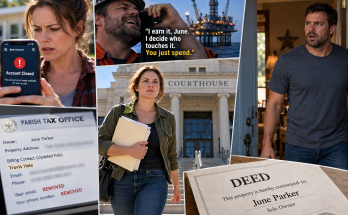
The alert arrived at 6:17 on a Tuesday morning.
I was standing barefoot in the kitchen, waiting for coffee, when my phone vibrated against the counter.
TRANSFER COMPLETED: $4,800.00
For several seconds I simply stared at the screen.
The transfer had come from our household account.
Four thousand eight hundred dollars.
No discussion.
No note.
No memory of approving anything close to that amount.
The room seemed to narrow around me.
My first thought was not reasonable.
Travis.
My second was worse.
Again.
I opened the banking app.
The transfer showed as an electronic payment to a company I did not recognize.
MORGAN FIELD SERVICES LLC.
My heartbeat climbed.
We had rules.
Seven hundred fifty dollars.
Anything larger involving household funds was supposed to be discussed.
Not because the bank technically required two signatures for every electronic payment, but because we had agreed that neither of us would move significant shared money without the other knowing.
Four thousand eight hundred was not close.
I heard the shower running upstairs.
For one ugly moment, I was back at the grocery register.
Card declined.
People waiting.
Chicken removed.
Coffee removed.
A husband hundreds of miles away explaining that he had simplified things.
I hated how quickly memory could erase years of progress.
I took screenshots.
Then another.
Then downloaded the transaction details.
Only after I had saved everything did I notice what I was doing.
Evidence first.
Conversation second.
My hands were shaking.
Travis came downstairs twenty minutes later wearing work clothes and carrying his boots.
“Morning.”
I turned the phone toward him.
“What is this?”
He stopped.
His eyes moved to the screen.
“I don’t know.”
The answer struck me like an insult.
“You don’t know.”
“No.”
“Four thousand eight hundred dollars left our account and you don’t know.”
He set his boots down.
“June, I haven’t moved anything.”
The old tone was not there.
No irritation.
No accusation that I was overreacting.
But my body did not care.
“Then why is it gone?”
“I don’t know.”
I heard myself getting louder.
“You said that already.”
Travis looked at me carefully.
“Do you want me to open my phone?”
“I want to know where the money went.”
“So do I.”
He reached toward the counter.
Then stopped before touching my phone.
“Can I see the details?”
I handed it to him.
He read silently.
“Morgan Field Services.”
“You recognize it?”
“No.”
“Business vendor?”
“Not ours.”
“You’re sure?”
“Yes.”
“Someone Noah uses?”
“I don’t know.”
I stared at him.
He caught himself.
“I can call Noah, but I’m not saying that explains it.”
That mattered.
Old Travis would already have begun building a theory.
Maybe accounting.
Maybe automatic payment.
Maybe I forgot.
Something to reduce the threat before understanding it.
This Travis handed the phone back.
“Call the bank.”
“You call.”
He looked surprised.
Then understood.
“You want to hear.”
“Yes.”
“Okay.”
He put the call on speaker.
The representative verified both of us.
The transfer had been initiated through our online bill-payment system.
The account profile associated with the initiation was mine.
My stomach dropped.
“Mine?”
“Yes, ma’am.”
“I didn’t do it.”
Travis said nothing.
The representative continued through security questions.
The payment had been scheduled almost three weeks earlier.
Three weeks.
I opened my calendar.
Then I remembered.
The workshop roof.
The second contractor.
A deposit.
“Oh.”
Travis looked at me.
I closed my eyes.
Morgan Field Services was the legal company name behind the contractor we had hired.
The invoice used the trade name.
The bank used the registered business name.
I had scheduled the final payment myself.
Three weeks earlier.
After the work passed inspection.
I had forgotten.
Completely.
The representative confirmed the bill-pay record.
My login.
My device.
My authorization.
No unauthorized access.
No mystery.
No Travis.
I thanked her and ended the call.
Silence filled the kitchen.
I could barely look at him.
“I’m sorry.”
Travis leaned against the counter.
“It’s okay.”
“No.”
I shook my head.
“Don’t do that.”
“What?”
“Don’t tell me it’s okay because you’re afraid of making me feel worse.”
His face tightened.
“All right.”
“I accused you.”
“You asked me.”
“I didn’t just ask.”
“No.”
“I looked at you like you’d done it again.”
He nodded.
“That hurt.”
The fact that he admitted it relieved me more than forgiveness would have.
“I know.”
“I also understand why.”
“Both.”
“Yes.”
I sat down.
The adrenaline had nowhere to go.
My hands still shook even though the danger had disappeared.
Travis sat across from me.
“Do you want to talk about it now?”
“I want to stop reacting like this.”
He considered that.
“Maybe you can’t decide that all at once.”
“I should be further along.”
“According to who?”
“Me.”
He smiled sadly.
“You’re strict.”
“Someone has to be.”
“No.”
The word was gentle.
“That’s exactly what we’re trying not to do.”
I looked at him.
He continued.
“You don’t have to become perfectly relaxed so I can feel forgiven.”
“I don’t want you living under suspicion forever.”
“Neither do I.”
“Then what?”
“We keep doing what we did.”
“What did we do?”
“You saw something. You asked. We checked.”
“I accused.”
“A little.”
“A lot.”
He almost smiled.
“Medium.”
Despite myself, I laughed.
Then I cried.
Not dramatically.
Just tears arriving while I was still half laughing.
Travis stayed where he was.
He did not reach for me.
That mattered too.
After a moment I held out my hand.
Then he took it.
“I hate that a bank alert can still do this to me.”
“I know.”
“I hate that you’re part of why.”
“I know.”
“And I hate that sometimes you aren’t doing anything wrong and I still hear the old version of you.”
He swallowed.
“I know.”
This time the phrase did not irritate me.
He actually did know.
We brought the incident to Dr. Morris.
She asked me to describe what happened before I looked at the transaction details.
“My body decided first.”
“What did it decide?”
“That money was disappearing.”
“And what did that mean?”
“That I was losing control.”
“Anything else?”
“That Travis knew something I didn’t.”
She nodded.
That was the trigger.
Not merely money leaving.
Information imbalance.
For years, information had meant power.
Who knew.
Who did not.
Who explained.
Who was expected to accept the explanation.
Dr. Morris turned to Travis.
“What happened for you when June showed you the alert?”
“I felt accused.”
“What did you want to do?”
“Prove I didn’t do it.”
“What stopped you?”
He looked at me.
“I realized proving myself too fast might sound like arguing her out of being scared.”
I had not known that.
“What did you feel after the bank confirmed June scheduled it?”
He hesitated.
“Relief.”
“Anything else?”
“Vindicated.”
The word stung.
He saw it.
“I’m not proud of that.”
“No. Keep going.”
He did.
“For maybe ten seconds, I wanted to say, ‘See? You were wrong.’”
“Why didn’t you?”
“Because being wrong about that transaction didn’t make her wrong about what happened before.”
Dr. Morris nodded.
“And if you had said it?”
“I would’ve turned one mistake into a weapon against her memory.”
The sentence stayed with me.
I had done something similar too.
Every new concern could become evidence that Travis remained untrustworthy.
Every old mistake could be pulled forward to strengthen a present argument.
If we did that forever, nothing could ever change.
After counseling, we made one practical adjustment.
Bill-pay transactions would include notes in our shared calendar when scheduled more than a week ahead.
Not surveillance.
Context.
A simple way to prevent forgotten payments from becoming mysteries.
Travis added the first one himself.
INSURANCE PREMIUM – 1,260 – scheduled June 14.
I saw it on the calendar.
Ordinary.
Transparent.
No anxiety.
Several weeks passed.
Then another test came from his business.
Noah called during dinner.
Travis stepped outside.
He returned ten minutes later looking tense.
“What happened?”
“One of our clients wants to accelerate a job.”
“Problem?”
“Maybe.”
He sat.
“We’d need to hire two contractors quickly.”
“Can you?”
“Yes.”
“But?”
“They want us to front some travel expenses.”
“How much?”
“About twelve thousand total.”
I waited.
He did not immediately say more.
“What do you think?”
“I think the contract supports reimbursement.”
“That sounds reasonable.”
“I also think I’m nervous because it resembles the Gulf Arc language.”
Temporary cash gap.
Money now.
Payment later.
He did not need me to remind him.
“What are Noah and Caleb saying?”
“Proceed, but document everything.”
“Sounds sensible.”
“Yeah.”
“Then why are you asking me?”
He thought.
“I’m not asking permission.”
“Good.”
“I think I’m asking whether being nervous means I shouldn’t do it.”
I shook my head.
“No.”
“What does it mean?”
“That you’re nervous.”
He laughed.
“Helpful.”
“I’m serious.”
I leaned toward him.
“You used to treat confidence like evidence.”
His smile disappeared.
“Yes.”
“Maybe now you’re treating anxiety like evidence.”
He considered that.
“Same mistake backwards.”
“Exactly.”
Risk was not determined by how calm he felt.
It was determined by facts.
Contract.
Cash reserves.
Exposure.
Documentation.
Ability to absorb loss.
He took the question back to his partners.
They reviewed the numbers.
The company proceeded.
The client reimbursed them on schedule.
Nothing dramatic happened.
That was important.
Not every situation resembling the past was the past returning.
Sometimes a transfer was a roof payment I had forgotten.
Sometimes a business advance was simply a business advance.
Healing, I discovered, required learning not only to recognize danger but also to stop inventing danger where facts did not support it.
That was harder than I expected.
Near the end of the year, Travis and I had another argument.
Not about money.
About Christmas.
He wanted his sister to stay with us for four nights.
I wanted two.
He said four made more sense because she was driving a long distance.
I said two was enough because I did not want a houseguest that long.
We went back and forth.
Then Travis said, “Four nights isn’t unreasonable.”
The sentence hit me wrong.
I became still.
He saw it immediately.
“What?”
“You’re doing it.”
“Doing what?”
“Making your preference reasonable and mine unreasonable.”
His face changed.
“I didn’t mean—”
“Intent isn’t the point.”
He stopped.
Old Travis would have argued about wording.
New Travis took a moment.
“You’re right.”
I blinked.
“I should’ve said I prefer four.”
“Yes.”
“And you prefer two.”
“Yes.”
“Neither is automatically unreasonable.”
“Correct.”
He sighed.
“Three?”
I almost laughed.
“Three.”
“Done.”
That was marriage now.
Not never triggering each other.
Not never making mistakes.
Catching them before they became systems.
The day his sister arrived, Travis showed her the guest room.
She looked around and said, “It’s nice being back in your house.”
Travis answered without hesitation.
“June’s house. Our home.”
I heard him from the hallway.
He did not know I was listening.
That made it matter more.
That night, after everyone went to bed, I stood in the kitchen alone.
My phone buzzed.
Bank alert.
INSURANCE PREMIUM – $1,260.
I looked at the shared calendar.
There it was.
Scheduled.
Expected.
No panic.
I closed the notification.
Then turned off the kitchen light.
Progress, apparently, could be measured in how quietly you returned your phone to the counter.
Click here to continue reading: PART 34: An Unexpected Offer for Daddy’s Land Put a Number on Everything I Had Fought to Protect and Forced Me to Decide What Ownership Really Meant
The Morning My Debit Card Failed, I Learned My Husband Had Quietly Redefined What Belonged to Us
Part 33 of 44