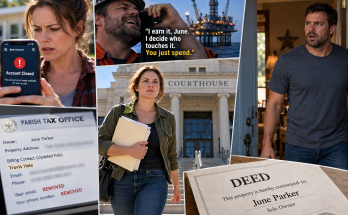
Travis stood on the porch for nearly three minutes before opening the front door.
I could see him through the narrow window beside it, one hand holding the envelope, the other gripping the strap of his duffel bag. He read the first page once. Then again. His mouth moved slightly on the second pass, not because he was speaking, but because concentration had pulled his lips into a thin line.
When the door finally opened, he did not call my name.
He stepped inside, placed the duffel beside the entry table, and walked toward the kitchen with the papers folded against his palm.
I remained seated at Daddy’s table.
Travis stopped in the doorway.
“What is this?”
His voice was controlled.
That frightened me less than it once would have.
“You read it.”
“I read some lawyer letter taped to my own front door.”
I glanced at the document in his hand.
“My lawyer sent it to this address.”
His eyes narrowed.
“Your lawyer?”
“Yes.”
He laughed once, without humor. “You hired a lawyer because I changed bank accounts?”
“No.”
“Then why?”
“Sit down.”
“Don’t tell me to sit down in my own house.”
There it was, less than sixty seconds after walking inside.
My own house.
For years I would have ignored it.
This time I reached beside me, took the certified deed from the table, and placed it between us.
Travis looked at the paper but did not move closer.
“What’s that supposed to be?”
“The deed.”
“I know what a deed looks like.”
“Then read whose name is on it.”
His jaw tightened.
“We’re married.”
“I know.”
“This is ridiculous.”
“I’m not discussing opinions yet. I’m asking about facts.”
He tossed the lawyer’s letter onto the table.
“You’ve been talking to somebody who’s filling your head with garbage.”
“No. I’ve been looking at records.”
“Same thing.”
I pushed the deed toward him.
“Did you apply for financing using this property?”
His eyes flicked down.
The movement lasted only an instant.
But I saw it.
“What are you talking about?”
I reached into the folder beside me and removed the copied application page.
His name.
My address.
Applicant ownership listed as his.
I placed it beside the deed.
The color left his face so gradually I might have missed it if I had not been watching.
“That didn’t go anywhere,” he said.
Not I didn’t do it.
Not That isn’t mine.
That didn’t go anywhere.
My fingertips became cold.
“So you did apply.”
He threw one hand outward. “I looked into options.”
“You signed a document saying you owned my property.”
“It’s our property.”
“The deed says otherwise.”
“You think marriage means nothing now?”
“I think a legal document asking someone to lend money against land requires the truth.”
He stared at me.
I had imagined this moment for several days. In some versions, Travis apologized. In others he shouted. Once, while lying awake at two in the morning, I imagined him sinking into the chair and telling me there had been some terrible emergency he had been too ashamed to explain.
The reality was quieter.
He looked irritated.
That hurt more.
“I was trying to improve our finances,” he said.
“By borrowing against property you don’t own?”
“By exploring a line of credit.”
“For what?”
“That’s not the point.”
“It’s exactly the point.”
He pulled out the chair opposite me and finally sat.
His posture changed immediately. Shoulders lowered. Voice softer.
It was the Travis who handled difficult conversations.
The reasonable one.
The one who had convinced me countless times that my concern was evidence I misunderstood something.
“June, listen to me.”
“I am.”
“The land is yours technically.”
“Legally.”
“Fine. Legally. But we’ve been married nine years. I’ve put money into this place.”
“You’ve lived here without a mortgage.”
He blinked.
“I’ve paid bills.”
“So have I, using the accounts I managed.”
“With money I earned.”
I sat back.
There it was again.
The argument always returned to the same sentence.
“You believe earning the paycheck makes everything yours.”
“That is not what I said.”
“You moved every dollar from our checking account into one I can’t access.”
“Because you panic about money.”
“I discovered more than a hundred thousand dollars in accounts you never told me about.”
This time his face truly changed.
The silence became immense.
Somewhere near the refrigerator, the ice maker clicked.
Travis slowly leaned backward.
“What did you do?”
It was almost fascinating.
Not What do you mean?
Not What accounts?
What did you do?
“I reviewed financial records.”
“My records?”
“Tax records with my name on them. Household documents. Statements kept in our shared office.”
“You went through my files.”
“You changed my access to joint accounts.”
“So you retaliated by snooping?”
“No.”
“Sounds like it.”
I kept my voice even.
“Where did the money come from?”
“My salary.”
“How much is there?”
He looked toward the window.
“That’s none of—”
He stopped himself.
Too late.
“None of my business?”
“I didn’t say that.”
“You were about to.”
He rubbed both hands over his face.
“You have no idea what those accounts are for.”
“That’s why I’m asking.”
“They’re long-term savings.”
“For whom?”
“For us.”
“Why was my name nowhere on them?”
“Because I opened them.”
“That doesn’t answer the question.”
“You don’t need your name on every financial instrument.”
“Apparently you thought I didn’t need my name on the money from our joint checking account either.”
His chair scraped backward.
“Jesus Christ, June.”
He stood and paced toward the sink.
“This is exactly why I handle this stuff. You see numbers, you don’t understand the context, and suddenly everything is a conspiracy.”
I watched him reach for a glass.
He stopped.
Opened another cabinet.
Found one.
Even after nine years in the house, he still sometimes opened the wrong door for glasses.
The observation struck me strangely.
He called this his house while I knew where every shutoff valve, breaker, warranty, spare key, and roofing receipt was stored.
“I understand one thing,” I said.
He filled the glass from the faucet.
“What?”
“You had $74,000 in one account and $32,000 in another while telling me we couldn’t replace a failing washing machine.”
His back stiffened.
“That money has a purpose.”
“What?”
“Investment.”
“What investment?”
He drank before answering.
“Future opportunities.”
“Name one.”
He set the glass down too hard.
“Do I have to submit purchases to you now?”
“You expected me to submit groceries.”
“That’s childish.”
“You gave me seven hundred dollars after removing access to twenty-eight thousand four hundred sixty dollars.”
“I didn’t remove your access to money. I reorganized.”
“You closed the account.”
“I can open another one tomorrow.”
“I already did.”
He turned.
For the first time since coming home, he looked genuinely unsettled.
“What?”
“I opened an account in my name.”
“Why?”
I almost laughed.
“Because you closed ours.”
He stared at me.
“How much did you put in it?”
That question told me more than he intended.
“Enough.”
“From where?”
“Money that belongs to me.”
His expression hardened.
“June, this is getting out of hand.”
“No. It got out of hand before I knew about it.”
He walked back to the table and pointed toward Rebecca’s letter.
“What exactly is your lawyer threatening here?”
“She isn’t threatening you.”
“It says not to encumber the property.”
“Yes.”
“I wasn’t planning to.”
“You already tried.”
“The financing never happened.”
“Because the ownership records stopped you.”
He said nothing.
That answer existed between us even without words.
I opened the folder again.
“Why did you redirect the property mail?”
His forehead tightened.
“What?”
“Property correspondence went to a post-office box.”
“I set up a box because mail gets stolen.”
“Not here.”
“You don’t know that.”
“We’ve used the same roadside mailbox since I was fourteen.”
“That doesn’t mean it’s secure.”
“You changed the insurance email too.”
“So?”
“To yours.”
“I handle finances.”
“Apparently you handled my information too.”
He pushed away from the table again.
“What do you want?”
The question came with exhaustion, as though my insistence on understanding had become the inconvenience.
“I want access restored to the joint savings.”
“Fine.”
“I want documentation showing where the checking balance went.”
“Fine.”
“I want statements for every account containing money earned during our marriage.”
His head snapped toward me.
“Absolutely not.”
There.
The first clean refusal.
“Why?”
“Because some accounts are mine.”
“Money earned while we were married may matter legally.”
“Oh, now you’re a lawyer?”
“No. That’s why I hired one.”
His nostrils flared.
“What has Rebecca Sloan told you?”
I had never told him Rebecca’s surname.
The room changed.
I looked at him carefully.
“How do you know who my lawyer is?”
Travis froze.
Only briefly.
“It’s on the letter.”
I looked down.
Rebecca’s firm name was printed across the top.
SLOAN & MERCER.
Fair enough.
But his reaction had still arrived too quickly.
He had recognized the name before checking the page.
“Do you know her?” I asked.
“No.”
“You answered pretty fast.”
“Oh my God.”
He dragged his hands down his face.
“June, can we stop pretending this is some detective movie?”
“I’m asking questions.”
“You’re interrogating your husband after he’s been offshore for three weeks.”
“Seventeen days.”
“What?”
“It’s been seventeen days since you closed the account.”
“So now you’re counting?”
“Yes.”
The answer surprised both of us.
Travis stared at me for several seconds.
Then something in him changed.
His shoulders dropped.
His voice softened.
“Okay.”
He pulled the chair out again.
“Okay, June. I handled this badly.”
I waited.
“I should’ve told you before moving the checking money.”
“Yes.”
“I should’ve explained the other accounts.”
“Yes.”
“And the property application—I should’ve talked to you.”
“Yes.”
His mouth tightened slightly at the third agreement.
He had expected gratitude for concessions that were merely admissions.
“I wasn’t trying to hurt you,” he said.
“What were you trying to do?”
“Build something.”
“What?”
“A better financial position.”
“With borrowed money against my house?”
“That was one option.”
“For what?”
He looked toward the counter.
Then back at me.
“I’ve been considering a business investment.”
Finally.
A concrete answer.
“What business?”
“Industrial supply.”
I waited for more.
Nothing came.
“What does that mean?”
“A guy I know has an opportunity.”
“Who?”
“Someone from work.”
“Name?”
Travis sighed.
“Darren.”
“Darren what?”
“Cole.”
I wrote it down.
His eyes dropped to my pen.
“You’re taking notes?”
“Yes.”
“That’s insane.”
“I forget less when I write things down.”
Daddy’s rule.
Paper remembers.
Travis stared at the notebook with obvious dislike.
“How much were you planning to invest?”
“Maybe eighty thousand.”
My pen stopped.
“Eighty?”
“It could return three times that.”
“With whose money?”
“Mine.”
“You tried to borrow against my property.”
“That was financing. Different thing.”
“No, Travis. That would have been my risk.”
He opened his mouth.
I kept going.
“If the investment failed and the loan was secured by this property, whose home would have been endangered?”
“It wasn’t going to fail.”
“You can’t know that.”
“I understand the industry.”
“You understand it so well you hid it from your wife.”
His face tightened.
“I didn’t hide it. I hadn’t finalized anything.”
“The application was already signed.”
“That doesn’t mean anything.”
“It means enough.”
The argument stopped there because he had no answer that did not make things worse.
For almost a minute, neither of us spoke.
Then Travis reached for the folder.
I placed my hand over it.
“Don’t.”
His eyes lifted.
“I’m just looking.”
“You can look at copies after Rebecca reviews everything.”
“Rebecca.”
The contempt in the name was small but unmistakable.
“Yes.”
“This woman has been in our marriage for what, five minutes?”
“No. You brought her into it when I needed legal advice to understand what you had done.”
“I’m your husband.”
“That stopped being a sufficient explanation.”
His chair scraped backward again.
This time he did not sit.
He walked toward the hall.
“Where are you going?”
“To shower.”
“We aren’t finished.”
“I am.”
I felt the old instinct rise.
Follow him.
Soften it.
Make peace before dinner.
Ask whether he wanted coffee.
Promise not to overreact if he would just talk.
I stayed seated.
“Travis.”
He stopped without turning.
“Tomorrow morning, I need the financial records.”
He laughed quietly.
“I need them, Travis.”
“You’ll get what’s relevant.”
“I don’t trust you to decide what’s relevant.”
He turned then.
His face was not angry.
It was colder.
“That’s a pretty serious thing to say to your husband.”
“So was ‘Why would I need permission to move money I earned?’”
He stared at me for a long time.
Then went upstairs.
I heard the bedroom door close.
Not slam.
Close.
That was more like him.
I remained at the table until the shower began.
Then I texted Rebecca.
He says the property financing was for an $80,000 investment in an industrial-supply business with someone named Darren Cole.
Her response came four minutes later.
Do not sign anything. Do not transfer funds. Preserve all communications.
I wrote back:
Understood.
Another message appeared.
Also, June—Darren Cole’s name sounds familiar. I’m checking something tomorrow.
I reread that sentence twice.
Outside, Travis’s truck sat beneath the oak trees, dust from the gravel road still covering its lower panels.
Upstairs, water continued running.
He had come home believing he needed only to explain away a closed checking account.
Instead, within an hour, he had admitted there was an eighty-thousand-dollar business investment he had never mentioned.
I closed the folder and looked at Daddy’s notebook.
One question had finally been answered.
Why did Travis try to use my property?
To raise money.
But Rebecca’s message had created another.
Why did the name Darren Cole sound familiar to her?
And judging from the way Travis had reacted when I began writing it down, he already knew that name was one I should remember.
Click here to continue reading: PART 6: The Man Behind Travis’s Secret Investment Was Not a Stranger, and His Name Connected My Marriage to a Debt I Never Knew Existed
The Morning My Debit Card Failed, I Learned My Husband Had Quietly Redefined What Belonged to Us
Part 5 of 44