The first time I saw Darren Cole in person, he was wearing a navy suit.
That surprised me.
For months he had existed as photographs, messages, recorded calls, financial charts, and Travis’s memories.
I had imagined him as somehow visibly dangerous.
He looked ordinary.
Mid-fifties.
Trim.
Gray beginning at his temples.
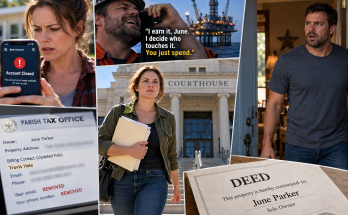
He spoke quietly with his attorney in the courthouse hallway.
If I had passed him in a grocery store, I would not have noticed him.
That unsettled me more than menace would have.
Rebecca stood beside me.
“You do not need to speak to him.”
“I won’t.”
The hearing concerned evidentiary and procedural matters.
No final judgment.
No cinematic confrontation.
Just lawyers.
Documents.
Arguments about what could be used later.
Travis arrived with his own attorney.
He saw Darren.
Stopped.
Then continued walking.
Darren looked up.
For half a second, something passed between them.
Twenty years compressed into one glance.
Then Darren smiled.
Not broadly.
Just enough.
“Trav.”
Travis stopped.
His attorney touched his arm.
“You don’t need to respond.”
But Travis did.
“Darren.”
That was all.
No accusation.
No curse.
No friend.
Darren’s expression barely changed.
“I heard you’ve been talking.”
Travis’s attorney stepped in.
“We’re not discussing anything here.”
Darren lifted both hands.
“Just saying hello.”
Rebecca moved me farther down the hallway.
I glanced back once.
Darren was still watching Travis.
Not me.
That told me something.
Even after everything, he believed the important relationship was between the men.
I remained collateral in his emotional world too.
Inside the courtroom, we sat separately.
Darren’s attorney argued that much of the evidence had been misinterpreted through hindsight.
Business projections were projections.
Investor discussions were ordinary.
The Hale property financing had been exploratory.
The false verification call, they argued, had occurred outside Darren’s direct knowledge.
The copied signatures could have been assembled by someone else.
Some statements sounded plausible in isolation.
That was the power of isolation.
One email.
One call.
One form.
Each could be explained.
Together they told a different story.
Prosecutors referred to the chronology.
The asset profile.
The note that I would resist.
The instruction to approach through Travis.
The signature sample.
The verification script.
The Lena message.
The fake call.
The attempt to keep communication away from me.
The same evidence I had watched accumulate piece by piece now appeared as one sequence.
I felt almost detached.
This had happened to me.
Yet hearing strangers describe it made it sound like another person’s life.
Then Darren’s attorney said something that pulled me back.
“Mrs. Hale’s own husband repeatedly represented himself as the person authorized to manage the couple’s finances and property affairs.”
My stomach tightened.
That was true.
Travis’s attorney looked down.
The prosecutor did not deny it.
Instead she said, “Financial management is not legal authority to fabricate owner consent.”
Also true.
Two truths.
Again.
Darren’s defense needed Travis’s wrongdoing.
The prosecution needed Darren’s separate wrongdoing.
My life had become a place where people fought over which betrayal mattered more.
I no longer needed to choose.
Both mattered.
During a break, I stepped into the hallway.
Travis stood near a window.
“Are you okay?” he asked.
“Yes.”
He nodded.
“They’re using my messages.”
“They should.”
He looked at me.
“I know.”
Then Darren walked out.
His attorney remained inside.
For a moment, only the three of us occupied that end of the hallway.
Rebecca started toward me.
Darren stopped several feet away.
“June.”
The sound of my name in his voice made every muscle in my body tighten.
I had never heard him say it before.
Travis stepped between us automatically.
Then stopped himself.
He looked back at me.
“Do you want me here?”
The question took one second.
“Yes.”
He stayed.
Not in front of me.
Beside me.
Darren noticed.
A tiny smile.
“I’m sorry things got out of control.”
I stared at him.
Rebecca reached us.
“Mr. Cole, do not address my client.”
He ignored her.
“I never wanted your house.”
My voice came before I could stop it.
“You wanted its value.”
Darren’s expression changed.
Barely.
“I was trying to save a company your husband believed in.”
Rebecca said, “This conversation is over.”
Darren looked at Travis.
“You know that’s true.”
Travis said nothing.
Darren took a step closer.
“You know what Gulf Arc could’ve been.”
There it was.
Could have been.
Future tense disguised as memory.
The hook.
Travis’s face tightened.
For one terrible second, I saw the old pull.
Then he said, “No.”
Darren blinked.
“No what?”
“I know what you told me it could be.”
Darren’s smile vanished.
“Same thing.”
“No.”
Travis’s voice stayed calm.
“That’s what I finally understand.”
Darren looked at him for a long moment.
Then laughed softly.
“You’re throwing away twenty years because your wife got scared.”
Something inside me went cold.
There it was.
The old story.
I was emotional.
I was scared.
I ruined business.
I dragged lawyers into things.
Darren still needed that version because if I was merely afraid, then my refusal did not have to mean anything.
Travis looked at him.
“She wasn’t scared.”
Darren shrugged.
“She shut down financing.”
“She found out you used her signature.”
“I didn’t—”
Travis cut him off.
“She said no before you had a signature.”
The hallway became still.
“She didn’t want her house used.”
Darren’s jaw tightened.
“That was between you and her.”
“Yes.”
“And I should’ve respected it before you ever entered the picture.”
Darren stared.
Travis continued.
“But you knew she hadn’t agreed and kept going anyway.”
Rebecca touched my arm.
Not to stop me.
Just present.
Darren said, “You’re trying to save your marriage.”
Travis looked toward me.
Then back at him.
“I may not save it.”
That surprised Darren.
I could see it.
“Then what’s this performance for?”
“It isn’t for her.”
Darren’s face hardened.
Travis said, “It’s because you spent years telling me every bad decision was one more step toward fixing the last one.”
“Careful.”
“No.”
His voice remained almost quiet.
“You don’t get to manage me anymore.”
The word landed.
Manage.
I saw it.
Darren did too.
His attorney emerged from the courtroom.
“Darren.”
He stepped back.
Before turning away, he looked at me.
I expected anger.
Instead, dismissal.
As though I remained secondary.
That was fine.
I no longer needed him to understand me.
Inside, the hearing resumed.
A judge ruled that several challenged records would remain available for later proceedings, subject to additional litigation over specific items.
Legal movement.
Incremental.
No thunder.
No verdict.
Outside afterward, reporters waited near the courthouse steps.
Rebecca guided me toward the side exit.
Travis walked separately.
Before we split, he said, “I’m sorry I stepped in front of you.”
“You stopped.”
“Yes.”
“Then asked.”
“Yes.”
“That mattered.”
He nodded.
I got into my car.
On the drive home, I thought about the hallway.
The old Travis would have fought Darren for me.
Maybe physically.
Definitely verbally.
He would have framed protection as possession.
My wife.
My house.
My problem.
The man standing beside me at the courthouse had done something harder.
He had checked whether I wanted him there.
The difference was small enough that nobody watching would have noticed.
I noticed.
That evening I wrote one sentence in my notebook.
He stood beside me, not in front of me.
I stared at it.
Then beneath it:
This is not forgiveness.
I underlined that.
I did not want one good moment to become another story I used to avoid complexity.
But neither did I want anger to force me to deny change simply because acknowledging it might complicate my decision.
The following week, Dr. Morris asked how the courthouse made me feel.
“Strange.”
“How?”
“I watched Darren try to use the same explanation on Travis that Travis used on me.”
“What explanation?”
“That the person objecting just doesn’t understand.”
Travis looked down.
Dr. Morris asked him, “What did that feel like?”
“Embarrassing.”
“Why?”
“Because I heard myself.”
I looked at him.
He continued.
“Darren always had some reason I didn’t understand the full picture.”
“Did you?”
“Sometimes.”
“And sometimes?”
“He was lying.”
Dr. Morris nodded.
“What did you tell June when she questioned the finances?”
Travis closed his eyes briefly.
“That she didn’t understand the full picture.”
“And sometimes?”
“I was lying.”
The parallel was exact enough to hurt.
I said, “Did you learn it from him?”
Travis thought for a long time.
“Maybe some.”
“That matters to you?”
“Yes.”
“Why?”
“Because part of me wants to believe I only became controlling because Darren normalized it.”
I waited.
“But?”
“But that would be another excuse.”
He looked at me.
“I liked the power before Gulf Arc.”
The honesty startled me.
“When?”
“Small things. Bills. Budget. Deciding what we could afford.”
“You mean deciding what I could afford.”
“Yes.”
“I didn’t notice at first.”
“I know.”
“I thought responsibility meant I should have the final answer if I earned more.”
There it was.
Earlier than Darren.
Darren had not created the flaw.
He had simply found it useful.
That mattered.
Because if the problem belonged only to Darren, removing Darren would solve it.
If it belonged to Travis, then only Travis could change it.
Dr. Morris asked, “What do you believe now?”
Travis said, “Income isn’t authority.”
Simple.
I wrote it down.
Not because slogans fix marriages.
Because concise truths are harder to hide from later.
Income isn’t authority.
That night, I added it to the growing file of things Travis understood now that he should have understood before.
I still did not know whether that file was building a bridge back to him.
Or simply documenting why the bridge had collapsed.
Click here to continue reading: PART 27: When the First Major Financial Recovery Arrived, Travis Did Something With the Money That Showed Me Whether His New Rules Survived Temptation
The Morning My Debit Card Failed, I Learned My Husband Had Quietly Redefined What Belonged to Us
Part 26 of 44