The final document arrived almost a year after the dinner.
It came from the court archive.
I almost ignored it.
The notice said it was an administrative correction.
Nothing more.
But the attached page contained Graham's final statement.
He had written it after the sentencing.
He had asked that it remain sealed until all related cases were complete.
Now it could be released.
I sat alone at the kitchen table.
The page was only six paragraphs long.
It was the shortest document in the entire case.
It was also the hardest to read.
Graham wrote that he had spent years believing he could control consequences.
He believed money could repair damage.
He believed secrecy could prevent pain.
He believed love justified decisions made on someone else's behalf.
Then he admitted that all three beliefs were wrong.
He wrote about the night he threw me out.
He said he had known exactly what he was doing.
He said he wanted to frighten me enough that I would leave the marriage.
But he also knew the cameras were recording.
He had deliberately left evidence.
That didn't excuse the violence.
He knew that.
His next sentence was the one I remembered.
I wanted to save her without allowing her to know she needed saving.
I stopped reading.
That sentence contained the entire failure of our marriage.
He had never trusted me with the truth.
He had trusted himself with my life.
That was the mistake.
The final paragraph was addressed to me.
He wrote that he hoped I would never confuse his love with permission to return.
He said that loving someone did not create a claim on them.
He wished me a life in which nobody needed to protect me from the truth.
I folded the document.
Then I cried.
Not because I wanted him back.
Not because I regretted leaving.
Because the marriage had once contained something real beneath all the damage.
And sometimes the hardest thing was accepting that something could be real and still be wrong for you.
I called Priya.
She didn't answer.
So I called Evelyn.
She came over.
I gave her the letter.
She read it quietly.
Then she placed it down.
“What will you do with it?”
“Keep it.”
“Why?”
“Because it happened.”
She nodded.
That was enough.
The next day, I returned to the company archive.
I asked the archivist to show me the original trust.
The document was preserved behind glass.
My grandfather's signature appeared at the bottom.
My father's amendment was attached.
The employee clause was still there.
My name was still there.
But I no longer felt that the document belonged to me.
It belonged to history.
The archivist asked whether I wanted to add anything.
I thought about it.
Then I requested that my father's final letter be included.
Not the private parts.
Only the section explaining why the trust existed.
The archive accepted it.
Years from then, someone might read it.
They might wonder why an old businessman created such complicated protections.
They might think he was paranoid.
They might think he was wise.
They might think he was frightened.
All three could be true.
That afternoon, I walked through the old company building.
The executive floor was quiet.
The boardroom table had been installed.
No head.
No throne.
No special chair.
Employees came and went.
A young woman was reviewing pension documents.
An older man was helping her.
Nobody cared who the Ashfords were.
They cared whether the numbers were correct.
I smiled.
That was the future my father had wanted.
Not a family empire.
A system that could survive the family.
Outside, the city was busy.
Cars moved through intersections.
People carried groceries.
Someone laughed outside a café.
Life had continued.
It always did.
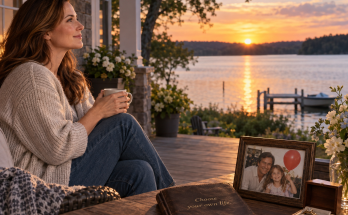
I drove home before sunset.
The lake was calm.
Evelyn and Mara were sitting on the porch.
They had made tea.
I joined them.
Mara handed me a cup.
“You look different.”
“I feel different.”
Evelyn smiled.
“Good.”
We watched the sun disappear behind the trees.
I thought about the woman I had been when Graham threw me onto that porch.
She had believed humiliation meant she had lost.
She had believed being rejected by one family meant she had no family.
She had believed the truth would destroy everything.
She hadn't understood yet that some things deserved to be destroyed.
Lies.
Fear.
Control.
The belief that love required silence.
Those things had gone.
What remained was quieter.
My work.
My friends.
The employee trust.
The lake house.
Evelyn.
Mara.
Priya.
The memory of my father.
Even the complicated memory of Graham.
None of it was perfect.
But none of it needed to be.
I looked at the house.
The door stood open.
That detail mattered.
For years, doors had been used to control me.
Graham had closed one in my face.
My father's secrets had closed another.
Samuel's manipulation had created invisible doors.
Now there was no reason to keep them closed.
That evening, I invited Evelyn and Mara inside.
We cooked together.
We argued about salt.
Mara burned the bread.
Evelyn blamed me.
I blamed the oven.
We laughed.
The sound filled the kitchen.
It was ordinary.
And that was the miracle.
Later, after they went to bed, I stood alone by the window.
The rain began.
I watched it fall.
I remembered that first night.
The cold.
The stone.
The humiliation.
The fear.
I remembered Graham's words.
Come back when you remember who pays for this house.
I smiled.
He had been wrong about almost everything.
The house wasn't what mattered.
The money wasn't what mattered.
The shares weren't what mattered.
Even the company wasn't what mattered most.
What mattered was that I had finally stopped asking other people to tell me what I was worth.
My worth had never been written in a trust.
It had never been hidden in a ledger.
It had never belonged to an Ashford account.
It had never depended on Graham's approval.
I turned away from the window.
The kitchen light was warm.
The table was still covered with dishes.
Three cups sat beside the sink.
I left them there.
Tomorrow, I would wash them.
Tonight, I wanted to remember the room exactly as it was.
Not perfect.
Not grand.
Not controlled.
Just lived in.
I walked upstairs.
Before going to bed, I opened the front door once more.
Cool air entered.
The porch was empty.
No cameras.
No waiting car.
No stranger holding an envelope.
Nothing.
Just rain.
I stepped outside.
For a moment, I stood where everything had begun.
Then I looked back at the open door.
I didn't need to run from the past.
I didn't need to punish anyone.
I didn't need another revelation.
The truth had already done what it needed to do.
It had returned my choices to me.
I closed the door gently.
Not as a prison.
Not as a barrier.
As a home.
And this time, I was the one who decided what happened on the other side.
Click here to continue reading: PART 25: The Case Was Over, Yet One Quiet Conversation With Evelyn Revealed the Part of My Father’s Story I Had Never Been Brave Enough to Ask About
He Thought Throwing Me Out in the Rain Would Break Me, Until One Quiet Detail Turned His Cruel Dinner Into Evidence
Part 24 of 27