Six months after the final hearing, I sold the Ashford mansion.
I kept the lake house.
I kept my father's study.
I kept the dining table.
Everything else went.
The mansion had become a museum of decisions I no longer needed to live inside.
The lake house was different.
It held painful memories.
But it also held the beginning of the truth.
I renovated the kitchen.
I removed the old security system.
I replaced the locks.
I painted the dining room.
Then I invited people to dinner.
Not executives.
Not lawyers.
Not investigators.
Employees.
Former employees.
Mara.
Evelyn.
Priya.
Daniel came too, after asking whether he was welcome.
I told him yes.
Thomas declined.
I understood.
Some relationships needed distance rather than ceremony.
The dinner was simple.
Soup.
Bread.
Roasted vegetables.
A pie Evelyn insisted on making.
Nobody sat at the head.
We talked about ordinary things.
Books.
Travel.
The weather.
Someone laughed about a broken dishwasher.
For the first time in years, a dinner table felt like what it was supposed to be.
A place where people sat because they wanted to.
After everyone left, I washed the dishes.
Priya stayed behind.
“You know,” she said, “most people would have sold the house and disappeared.”
“Maybe I should have.”
“Maybe.”
I dried a plate.
“But then the house would still have belonged to the story.”
She smiled.
“You've changed.”
“I hope so.”
The next morning, a letter arrived from the correctional facility where Graham was serving his sentence.
I recognized his handwriting immediately.
I didn't open it for several hours.
When I finally did, it contained only two pages.
He didn't ask for forgiveness.
He didn't ask me to visit.
He wrote about the company.
The employees.
The trust.
Then he wrote about the dinner.
He remembered the night he had thrown me outside.
He said he had replayed the moment many times.
Not because he missed the house.
Because he understood what he had done.
He wrote:
You were standing on that porch believing I had taken everything from you.
I know now that was the night I lost everything instead.
I folded the letter.
I didn't cry.
I didn't smile.
I simply placed it in the drawer with the others.
Some things could remain unfinished.
Not every wound needed to become a reunion.
A week later, I received an invitation from the employee trust.
They wanted me to join the advisory board.
I accepted.
Not because I wanted another title.
Because I wanted the safeguards my father designed to remain intact.
At the first meeting, an employee asked whether the company should keep the Ashford name.
The room became divided.
Some wanted it removed.
Others wanted to preserve the history.
I said neither choice belonged to me.
“It belongs to the people who work here.”
They voted.
The name stayed.
But the company added a permanent historical exhibit explaining the fraud, the pension investigation, and the reforms that followed.
Nothing was hidden.
Not Edwin.
Not Samuel.
Not Graham.
Not me.
The display included copies of the original trust.
My father's amendments.
The employee protections.
And the final court order.
I stood in front of it for a long time.
A young employee approached.
“Did you know your father created all of that?”
“Not until recently.”
“He must have been very brave.”
I thought about that.
“He was afraid.”
The employee looked surprised.
I smiled.
“Being afraid and doing the right thing aren't opposites.”
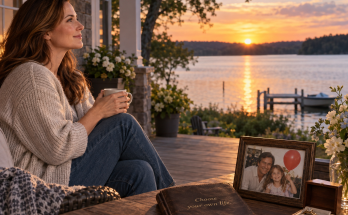
That evening, I drove to the lake house.
The sun was setting.
The water looked almost silver.
I carried my father's photograph outside.
Evelyn joined me.
She had begun spending weekends at the house.
She was no longer running.
Mara had moved nearby.
The three of us had become an unlikely family.
Not because blood had repaired everything.
Because honesty had finally made room for trust.
Evelyn looked at the photograph.
“He would be proud.”
“I don't know.”
“He would.”
I looked at the picture.
“I wish he had told me.”
“So do I.”
We stood quietly.
Then I placed the photograph on the table.
I didn't need to keep it hidden anymore.
Years earlier, I had believed the worst thing a husband could do was humiliate his wife in front of everyone.
I had been wrong.
Humiliation was painful.
Betrayal was painful.
But the deepest damage came from being taught to doubt your own judgment.
Graham had done that.
His family had done that.
Even people who loved me had done it when they decided silence was safer than truth.
I had spent years asking whether I had been foolish for trusting them.
I no longer asked.
Trusting someone was not foolish.
Refusing to learn from betrayal was.
That distinction allowed me to move forward.
Months later, I started teaching forensic accounting workshops for young professionals.
At the beginning of the first class, I wrote one sentence on the board.
Keep records.
A student laughed.
“That sounds obvious.”
“It isn't.”
I explained that evidence was not revenge.
It was memory.
It preserved what happened when people later disagreed about the truth.
After class, one student stayed behind.
She asked whether I had ever regretted getting involved in the Ashford investigation.
I thought about the porch.
The rain.
The dining room.
My father's letter.
Graham's confession.
Evelyn's photographs.
Samuel's files.
The trust.
The employees.
Then I answered.
“I regret what people chose to do.”
She waited.
“But I don't regret choosing to find out.”
That night, I stood alone on the porch.
The rain had returned.
It was gentle this time.
I opened the front door.
Cold air entered the house.
I remembered sitting on those steps years earlier, believing I had been thrown out of my own life.
Now I understood something simpler.
A door could close behind you without closing your future.
I stepped outside.
The porch light reflected across the wet stones.
For years, I had thought freedom would feel like revenge.
It didn't.
It felt ordinary.
It felt like making coffee in my own kitchen.
It felt like choosing who sat at my table.
It felt like hearing my father's voice and no longer needing to guess what he meant.
It felt like knowing Graham's apology could exist without becoming my obligation.
It felt like forgiving myself for not knowing what nobody had told me.
I looked back at the house.
There were no shadows behind the curtains.
No waiting figure.
No family gathering inside.
Just a quiet room and a table I had chosen to keep.
I closed the door gently.
Then I turned the key.
Not because I was afraid of what might come through it.
Because, for the first time, I was the one deciding when the door opened.
Click here to continue reading: PART 21: Just When My New Life Felt Steady, a Sealed Court File Arrived With One Last Ashford Secret No One Had Ever Mentioned to Me
He Thought Throwing Me Out in the Rain Would Break Me, Until One Quiet Detail Turned His Cruel Dinner Into Evidence
Part 20 of 27