Three years later, Leo was thirteen.
He had grown past my shoulder.
His voice had changed.
His baseball equipment had multiplied as if reproducing in closets.
The Important Business Room had become mostly homework, gaming, and a collection of objects I was forbidden to identify as clutter.
The house remained ours.
The maple tree had grown tall enough to shade part of the yard.
Richard was seventy-nine.
Slower.
Thinner.
Still argumentative.
Still seeing his cardiologist.
Still claiming salt restrictions were an organized campaign against joy.
He and Leo had settled into a relationship nobody could have predicted on the morning Richard demanded I send my son away.
Leo called him Grandpa consistently now.
Not because anyone asked.
Because the word had become accurate in the way that mattered to him.
They went to baseball games.
Listened to records.
Played chess.
Argued.
Sometimes Leo stayed at Richard’s apartment for an afternoon.
Never because a court ordered it.
Never because a settlement required it.
Because he wanted to.
Richard never again asked me to define his place.
He let Leo define it.
That may have been the deepest change of all.
My own relationship with Richard became something harder to name.
We were not friends in the ordinary sense.
We knew too much.
We had loved each other too intimately and hurt each other too specifically.
But we could sit at the same table.
We could celebrate Leo.
We could call during emergencies.
We could occasionally make each other laugh.
I never remarried Richard.
I never wanted to.
That surprised people who saw how much he changed.
They sometimes assumed improvement should restore what had been lost.
I stopped trying to explain.
Change does not create a debt.
Richard becoming better did not require me to reward him with the marriage.
His growth belonged to him.
My freedom belonged to me.
One autumn afternoon, Leo came home carrying a school assignment.
“Family history.”
I looked up from my laptop.
“That sounds dangerous.”
“We have to write about a turning point.”
“In history?”
“Our family.”
“Much worse.”
He dropped the assignment on the table.
“I want to write about the bags.”
My body went still.
“What bags?”
He gave me a look.
“Richard’s.”
I had not expected that.
“You remember?”
“Some.”
“You were ten.”
“I remember the stairs.”
My chest tightened.
“What about them?”
“I was sitting there.”
“I know.”
“I remember thinking you were going to send me to Grandma’s.”
I closed the laptop.
“Leo.”
“I know you weren’t.”
“I didn’t know you remembered it that clearly.”
He shrugged.
“I remember Richard saying he needed peace.”
I swallowed.
“And?”
“I remember you being really quiet.”
That detail surprised me.
“You remember that?”
“Yeah.”
“I thought you were going to say okay.”
My heart broke three years late.
“I’m sorry.”
“For what?”
“That you had even a minute where you believed that.”
He sat opposite me.
“Then I remember the suitcases.”
I smiled faintly.
“Five.”
“Why five?”
“Your grandfather had too many clothes.”
“Still does.”
“Yes.”
Leo looked at the assignment.
“Can I write about it?”
“It’s your story too.”
“Will Richard care?”
“That’s something you should ask him.”
So he did.
He called that evening.
I heard only Leo’s side.
“I have to write about a family turning point.”
Pause.
“The morning you told Mom to send me away.”
Longer pause.
“No, I remember.”
Another pause.
“I want to write it.”
Then Leo laughed.
“Yeah, I know it makes you look bad.”
I tried not to listen.
Failed.
“No, I’m not going to make stuff up.”
Pause.
“Okay.”
He hung up.
“Well?”
“He said yes.”
“That easily?”
“He said if I’m going to write about family, I should write what actually happened.”
I smiled.
“That sounds like him now.”
Leo looked at me.
“He also said I should spell ‘ultimatum’ correctly.”
“That definitely sounds like him.”
For three nights, Leo worked on the assignment.
He did not show me.
I did not ask.
On Thursday, he left a printed copy on the kitchen table.
At the top:
THE MORNING MY FAMILY CHANGED.
I sat down.
His writing was thirteen-year-old writing.
Direct.
Uneven.
Occasionally dramatic.
He described hearing Richard say he wanted peace and quiet.
He described sitting on the staircase and believing I might send him to his grandmother.
He described asking me whether he should pack.
Then came a sentence that stopped me.
I thought being loved meant trying not to be difficult enough that people would keep you.
I covered my mouth.
I continued.
Then my mom packed Richard’s bags instead of mine.
The next sentence made me laugh through tears.
There were five bags, which was excessive.
I kept reading.
Leo wrote about Richard leaving.
About baseball games.
The outfield fence.
The apology letter.
The hospital.
Chess.
Christmas.
He did not turn Richard into a villain.
He did not turn me into a hero.
Children who feel safe eventually become capable of complexity.
Near the end, he wrote:
Richard did something bad, but he did not stay the exact person who did it. Mom forgave parts of him without marrying him again. I think that matters because forgiveness is not the same as giving somebody back the position where they hurt you.
I had to stop.
Thirteen.
My thirteen-year-old had understood something I had needed lawyers, months, and heartbreak to learn.
The final paragraph was shorter.
The turning point was not when Richard told Mom to choose. It was when she showed me that I was never supposed to audition for my place in my own family.
I cried.
Leo found me ten minutes later.
“You read it.”
“Yes.”
“Is it bad?”
“No.”
“You’re crying.”
“That is not evidence of bad writing.”
“Sometimes it is.”
I laughed.
He sat beside me.
“Did I get anything wrong?”
“Richard’s suitcases were different sizes.”
“That does not matter.”
“It mattered while packing them.”
“Mom.”
“The rest is right.”
He looked relieved.
Then he asked, “Would you do anything different?”
I thought about it.
“Yes.”
“What?”
“I would have noticed sooner.”
“What?”
“How much you were making yourself smaller.”
Leo looked down.
“You noticed eventually.”
“I should have noticed before you had to hear him say it.”
He shrugged.
“I’m okay.”
“I know.”
That was the gift.
He was.
Not untouched.
Not magically unaffected.
Okay because what happened afterward had taught him the right lesson about what happened before.
“Can Richard read it?” he asked.
“If you want him to.”
“I do.”
We printed another copy.
Richard came Sunday.
Leo handed it to him after breakfast.
“What is this?”
“Homework.”
Richard adjusted his glasses.
“Am I grading it?”
“No.”
“Then why am I reading homework voluntarily?”
“Just read.”
Richard sat in the den.
Leo disappeared upstairs.
I stayed in the kitchen.
Twenty minutes passed.
Then Richard appeared.
He held the pages carefully.
His eyes were red.
“Where is he?”
“Upstairs.”
Richard nodded.
“He is a better writer than Daniel.”
“I’m telling Daniel you said that.”
“Please do.”
He looked at the pages.
Then at me.
“I didn’t know.”
“What?”
“That he thought he had to audition.”
I swallowed.
“Neither did I.”
Richard sat at the kitchen table.
For a while, neither of us spoke.
Then he said, “That is what I did to him.”
“Yes.”
No softening.
No cruelty.
Truth.
Richard nodded.
“And you stopped it.”
“We stopped it eventually.”
“No.”
He looked at me.
“You stopped it first.”
I remembered the suitcases.
The legal envelope.
My shaking hands.
The terror I had hidden from Leo.
“I was furious.”
“Sometimes fury is useful.”
“Therapy?”
“No.”
I smiled.
“Finally.”
Richard smiled too.
Then his expression became serious.
“I am sorry, Sarah.”
“I know.”
“No. Not asking for forgiveness.”
“I know.”
“I’m just sorry.”
I reached across the table and took his hand.
For perhaps five seconds.
Then released it.
That was enough.
Leo came downstairs.
Richard stood.
“I read it.”
“And?”
“You misspelled ‘irrevocable.’”
Leo stared.
“That word isn’t even in it.”
“I wanted to make sure you were paying attention.”
Leo threw a cushion at him.
Richard caught it badly.
They argued.
I watched.
Years earlier, I would have intervened when their voices rose.
Now I knew the difference between conflict and danger.
That knowledge had changed everything.
Later, Richard left.
Leo went to a friend’s house.
I found myself alone in the foyer.
The afternoon sun fell across the floor where the suitcases once stood.
I could still picture them.
Five pieces of luggage.
The leather trunk.
The legal envelope.
Richard’s face when he understood I had chosen differently than he expected.
For years afterward, people who heard some version of our story focused on that moment.
They liked the bags.
It was satisfying.
A clean reversal.
A man told a mother to remove her child, and she packed the man’s belongings instead.
But that was never the most important part.
Packing bags took an afternoon.
Undoing the damage took years.
It required Richard to understand that apology did not purchase access.
It required me to stop confusing accommodation with love.
It required Leo to learn that belonging was not something he earned by being quiet.
It required all of us to accept that forgiveness could exist without restoration.
Richard and I never became husband and wife again.
That was not a failure of forgiveness.
It was one of its boundaries.
He remained part of Leo’s life.
That was not a failure of mine.
It was Leo’s choice.
The house changed too.
Richard’s old study remained Leo’s Important Business Room, though the paper sign had eventually been replaced by a small wooden plaque Leo made at school.
The room above the garage was never quiet.
My mother still complained about the carpet.
The landscape Richard loved remained in the upstairs hallway.
Our wedding photograph stayed in the drawer.
Sometimes I looked at it.
Most of the time I did not.
I never regretted marrying him.
That may be difficult to understand.
Without Richard, there would have been no six years of dinners, arguments, travel, laughter, movies, Christmas mornings, or the strange family that remained after our marriage ended.
Regret would have required pretending only the ending was true.
It was not.
But I never regretted leaving either.
That mattered more.
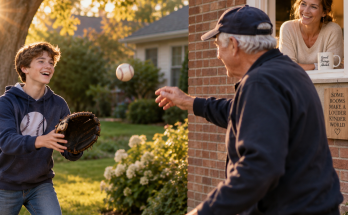
One evening, shortly after Leo’s assignment, I stood at the kitchen sink while he threw a baseball against the brick wall outside.
Thump.
Catch.
Thump.
Catch.
The window was open.
The sound traveled directly into the kitchen.
“Leo!”
The ball stopped.
“What?”
“Dinner in ten.”
“Okay!”
Thump.
Catch.
I smiled.
Then another sound joined it.
A car door.
Richard had come to return a record Leo left at his apartment.
He walked around the side of the house.
Leo threw him the ball.
Richard nearly missed.
“Grandpa, come on.”
“I’m seventy-nine.”
“That’s not an excuse.”
“It is an excellent excuse.”
“Throw.”
Richard threw.
Leo caught.
Back and forth.
The old man who had once demanded peace and quiet stood beside the wall making more noise than my son.
I watched for a minute.
Then returned to dinner.
There was no perfect ending.
Richard could not unsay the ultimatum.
I could not give Leo back the years he had spent monitoring himself.
The missing financial disclosure did not become harmless because we settled it.
Love did not erase control.
Growth did not erase consequences.
But consequences did not make growth meaningless either.
That was the part I understood only afterward.
People can change and still lose what their old selves damaged.
They can be forgiven and still not be restored to the same place.
They can become family in a different shape.
Outside, Leo laughed.
Richard said something I could not hear.
The ball struck the wall again.
Thump.
Then Leo shouted, “Mom, Grandpa says dinner better not be salad.”
I leaned through the open window.
“Tell Grandpa he doesn’t live here.”
Richard called back, “I am aware.”
Leo laughed so hard he missed the next catch.
The baseball rolled across the grass.
Neither of them hurried to retrieve it.
For one moment, the yard became still.
Not empty.
Still.
There was a difference.
I had learned that too.
I looked at my son.
He was taller now.
Louder.
Certain of his place.
That was the ending I cared about.
Not the divorce decree.
Not the house.
Not Hawthorne Ridge.
Not Richard’s apology.
Not even the suitcases.
The morning Richard demanded that I choose between my husband and my child, he believed the difficult part was deciding who would leave.
He was wrong.
There had never been a choice.
My son was ten years old.
He should never have been asked to compete with a grown man for the right to belong in his own home.
So I packed the bags that actually needed packing.
And years later, when I heard Leo laughing in the yard with the same man whose luggage had once waited by our front door, I finally understood the full consequence of that decision.
I had not chosen Leo so that Richard had to disappear.
I had chosen Leo so Leo would never again believe he had to.
The End
Read more original stories on Feel Every Story.
My Husband Gave Me Until Dinner to Decide Which Person in Our House Was Allowed to Stay
Part 27 of 27