Richard requested another meeting.
This time I refused to meet without lawyers.
He did not object.
That alone told me something had changed.
We gathered two days later in a conference room at Martin Keene’s office.
Richard sat across from me.
Martin beside him.
My attorney beside me.
Priya joined in person.
No one brought coffee.
No one pretended the meeting was social.
On the table lay copies of the trust amendment Helen had found.
One year after our wedding, Richard had regained a limited power to replace the independent trustee.
Priya explained why that mattered in language even I could follow.
Control mattered.
Not necessarily enough to invalidate the trust.
Not automatically enough to destroy the prenup.
But enough to raise serious questions about whether Richard’s economic and practical relationship to the assets had been accurately characterized before I signed.
Richard listened without interrupting.
That was new.
Martin spoke first.
“My client is prepared to provide full historical trust records subject to appropriate confidentiality protections.”
My attorney nodded.
“That is overdue.”
Martin ignored the jab.
“We are also prepared to stipulate that household expenses continue without restriction while the matter is pending.”
Another change.
“What about the cards?” I asked.
Richard answered.
“They’ll be restored.”
“Today?”
“Yes.”
“Not through some controlled allowance?”
His face tightened.
“No.”
I looked at my attorney.
She wrote something down.
Martin continued.
“Mr. Vance is also willing to agree that Sarah and Leo retain exclusive residential use of the Westchester property during the separation process without prejudice to final property claims.”
I stared at Richard.
“Why?”
He looked at me.
“Because Leo should not have to wonder whether he’s leaving.”
The sentence was clean.
No legal qualification.
My chest tightened.
Priya continued reviewing terms.
Financial disclosure.
Preservation.
No transfers above an agreed threshold without notice.
Independent valuation of Hawthorne Ridge.
Complete production of the original trust documents and all amendments.
Then my attorney said, “We still need to address the circumstances surrounding the original disclosure.”
Martin nodded.
“We understand.”
“Do you?”
Richard spoke.
“Yes.”
His voice was tired.
My attorney leaned back.
“Then explain.”
Martin turned slightly.
“Richard—”
“No.”
Richard looked at him.
“I’m done having other people explain what I did.”
The room went still.
He folded his hands on the table.
For several seconds, he seemed to search for the right place to begin.
“I was afraid.”
I had expected denial.
Legal argument.
Technical distinctions.
Not that.
“Of what?” I asked.
“Losing control.”
The honesty almost made me angry.
“Over money?”
“Over everything.”
He looked at the amendment.
“When Robert and I started Hawthorne Ridge, we nearly lost it twice.”
No one interrupted.
“The first time was a bad commercial real-estate investment. The second was litigation involving one of our partners.”
He rubbed his thumb across his knuckle.
“I spent years structuring everything so no single event could destroy what I built.”
“That doesn’t explain lying to me.”
“I know.”
“Then continue.”
He nodded.
“When you and I decided to marry, I wanted certainty.”
“Meaning a prenup.”
“Yes.”
“And moving assets.”
“Yes.”
The word landed hard.
Martin looked down.
Richard continued.
“The trust restructuring had been discussed before our engagement.”
“That’s true?” Priya asked.
“Yes.”
“Documented?”
“Yes.”
“Then why the timing?”
“Because the marriage made me finish it.”
I stared at him.
“Robert said you moved it because you were getting married.”
“He wasn’t entirely wrong.”
“What were you trying to protect from me?”
“My children’s inheritance.”
Emily and Daniel.
Always the justification.
“Did they ask you to?”
“No.”
“Did they know?”
“Not the details.”
“So you made decisions for them and blamed their future.”
His mouth tightened.
“Yes.”
That admission surprised everyone.
I leaned forward.
“Why not simply tell me the full value?”
He looked at me for a long moment.
“Because I was afraid you would think I didn’t trust you.”
I laughed.
The sound was bitter.
“So you hid the thing that proved you didn’t trust me.”
“Yes.”
His willingness to agree made anger difficult to aim.
“You could have told me.”
“I know.”
“I would have signed anyway.”
His face changed.
“I know that now.”
“No. You knew it then.”
“I hoped.”
“You knew I wasn’t marrying you for money.”
“I believed that.”
“Then why?”
He took a breath.
“Because once you knew the scale, your lawyer could have insisted on different protections.”
“There it is.”
“Yes.”
The room went silent.
Richard continued.
“I wanted the agreement structured my way.”
“Control.”
“Yes.”
Priya asked, “Did you intentionally suppress the supplemental disclosure?”
Richard looked at her.
“No.”
“Did you instruct Frank Delaney to retrieve full trust materials after execution?”
“Yes.”
“Why?”
“I believed they were confidential and unnecessary once the summary had been accepted.”
“Did you know Sarah had not personally reviewed the full disclosure?”
Richard hesitated.
Then nodded.
“Yes.”
My stomach turned.
“Did you know my lawyer initially insisted I review it?”
“Yes.”
“And you let me sign anyway.”
“Yes.”
I had imagined this admission for days.
I thought it would feel victorious.
Instead it felt like grief.
“You cheated me.”
Richard’s face tightened.
“I did not intend to deprive you financially.”
“That isn’t what I said.”
He looked at me.
“You cheated me of informed choice.”
He closed his eyes.
When he opened them, they were wet.
“Yes.”
Nobody moved.
I had never seen Richard cry.
Not at his brother’s funeral.
Not when his knee surgery frightened him.
Not even when we packed his first wife’s remaining belongings for donation years after she died.
His eyes filled now.
He did not wipe them.
“I thought I could control risk,” he said.
“And instead?”
“I became the risk.”
The sentence was almost too neat.
I wondered whether he had rehearsed it.
Then I saw his hands.
They were shaking.
Not theatrically.
Age had made the tremor visible where pride could not hide it.
My attorney asked, “Are you prepared to memorialize these admissions formally?”
Martin stiffened.
“Not today.”
Of course.
Legal reality returned.
Richard looked at Martin.
“Eventually.”
“Richard.”
“I said eventually.”
Martin did not argue further.
Then I asked the question no one else cared about.
“Did you marry me knowing you might one day ask me to send Leo away?”
Richard’s face changed.
“No.”
“Robert warned you.”
“Yes.”
“You told him you were worried about raising a child.”
“Yes.”
“You married me anyway.”
“Yes.”
“So what did you expect?”
He looked toward the window.
“I expected myself to become better.”
The answer hurt because I believed it.
“You thought marriage would change you.”
“Yes.”
“And when it didn’t?”
“I blamed the noise.”
“Leo.”
“The noise.”
“Leo was the noise.”
Richard swallowed.
“Yes.”
I sat back.
For days I had wanted a hidden motive.
Something more complicated than selfishness.
A secret plan.
A financial scheme tied directly to the house.
A reason Richard’s ultimatum had happened now.
But sometimes the truth was smaller and worse.
He had aged.
His patience had narrowed.
Leo had grown.
And Richard had chosen his own comfort over the child who trusted him.
The financial deception belonged to the same flaw.
Control first.
Honesty later.
Other people adjusted.
He looked at me.
“I want to make this right.”
“You cannot make six years honest retroactively.”
“I know.”
“You cannot make Leo unhear you.”
“I know.”
“You cannot decide he forgives you because you finally understand.”
“I know.”
Each answer came quieter.
I believed he meant them.
That did not make them enough.
“What do you want from me?” I asked.
His eyes stayed on mine.
“Nothing today.”
That was perhaps the first answer Richard had ever given me that did not contain a hidden demand.
Martin slid a draft agreement across the table.
Temporary occupancy.
Financial access.
Preservation.
Disclosure.
Richard had agreed to nearly everything we had requested.
I read the first page.
Then the second.
At the bottom of the third was another provision.
Voluntary family counseling, only if Leo requested or consented.
No compulsory contact.
No step-parent visitation claim.
No attempt to remove him from his school, home, or activities.
I looked at Richard.
“You added this?”
“Yes.”
“Why?”
“Because I finally understand that making him feel safe may mean accepting that he doesn’t want me near him.”
My throat tightened.
“Did your lawyer tell you to write that?”
Martin answered.
“No.”
That mattered.
We signed nothing that day.
My attorney insisted on revisions.
Priya wanted stronger trust language.
Martin wanted confidentiality boundaries.
Lawyers remained lawyers.
But before we left, Richard asked one question.
“Is Leo still playing Saturday?”
I looked at him.
“Yes.”
“Home game?”
“Yes.”
He nodded.
“I won’t go.”
Something in me twisted.
“Why?”
“Because I don’t want him looking at the stands wondering what I’m doing there.”
He stood.
“If he ever wants me to come, he can ask.”
Then he left the room.
Saturday arrived cold and bright.
Leo’s team played at ten.
My mother sat beside me in the bleachers wrapped in two scarves.
Emily came.
Daniel came too.
Neither had been invited by Richard.
They came for Leo.
He noticed them during warm-ups and smiled.
A real smile.
Halfway through the game, he hit a double down the left-field line.
I stood so fast I nearly spilled coffee on the woman beside me.
Daniel shouted.
Emily clapped above her head.
My mother yelled something incomprehensible.
Leo reached second base and looked toward us.
Then his eyes moved farther down the bleachers.
To an empty section.
I knew whose absence he was checking.
After the inning, he sat in the dugout.
Later, in the car, he was unusually quiet.
“Good game,” I said.
“Thanks.”
“That hit was beautiful.”
“The pitcher left it high.”
“Look at you, analyzing.”
He smiled slightly.
Then stared out the window.
“Did Richard know?”
“Know what?”
“About the game.”
“Yes.”
“Did you tell him?”
“He asked.”
Leo kept looking outside.
“Why didn’t he come?”
I chose my words carefully.
“Because he thought showing up without your permission might make you uncomfortable.”
Leo was silent.
Then he said, “Oh.”
We drove another block.
“Are you disappointed?”
“I don’t know.”
“That’s okay.”
Another block.
Then:
“Can he come next time?”
My hands tightened on the steering wheel.
“If you want.”
“But not sit with us.”
“Okay.”
“Maybe by the fence.”
“Okay.”
“And I don’t want to talk after.”
“Okay.”
Leo nodded.
He had just created his own terms.
Not mine.
Not Richard’s.
His.
When we got home, I texted Richard.
Leo says you can come next Saturday. He wants you by the outfield fence, not with us, and he doesn’t want to talk afterward.
The reply took less than a minute.
Tell him thank you.
Then another.
I will follow exactly what he asked.
I showed Leo.
He read it.
Then handed the phone back.
“Good.”
He grabbed his glove and went into the yard.
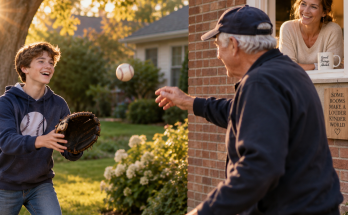
Through the kitchen window, I watched him throw a tennis ball against the brick wall and catch the rebound.
Again.
Again.
Again.
The sound echoed through the house.
Thump.
Catch.
Thump.
Catch.
Once, I would have asked him to move farther from Richard’s study.
This time I opened the window.
The noise came in clearly.
And for the first time, I understood that peace was not the absence of sound.
It was the absence of fear.
Click here to continue reading: PART 17: Richard Came to the Ball Field Alone and Learned That Being Invited Back Was Not the Same as Being Forgiven
My Husband Gave Me Until Dinner to Decide Which Person in Our House Was Allowed to Stay
Part 16 of 27