The divorce became final on a Tuesday in March.
No courtroom.
No confrontation.
No last-minute reversal.
At 9:16 in the morning, my attorney emailed a stamped copy of the decree with a message that was almost offensively ordinary.
The judgment has been entered. Call when you have time.
I was standing in the kitchen in socks, waiting for the toaster to release a piece of bread I had forgotten twice already.
I read the email.
Then read it again.
Six years of marriage had ended between breakfast and taking Leo to school.
I expected my hands to shake.
They did not.
I expected relief.
That did not arrive either.
What came instead was a strange awareness of objects.
The coffee mug Richard bought me in Vermont.
The small scratch on the kitchen island.
Leo’s science project leaning against a chair.
The brass key Richard returned the night we signed the settlement.
Nothing in the room had changed.
Legally, everything had.
“Mom.”
I looked up.
Leo stood in the doorway wearing one sneaker.
“What?”
“You’re staring.”
“I’m thinking.”
“That’s dangerous.”
“Put your other shoe on.”
He hopped toward the mudroom.
Then stopped.
“Did something happen?”
Children always knew.
Not the facts.
The pressure in the room.
“The divorce is final.”
He stood still.
“Oh.”
“Yeah.”
“Like final-final?”
“Yes.”
“No more court?”
“Not about the divorce itself.”
“No more lawyers?”
“I hope not.”
He considered this.
Then asked, “Can Richard still come Sunday?”
That was his first question.
Not whether we had to move.
Not whether Richard was angry.
Not whether he had caused it.
Not whether our family was disappearing.
Just Sunday.
“Yes.”
“Okay.”
He continued toward his shoe.
I watched him go.
Months earlier, the possibility of my marriage ending had frightened him because he believed every outcome might cost him someone.
Now he understood relationships could change shape without requiring somebody to vanish.
That was more important than anything written in the decree.
At school drop-off, Leo opened the door, then leaned back inside.
“Are you sad?”
“A little.”
“Why?”
“Because something can be right and still be sad.”
He nodded.
“Like when I stopped playing catcher.”
“Exactly.”
“My knees hurt.”
“My reasons were slightly more complicated.”
He grinned.
“See you.”
“Love you.”
“Love you too.”
He slammed the door and ran toward school.
I drove home alone.
For the first time in months, I had nowhere urgent to be.
No attorney meeting.
No document review.
No trust analysis.
No strategy call.
No emotional emergency waiting at the other end of my phone.
I parked in the driveway and stayed in the car.
Then I cried.
Not dramatically.
No sobbing against the steering wheel.
Tears simply arrived and kept arriving.
I cried for the woman who had married Richard believing adulthood and love could make complicated families simple.
I cried for the mornings I had monitored his moods.
For the sleepovers Leo never had.
For the headphones.
For the game room above the garage.
For the full financial disclosure I should have received before signing the prenup.
For Richard too.
That surprised me.
I cried because I knew exactly what he would be doing when he received his copy of the decree.
He would read every page.
He would understand every sentence.
Then he would sit somewhere very quiet with the knowledge that control had not protected him from loss.
At eleven thirty, my phone rang.
Richard.
I let it ring twice.
Then answered.
“Hello.”
“Hello.”
Silence.
“You received it?” he asked.
“Yes.”
“So did I.”
Another silence.
I looked at the maple tree through the windshield.
Tiny buds had begun appearing.
“How are you?” he asked.
“I don’t know yet.”
“That makes two of us.”
Neither of us laughed.
Then Richard said, “I wanted to thank you.”
“For divorcing you?”
“No.”
“That would be unusually evolved.”
A faint laugh.
“For not destroying me when you probably could have made the process much worse.”
I closed my eyes.
“I wasn’t trying to destroy you.”
“I know.”
“That was the point.”
“I understand that now.”
He paused.
“I also know you didn’t have to preserve Leo’s relationship with me.”
“That wasn’t mine to preserve.”
“You could have made it difficult.”
“Yes.”
“You didn’t.”
“Because he wanted you.”
Richard was quiet.
“That sentence still feels like more than I deserve.”
“Then don’t waste it.”
“I won’t.”
I believed him.
That was new too.
Not complete trust.
Something narrower.
I trusted that Richard understood the cost now.
“Are we all right?” he asked.
The question was impossible.
“What does all right mean?”
“I don’t know.”
“Then probably.”
He laughed softly.
“Fair.”
I could hear traffic on his end.
“Where are you?”
“Walking.”
“You?”
“In the driveway.”
“You always sit in the car when you’re upset.”
I smiled.
“You remember.”
“Yes.”
The familiarity hurt less than it used to.
“I should go inside.”
“All right.”
“Richard?”
“Yes?”
“You were not the worst thing that happened to me.”
He said nothing.
“I need you to know that.”
His voice became rough.
“Thank you.”
“But what happened with Leo was enough.”
“I know.”
“Both things can be true.”
“Yes.”
“Goodbye, Richard.”
He inhaled.
“Goodbye, Sarah.”
We both knew I did not mean forever.
That made the word possible.
I went inside.
At noon, my mother arrived carrying champagne.
“You drove?”
“I brought sparkling cider for myself.”
“Why?”
“Because I intend to drive home.”
I stared at the champagne.
“Then who is drinking that?”
“You.”
“At noon?”
“You’re divorced.”
“I was divorced at breakfast.”
“You wasted four hours.”
I laughed.
She put the bottle in the refrigerator.
Then looked at me.
“You okay?”
“Yes.”
“Liar.”
“I’m sad.”
“Better.”
“And relieved.”
“Also allowed.”
“And guilty about being relieved.”
“Less useful.”
I sat at the table.
She sat opposite me.
“I loved him.”
“I know.”
“I still do, in some way.”
“I know.”
“I don’t want him back.”
“I know.”
“You’re being irritating.”
“I know.”
I smiled.
My mother reached across and covered my hand.
“You keep thinking feelings are supposed to vote.”
“What?”
“Love votes stay. Anger votes leave. Guilt votes go back. Relief votes run.”
She shook her head.
“They’re feelings, Sarah. They don’t run elections.”
“That is unexpectedly good.”
“I’m old.”
“You’re seventy-two.”
“Ancient.”
“You’re younger than Richard.”
“Exactly. Practically a child.”
When Leo came home, my mother announced we were having pizza.
“Why?”
“Your mother is officially divorced.”
Leo looked at me.
“Are we celebrating?”
I hesitated.
My mother said, “We are eating pizza. Interpret it however you want.”
Leo accepted that.
At dinner, he asked whether my name would change.
I had not thought about it.
“Maybe.”
“To what?”
“My old name.”
“Would mine change?”
“No.”
He frowned.
“Then we’d have different names.”
“We already did before I married Richard.”
“I don’t remember.”
“You were four.”
“Would it be weird?”
“No.”
“Would you still be my mom?”
I stared at him.
“Obviously.”
“Then whatever.”
Children could reduce identity crises to astonishingly practical terms.
The question stayed with me.
For six years, I had been Sarah Vance.
The name opened doors.
It appeared on charity invitations and holiday cards.
People recognized it.
Richard’s world had a way of making his name feel like infrastructure.
I called my attorney the next day.
“What do I need to do to restore my previous surname?”
She explained.
Paperwork.
Records.
Accounts.
Nothing impossible.
I began the process.
Not because I wanted to erase Richard.
Because I wanted my own name back.
Leo watched me update forms over the following weeks.
One afternoon he asked, “Does Richard care?”
“I don’t know.”
“Ask him.”
“Why?”
“I’m curious.”
So I did.
His reply came several minutes later.
It’s your name. You should use the one that feels like yours.
Then another message.
I will miss seeing Vance beside yours.
That was honest.
I answered:
I understand.
No argument.
No accusation.
No guilt.
I changed it.
Spring arrived slowly.
Baseball started again.
The room above the garage was finished.
Leo’s Important Business Room acquired paint stains on the rug.
My mother complained about the rug.
I reminded her it was not her rug.
She complained anyway.
Richard continued Sunday breakfasts.
Sometimes.
He attended games.
Sometimes.
He missed one because of a cardiology appointment and called Leo afterward.
He did not overcompensate with gifts.
He remained imperfect.
Once, he snapped at Leo for spilling orange juice at his apartment.
Leo froze.
Richard saw it.
So did I, because Leo told me later.
“What happened next?” I asked.
“He apologized.”
“Immediately?”
“Like ten seconds.”
“What did he say?”
“That he sounded like the old version of himself.”
“How did you feel?”
“Mad.”
“Good.”
Leo looked offended.
“Why good?”
“Because you’re allowed to be mad when someone treats you badly.”
He considered that.
“Then I was okay.”
Repair.
Not perfection.
That was what change looked like.
In May, the maple tree filled with leaves.
One Saturday, Leo and I worked in the yard.
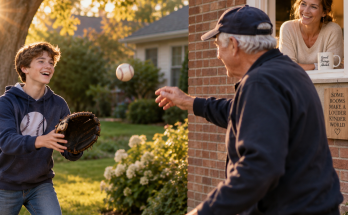
He threw a baseball against the brick wall.
I pulled weeds.
The sound repeated.
Thump.
Catch.
Thump.
Catch.
A year earlier, I might have checked whether Richard was working.
Now nobody needed permission.
Leo missed one catch.
The ball rolled toward me.
I picked it up.
“Mom.”
I threw badly.
He caught it anyway.
“Again.”
We played for twenty minutes.
Neither of us was good.
It did not matter.
That evening, an envelope arrived from Richard.
Not legal.
No lawyer copied.
Inside was a single photograph.
Our wedding day.
Richard and me outside the hotel.
Leo between us, four years old, holding both our hands.
On the back Richard had written:
Not everything that ended was a mistake.
I stood in the kitchen for a long time.
Then I placed the photograph in a drawer.
Not the trash.
Not a frame.
A drawer.
Some memories did not need to dominate a room.
They also did not need to be destroyed.
Click here to continue reading: PART 26: A Year After the Ultimatum, Richard Returned to the Foyer Where His Suitcases Had Waited and Finally Told Leo What Changed Him
My Husband Gave Me Until Dinner to Decide Which Person in Our House Was Allowed to Stay
Part 25 of 27