The prison visitation room smelled faintly of disinfectant and burnt coffee. I remember noticing that before I noticed my mother. Maybe my mind needed something ordinary to hold on to.
She sat behind the glass, waiting for us, wearing a pale prison uniform that seemed too large around her shoulders. Six years had passed since I had last seen her outside a courtroom, and somehow those years had changed the shape of her.
Her hair, once dark except for a few silver strands, was nearly gray. Her cheeks looked thinner. Her hands rested quietly on the table, fingers intertwined, as if she were afraid that any movement might reveal how badly they were shaking.
But her eyes were unchanged.
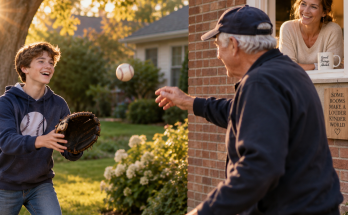
Those were the eyes I remembered from childhood. The eyes that had watched me race around the backyard with a baseball glove. The eyes that had stayed awake beside my bed when I was sick. The same eyes I had spent six years avoiding in my memories because remembering them made the accusation against her harder to accept.
My father was dead.
My mother had been convicted of killing him.
And I had believed the verdict.
I was nineteen when Dad died. My younger brother, Noah, was seven. Our lives changed on an ordinary evening that began with dinner and ended with police cars surrounding our house.
Dad had been found in the kitchen with a single stab wound to the chest. The knife was later discovered beneath my mother’s car seat. Her fingerprints were on the handle.
There had already been problems between my parents. Money was tight. Their arguments had become more frequent. There had been nights when doors slammed hard enough to rattle the picture frames in the hallway.
To a prosecutor, the pieces seemed to fit.
A troubled marriage.
A dead husband.
A wife with his blood in her home.
A weapon bearing her fingerprints.
And a family history that could be turned into motive.
I remembered sitting in the courtroom and watching my mother listen as the verdict was read. She did not collapse. She did not shout. She simply closed her eyes for a few seconds.
Then she looked at me.
I looked away.
That decision haunted me more than the verdict.
The conviction held. Appeals failed. The years passed with a cruel steadiness. I finished school, found work, moved apartments, and learned how to answer questions about my family without giving anyone enough information to ask another.
Noah changed too.
At seven, he had been a frightened little boy who barely spoke after Dad died. At thirteen, he was taller, quieter, and far more observant than people realized.
Neither of us talked much about Mom.
That morning, however, Noah insisted on coming with me.
The state had scheduled her execution for later that day.
I hated myself for agreeing to the visit. Part of me wanted to see her one last time. Another part wondered whether saying goodbye would make the verdict feel final.
Noah sat beside me in the waiting area, holding a folded sheet of paper against his knee.
I asked him what it was.
“Nothing,” he said.
He said it too quickly.
I looked at the paper, then at him.
“You've been holding that since we left.”
“I know.”
“Is it something for Mom?”
He nodded.
“What is it?”
He tucked it closer to his chest.
“I want to give it to her myself.”
I let it go.
A guard eventually called our names.
The door opened with a heavy metallic click, and Noah immediately stood. He looked nervous, but he did not hesitate.
When we entered the visitation room, Mom looked through the glass and smiled.
It was a small smile.
Not happy.
Not relieved.
Just grateful that we had come.
She lifted one hand.
Noah lifted his in return.
For several seconds, none of us spoke.
Then the phone beside the glass rang.
I picked it up.
Mom did the same.
“Hi,” she said.
Her voice sounded exactly as I remembered.
That nearly broke me.
“Hi, Mom.”
She looked at Noah.
“Look at you. You've grown again.”
Noah smiled faintly.
“You always say that.”
“Because you keep doing it.”
He laughed under his breath.
For a few minutes, we talked about harmless things. School. Work. The weather. The cafeteria food. Anything except the reason we were there.
Mom finally looked at me.
“You don't have to stay long.”
“I know.”
“You should go home.”
“I know.”
Her expression softened.
“I don't want this to be harder for you.”
I swallowed.
“You're my mother.”
She lowered her eyes.
“I know.”
Noah had been silent the entire time.
Then he stood.
I thought he needed the restroom.
Instead, he walked toward the glass as far as the rules allowed and pressed his hand against it.
Mom stood too.
She placed her palm against the other side.
For a moment, they were separated by nothing but a sheet of glass and six years of silence.
Then Noah shook his head.
He looked at the guard.
The guard nodded reluctantly and allowed him a brief supervised embrace through the designated area.
Noah hurried around the partition.
Mom opened her arms.
He held her tightly.
And then he whispered something against her shoulder.
I almost didn't hear it.
At first I thought he had said her name.
Then I caught the words.
“Mom… I know who did it.”
Mom went completely still.
I felt the blood leave my face.
She pulled back just enough to look at him.
“What did you say?”
Noah glanced toward me.
His expression was terrified.
Then he whispered the name.
“Uncle Greg.”
Click here to continue reading: PART 2: My Brother Had Carried One Forgotten Memory for Six Years, and the Drawing in His Hands Made Me Question Everything
Six Years After My Father’s Murder, I Returned to the Prison Where My Mother Was Waiting for Her Final Goodbye
Part 1 of 27